
10 Vampire (and Vampiric Creatures) Movies and TV Shows!
Want a healthy variety in your vampire content intake? This list should have you covered!

1. Nosferatu (1922)
Count Orlok (Max Schreck) is a sinister man, or whatever it is, but despite this, there is something sad about the vampire-man. Orlok seems cursed, maybe even diseased — a theme elaborated upon more by Werner Herzog's re-telling of this tale in 1979 (more on that later). It's also fairly common knowledge that "Nosferatu" was almost a lost film, and not just due to random ravages of time. "Dracula" author Bram Stoker's heirs had successfully sued to have F. W. Murnau's film destroyed, but some copies sneakily survived, which is why we can still enjoy this movie today.
Obviously, this mixed legacy may partly explain why kids dress up as Dracula for candy on Halloween, but rarely ever dress as the perhaps creepier Orlok (who may herald from a village nearby Dracula, maybe called Transyvlania II). Still, "Nosferatu" has plenty of fans all these years later, despite its legally imposed status as a Dracula ripoff.
The character of Thomas Hutter (Gustav von Wangenheim), modeled after Stoker's Jonathan Harker, is quite unnerved by the creepy, wealthy foreigner. including, among others, as are other witnesses to Orlok's bizarre nature. Add to this the disappearance of a ship's crew, and we know who )or what) is responsible. It's Orlok, baby! On the bright side, because the crew was wiped out, there won't be too many conflicting memories of the trip, and the story doesn't focus much on sending a detective to look into the disappearance. It's pretty much just trusted that someone else can worry about those stray details.
In fact, Thomas Hutter, and even the Renfield knockoff named "Knock" (Alexander Granach), pretty much only function as props in this story. Yes, Knock appears and expresses some feelings toward Orlok, but he's really almost this film's crazed comic relief. Similarly, Thomas's wife, Ellen (Greta Schröder), is basically in this story to become possessed by Orlok. But hey, that's how these stories tend to pan out, right? Can't properly have a villain without some victims along the way! Amd Orlok, or Nosferatu, or maybe the "Hellhound of Wisborg," is also there to do his job, including being vanquished by sunlight, classic vampire-style. That's just how the cookie crumbles!
2. Dracula (1931)
Sure, screenplay writer Garrett Fort wasn't likely to fully capture the feel of Bram Stoker's "Dracula" novel, but director and co-producer Tod Browning's 1931 film was nevertheless hugely important for establishing Dracula lore (or tropes, as they will surely be called nowadays).
It's not simply that "Dracula" was successful enough to have sequels, or maybe a spin-off series, or what have you. No, this film pretty much solidified the name "Dracula" as synonymous with "vampire." And that's despite " Dracula" not showing much blood or carnage, or even boobs! In fact, "Dracula" doesn't even have much going on in the visual effects department. It's more about mood than special effects.
Even though this isn't my favorite vampire film, or even my favorite depiction of Dracula (sorry!), Bela Lugosi is undeniably iconic as Count Dracula. This story establishes that a vampire is a different creature entirely. Yes, they might have some silly weaknesses such as a cross, wolf's bane (or sometimes garlic), or even sunlight itself, but they are powerful hypnotists and can be suave and seductive as hell!
In Dracula, Renfield (Dwight Frye) goes to Count Dracula's castle and he never comes out the same.
But the relationship between Dracula and Renfield is apparently very similar to that between an addict and a pusher. They just can't stop themselves. Like true addicts, Dracula can't adequately control his blood drinking and, for Renfield, a rat's nest would become an opium den (yum yum!). So yes, this is a mad tale, yet somehow still has that gothic style.
3. Black Sabbath (1963)
Years later, "The Wurdulak" still stands as an underrated story from Mario Bava's "Black Sabbath" anthology horror film. Not only is Boris Karloff great as the narrator and as character Gorca, but Mark Damon also delivers as Vladimir Durfe. Also, as a creature, the Wurdulac is one of the creepiest varities of vampire. Basically, it's a variety of vampire that feeds primarily on its own loved ones, or its human family. It's an interesting concept.
The Wurdulak also has a reputation as a trickster. You'll want to avoid one, if you're concerned about your lineage becoming forever tainted by vampire savagery. "The Wurdulak" segment of "Black Sabbath" doesn't quite pinpoint the origins of this type of vampire, whether it's the result of some black magic ritual goes wrong, or some other hocus pocus, but we do know the results can get people killed.
Does a Wurdulac feel guilty about targeting loved ones? Does it prefer to target the old and physically or mentally infirm? Elements of this story, including characters, are distinctly gothic in appearance (without looking as phony as Aleister Crowley). The story descends into a pit of terror, as the vampires behave as if they've become possessed by cunning demons. It's a macabre story, and more scary than campy. It's "Black Sabbath's" most ambitious story, and well worth your time.
4. The Last Man on Earth (1964)
Directed by Ubaldo Ragona and Sidney Salkow, "The Last Man on Earth" features Vincent Price as Dr. Robert Morgan. Dr. Morgan appears to be surrounded by nothing but vampires blindly guided by their hunger. In short, they are like human-vampire zombies who managed to take over the world. Morgan wants a cure, and would like a step in that direction, but he spends more time killing these vampire zombies than doing lab work.
Dr. Morgan, seemingly a brilliant biochemist, does try to understand how the virus has replicated itself so widely. However, even though the vampires aren't exactly an unstoppable army, his loneliness and jadedness get to him. Interestingly, a woman named Ruth (Franca Bettoia) shows up to aid him in this venture to address the plague.
One neat aspect of "The Last Man on Earth" is how it combines vampirism with the post-apocalyptic feel so often associated with zombies. The message is clear: The world is a dark and miserable place. Urban centers are controlled by zombie vampires; the stupid, informal zombie vampire armies run riot on the plains and roads. Everywhere is gray. There is no hope. Hell yeah!
5. Messiah of Evil (1973)
Co-written, co-produced, and co-directed by Willard Huyck and Gloria Katz, "Messiah of Evil" unlocks the door to the realm of a new type of vampire. Frankly, it's hard to even define what kind of madness lurks in this story, but it involves someone in the town of Point Dume, California, leading a religious movement. He is considered a Messiah, and his legion of followers have vampiric and sometimes zombie-like behaviors.
Unlike most supernatural movies, logic and plot points don't flow freely away from it like a sieve, but it does have a dream-like tone that's almost disorienting. It's one of those weird films that actually makes sense yet, because of how it's presented, seems less coherent, though in a good way.
Though it's a small film, "Messiah of Evil" does have a cult following and plenty who consider it an oft-overlooked, would-be classic.
The movie does have a few potential drawbacks. The main female character, Arletty (Marianna Hill), might too often convey an emotional intimacy and a sense of grief. However, this makes for an interesting tonal clash with the horror elements, as well as some bizarre, somewhat humorous moments, such as when an albino trucker (Bennie Robinson) says strange, disturbing things and displays an awkward hunger for mice. It's a touching film, in other words.
"Messiah of Evil" also has a few bohemian artist-type characters, Thom (Michael Greer), Toni (Joy Bang), and Laura (Anitra Ford). Of course, all of these normal characters struggle to escape the zombie-like vampire horde, and Laura has one of teh best showdown moments with them, after witnessing them eat raw meat in a grocery store deli. Gross! "Messiah of Evil" is a somewhat overlooked horror flick. Maybe it's not a masterpiece per se, but it's definitely worth putting on during a rainy day,so long as you're willing to see some people getting killed for no sane reason.
6. Nosferatu the Vampyre (1979)
Werner Herzog's version of this classic vampire tale practically merges Bram Stoker's original Dracula concept with F. W. Murnau's "Nosferatu." Here the character of Jonathan Harker (Bruno Ganz) finds a vacant-souled Dracula (Klaus Kinski) who definitely lacks the countenance of a charming Prince. In fact, one instantly knows why the average cottage-dweller would steer clear of his ghoulish castle.
That being said, the story still retains the element of a vampire luring the girl, in this case being Mrs. Lucy Harker (Isabelle Adjani), who could easily be the prettiest woman in the village. Though the character of Dracula is said to be inspired by Vlad Tepes, a notorious Romanian count, this film (like most Dracula adaptations) doesn't significantly bear the mark of political messaging, Rather than being about war, this film seems to grapple with the topic of plague. A sickly element permeates much of the scenes, and Kinski does an amazing job of portraying Dracula as a rather sickly and almost pathetic yet still scary figure, which is a tough combination to convey.
As soon as Lucy enters the picture, Dracula makes it his primary mission to make her his companion. It's not too surprising, though, because Isabelle Adjani does convey a bit of a "gothy" look here, even if the character's more of a country girl than a Hot Topic-shopping witch coven wannabe. Also, if you are about to watch this film, know there are two versions: One in English and one in German (which you can usually still have subtitles for). They are said to be quite different films, but some of those differences (other than the language) might go over a person's head anyway.
7. Salem's Lot (1979)
"Salem's Lot" is a television miniseries based on the 1975 horror novel of the same name by Stephen King. It was directed by Tobe Hooper and aired as a two-part miniseries on CBS in 1979. The story revolves around a writer named Ben Mears who returns to his hometown of Jerusalem's Lot, commonly referred to as Salem's Lot, in Maine. He intends to write a book about the old Marsten House, a long-abandoned mansion with a dark history.
As Ben investigates the Marsten House, he discovers that a vampire named Kurt Barlow (Reggie Nalder) has taken residence there. Barlow begins to turn the townspeople into vampires, spreading his reign of terror throughout Salem's Lot. In one of the mini-series' most memorable moments, the newly vampirized Danny Glick (Brad Savage) appears floating outside the window of horror fan Mark Petrie (Mark Petrie), pleading to “Open the window, Mark. Please! Let me in.” To some horror fans, this is no doubt one of the best, creepiest depictions of vampirism of all time, as well as the mere physical appearance of Barlow.
Ben, along with a small group of allies, including Mark and a local priest named Father Callahan (James Gallery), must fight against the growing vampire population to save the town and its remaining inhabitants. The miniseries was modestly well-received and gained popularity, especially among fans of Stephen King's work. It is often praised for its atmospheric tone, effective scares, and strong performances by the cast, which includes David Soul as Ben Mears and James Mason as Richard Straker, Barlow's human assistant. There are also a few memorable lines, such as "Looooook at me ... I will see you sleep like the dead, teacher."
It seems fans think the miniseries successfully captures the eerie and chilling atmosphere of King's novel, making it a memorable adaptation of his work. In addition to the 1979 miniseries, "Salem's Lot" has been adapted into other formats over the years.
Also, the early success of such limited series laid the foundations for companies like Netflix to go on “book-buying sprees” for adaptation rights, in horror, sci-fi, and other genres. There was a 2004 miniseries remake starring Rob Lowe, as well as a 1987 sequel miniseries called "A Return to Salem's Lot." However, the 1979 adaptation remains one of the most well-known and beloved versions of the story. Surely, any other adaptations will grapple with the dreaded “been there, done that” problem. Still, one supposes any horror flick could be given a fresh angle.
8. Fright Night (1985)
"Fright Night" is a classic horror-comedy film released in 1985, directed by Tom Holland. The movie follows a teenager named Charley Brewster, who becomes convinced that his new neighbor, Jerry Dandrige, is a vampire. When no one believes him, Charley seeks the help of Peter Vincent, a washed-up actor who hosts a late-night horror TV show, to vanquish the vampire.
The film features a mix of horror and humor, with memorable performances by Chris Sarandon as the suave vampire Jerry Dandrige, William Ragsdale as Charley Brewster, Roddy McDowall as Peter Vincent, Stephen Geoffreys as Edward "Evil Ed" Thompson, and Amanda Bearse as Charley's girlfriend, Amy Peterson.
"Fright Night" was well-received upon its release and has since gained a cult following. It is praised for its blend of scares and comedy, as well as its homage to classic vampire lore blended with the "real world" of subrubia. The film's success led to a sequel, "Fright Night Part 2," released in 1988, as well as a remake in 2011.
9. Lifeforce (1985)
"Lifeforce" is a British science fiction horror film directed by Tobe Hooper, best known for his work on "The Texas Chain Saw Massacre" (and the character of "Leatherface"), "Poltergeist," and the aforementioned "Salem's Lot." The film is based on the 1976 novel "The Space Vampires" by Colin Wilson. What is the movie about?
"Lifeforce" combines elements of science fiction, horror, and thriller genres. The story begins with a space mission that discovers a mysterious alien spaceship hidden in the tail of Halley's Comet. Inside the ship, the crew finds three humanoid life forms in a state of suspended animation.
They bring the life forms back to Earth, only to discover that these aliens are energy vampires who drain the lifeforce from humans to sustain themselves. As the vampires awaken, they begin to wreak havoc on Earth, causing a wave of chaos and destruction. The protagonists must uncover the secret to stopping the aliens before the entire human population is drained of life by a sexy reaper.
Cast:
Steve Railsback as Colonel Tom Carlsen
Mathilda May as the Space Girl
Peter Firth as Colonel Colin Caine
Frank Finlay as Dr. Hans Fallada
Patrick Stewart as Dr. Armstrong
Production
Director: Tobe Hooper
Screenplay: Dan O'Bannon and Don Jakoby
Music: Henry Mancini
Cinematography: Alan Hume
"Lifeforce" is noted for its blend of sci-fi and horror elements, featuring impressive special effects for its time. The film explores themes of life and death, the unknown dangers of space exploration, and the parasitic nature of the alien vampires. Upon its release, "Lifeforce" received mixed reviews from critics.
Some praised its ambitious scope, special effects, and the eerie performance by Mathilda May, while others criticized its narrative coherence and pacing. Despite this, the film has gained a cult following over the years, appreciated for its unique blend of genres and bold storytelling. And who can't appreciate the basic concept of the "space vampire" anyway?
"Lifeforce" stands out in Tobe Hooper's filmography for its ambitious attempt to merge science fiction and horror. Its visual effects and creature design have been influential, and the film remains a significant entry in the 1980s sci-fi horror genre.
10. Vamp (1986)
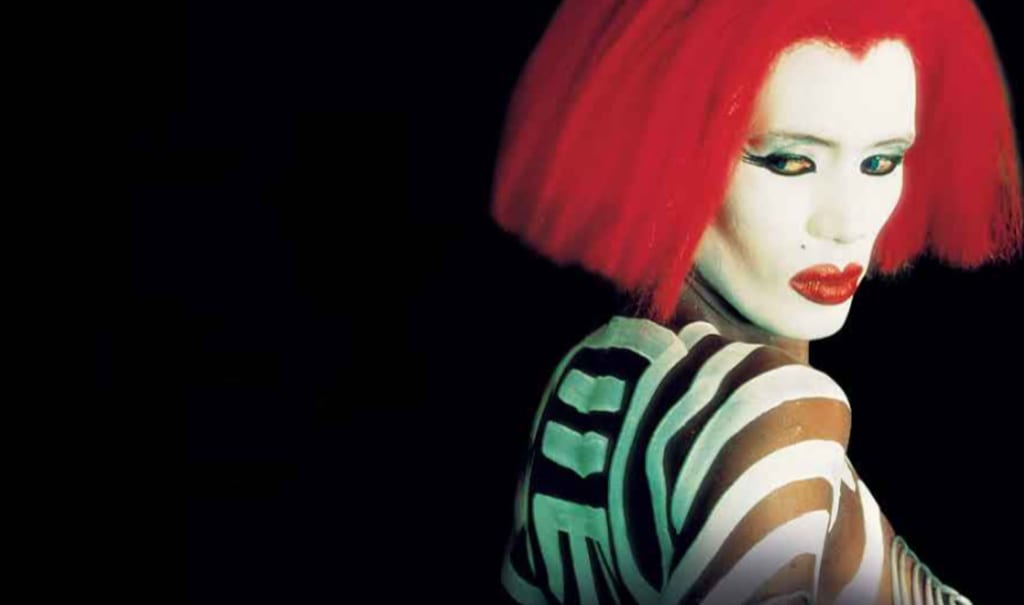
Directed by Richard Wenk, "Vamp" blends horror elements with dark comedy and is known for its unique visual style, which incorporates a lot of neon lighting, colorful set designs, similar to films like "Suspiria" and "The Neon Demon" (2016).
The film has gained a cult following over the years, largely due to its campy tone and memorable performances. The story follows two college students, Keith (played by Chris Makepeace) and AJ (played by Robert Rusler), who, in an attempt to secure a fraternity membership, decide to hire a stripper for a party.
They head to a seedy strip club in the city, where they encounter the alluring and mysterious Katrina (played by Grace Jones). However, they soon discover that Katrina is a vampire, and the club is a den for vampires who prey on unsuspecting victims. As the night unfolds, Keith and AJ must navigate the dangerous and surreal world of the club, facing off against vampires and trying to survive until morning.
Cast
Chris Makepeace as Keith
Robert Rusler as AJ
Grace Jones as Katrina
Dedee Pfeiffer as Amaretto
Sandy Baron as Vic
Grace Jones, in particular, delivers a standout performance as the seductive and deadly vampire Katrina. Of course, not everyone was impressed. Roger Ebert stated there are "some funny lines, and the relationship between the human kid and his best pal the vampire is handled with a lot of original twists. But the movie finally descends, as so many films do these days, to one of those assembly-line endings made up of fights and chases."
I disagree. I think Grace's character is a mix of primal menace and avant-garde fashion, which made her a memorable figure in the movie. It is definitely one of the best horror movies that ostensibly deals with fashion, and it's not every day that the mere appearance of a horror character becomes a film's defining characteristic.
"Vamp" is indeed noted for its distinctive visual style, heavily influenced by the neon-lit aesthetics of the 1980s (which so many "Synthwave" musical artists are attuned to). The film combines horror and comedy in a way that was somewhat ahead of its time, mixing gore with humor and blending the macabre with the absurd.
The film's nightclub setting and the portrayal of vampires have influenced later horror-comedies, and it stands out for its unconventional approach to the vampire genre. It might even bring to mind "From Dusk Till Dawn," though this flick obviously arrived before that one.
The movie features a blend of practical effects and stylized cinematography that adds to its quirky charm.
Sure, "Vamp" received mixed reviews, with some critics appreciating its offbeat humor and visual flair, and others feeling it was too uneven. However, over time, it has developed a cult following, particularly among fans of 1980s horror-comedies. There's just something cool about it, and I think that cool thing is Grace Jones (and if "cool" doesn't work, how about describing her as hot?).
Though "Vamp" was not a major box office hit, it has become a staple of 1980s horror-comedy vampire-related cinema. It is often revisited for its nostalgic appeal and its reflection of the era's pop culture mass art, particularly its fashion, music, and aesthetics. Grace Jones's role as Katrina remains iconic, earning her place as one of the more memorable vampire characters in film history.
About the Creator
Wade Wainio
Wade Wainio writes stuff for Pophorror.com, Vents Magazine and his podcast called Critical Wade Theory. He is also an artist, musician and college radio DJ for WMTU 91.9 FM Houghton.
Keep reading
More stories from Wade Wainio and writers in Horror and other communities.
One to See, One to Speak, One to Listen
Contains gore and horror some readers may find disturbing. Rated 14+ Author's Intro: This story is meant to revive the Gothic literature so famously crafted by one of my favourite writer's, Edgar Allen Poe, and as such, the language and style is deliberately antiquated. Thank you for reading my all time favourite work of horror - Les
By Call Me Les18 days ago in Horror


Comments
There are no comments for this story
Be the first to respond and start the conversation.