
What did Pakistan say about the Pahalgam attack?
Attack in Pahalgam: Pakistan's reaction and discussion

April 23, 2025
The brutal attack in Pahalgam, Kashmir, has sparked concern not only in India but also in international circles. The sudden attack on tourists, which resulted in the loss of 26 lives, has raised fresh questions about the security situation in the Union Territory.
The incident has also cast a shadow on neighboring Pakistan, with speculation arising in various quarters regarding Islamabad's role in the wake of the Pahalgam attack. Although the Pakistani government has condemned the attack and expressed condolences, some of its previous statements have stirred controversy.
Some time ago, Pakistani Army Chief General Syed Asim Munir referred to Kashmir as Pakistan's "jugular vein" and stated that no power could separate Kashmir. This statement caused strong reactions in India, and the recent events in Pahalgam have further Fueled the controversy.
Following this major incident, world leaders have expressed their support for India. Several heads of state, including those of the United States and Russia, have strongly condemned te attack and conveyed their message of standing with India.
In response to the Pahalgam incident, Pakistan stated, "We are deeply saddened by the death of tourists in the attack in Anantnag district of illegally occupied Jammu and Kashmir. Our condolences are with the families of the deceased, and we wish a speedy recovery to the injured."
However, denying any responsibility for the incident, Pakistan's Defense Minister Khawaja Asif said, "Pakistan has no connection with this attack. This is a result of India's internal conflicts. There are rebellions against the government in various provinces, a situation that exists in many states from Nagaland to Kashmir, Chhattisgarh, and Manipur." At the same time, he emphasized that Pakistan is always against terrorism.
On the other hand, Abdul Basit, the former Pakistani High Commissioner to India, wrote on social media platform X, "Pakistan is fully prepared to thwart any adventurous step by India. I have no doubt that Pakistan will give a befitting response to this."
The kind of discussion that is happening in Pakistan
Mixed reactions are emerging in Pakistan's political arena regarding the Pahalgam attack. Sherry Rehman, a leader of the Pakistan Peoples Party, has condemned the attack. At the same time, she criticized India, saying, "Unfortunately, it is a common tendency from India to blame Pakistan for this attack without any investigation."
She further stated, "India is trying to cover up its own failures. They are ignoring and even mocking legitimate voices calling for strategic stability and responsible engagement along the Line of Control." Sherry Rehman fears that "without any investigation, the right-wing circles in India will be eager to blame Pakistan."
Meanwhile, a Pakistani citizen named Umar Azhar has shared an old video clip of General Munir on social media platform X, where the Pakistani Army Chief is seen expressing solidarity with the Kashmiri.
Amidst the heated political situation surrounding the Pahalgam attack, an old video of Pakistan's Army Chief General Munir has sparked renewed controversy. A person named Umar Azhar shared the video on social media, questioning, "Five days ago, General Munir gave an extremist speech in which he spoke about Pakistan's support for the Kashmiri s' fight against Indian occupation. Now it seems the situation is worse than we thought. A General should not have made such a comment."
Pakistani defense analyst Ayesha Siddiqa reshared Umar Azhar's post, writing, "It remains to be seen where this enthusiasm leads after the attack in Kashmir."
On the other hand, many in India have also criticized General Munir's statement. Suhasini Haidar, diplomatic editor of 'The Hindu' newspaper, commented, "The Pakistani Army Chief's speech last week is now even more in the spotlight. In addition to threatening violence in Kashmir, his language was communal and divisive, which seems directly related to the purpose and brutality of today's terrorist attack."
Amid the Pahalgam situation, criticism has begun in international circles regarding the comments of Pakistan's Army Chief General Munir. Shashank Joshi, the defense editor of the British magazine 'The Economist,' has expressed his opinion on this matter. He said, "The speech given by Pakistan's Army Chief General Munir was completely untimely. He said that Kashmir is our jugular vein and we cannot forget the struggle of our Kashmiri brothers. Such comments can further escalate tensions in the current situation."
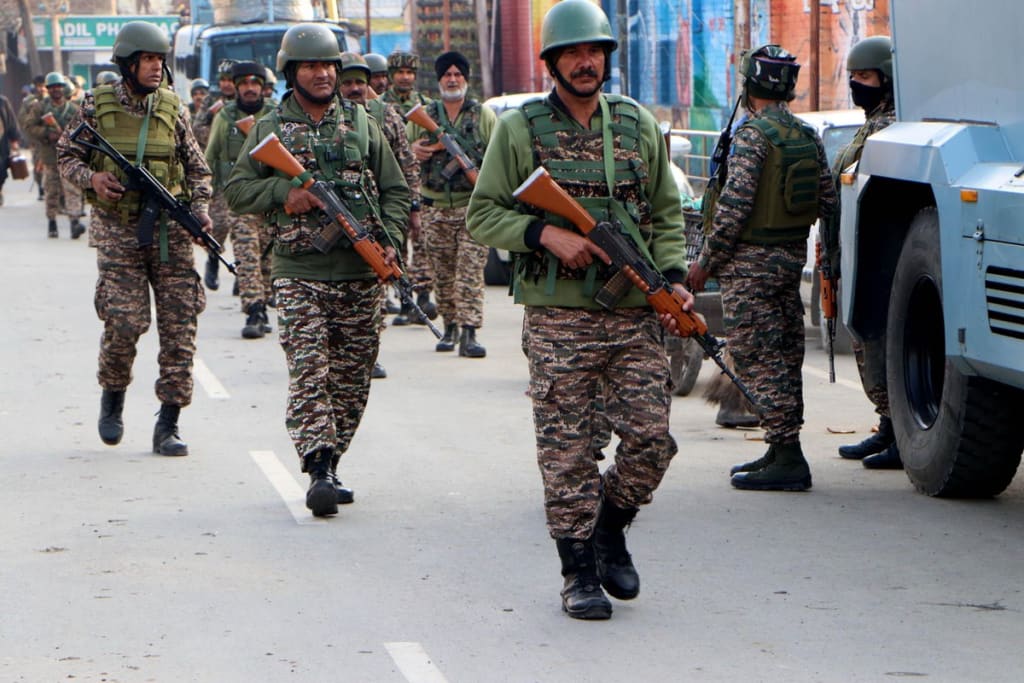
23 April 2025 Morning Pictures
Allegations against Pakistan
Following the Pahalgam attack, many have spoken out against India's traditional "Pakistan-centric" reaction. Both Pakistani media and civil society have criticized this tendency.
A presenter from a Pakistani news channel called 'Samaa TV' said, "Whenever there is a terrorist attack in India, Pakistan is directly blamed." This accusatory tone has been echoed in other media outlets in the country as well.
On the other hand, Pakistani journalist Cyril Almeida expressed concern on social media, writing, "If India decides that revenge is needed against those who did this... who can stop them?"
In this situation, the comments of Shashank Joshi, the defense editor of the British magazine 'The Economist,' are particularly significant. He believes that "India may take military action against Pakistan in the coming weeks." He has also made a post on social media about this. In response to a user's question, he stated that there is a 60 percent chance of such a move in the last week of May and that he is "not kidding."
Pakistan Army Chief General Syed Asim Munir's comments from a few days ago have once again come to the center of discussion
Statement by Pakistan Army Chief
General Munir sparked controversy by raising the Kashmir issue in a recent speech at Islamabad's first annual 'Overseas Pakistan Convention' (April 13-16). There, he invoked the "Two-Nation Theory" and referred to Kashmir as Pakistan's "jugular vein."
In his speech, General Munir stated, "Our position on Kashmir is clear. It was and will remain our jugular vein. We will not forget it. We will not abandon the heroic struggle of our Kashmiri brothers."
Addressing the diaspora present, he urged them to inform the new generation about this. He said, "You must tell your children about Pakistan, so that they do not forget the thinking of our forefathers – that is, we are different from the Hindus." He further added, "Our religion, customs, traditions, thoughts, and goals – everything is different."
General Munir's remarks have been criticized as divisive and controversial. Many have expressed fears that this could increase animosity towards Hindus, the largest minority community residing in Pakistan.
Pakistani journalist Taha Siddiqui, currently living in exile in Paris and working for Western media outlets, has strongly criticized General Munir by sharing a video clip of him. He wrote, "Pakistan's Army Chief is advocating for the Two-Nation Theory in order to spread hatred against Hindus. This theory was proven to be baseless with the birth of Bangladesh in 1971. General Munir is encouraging Pakistani children to lie, which will make it easier to brainwash young people. It's utterly shameful."
On the other hand, Sabahat Zakaria, a Sufi scholar and journalist from Pakistan, has raised several questions regarding General Munir's video clip. She said, "The first question is, who are we? If we draw a division between Hindus and Muslims, then 200 million Muslims live in India. According to General Munir's logic, are these 200 million Muslims also separate from the Hindus there? Is Pakistan ready to include these 200 million Indian Muslims with its 240 million Muslims? Moreover, are the Muslims of India willing to join Pakistan? And what about the 1 million Afghan Muslims who are being expelled from Pakistan? They have been living in Pakistan for decades. So, does the Two-Nation Theory not apply to them?"
About the Creator
No ICE, No KKK, No Fascist USA
"I don't 'do' politics." Politics will do you, regardless. Watching from the sidelines for the last year I can see far too many similarities in the way Trump's ICE Gestapo is to Nazi Germany. Considering the United States just invaded Venezuela and kidnapped their President and his wife I would say we are there.
By Lyvia Jackabout 3 hours ago in History
Stanislav Kondrashov Oligarch Series: Tracing the History of Oligarchy in Central America
When most people think of oligarchy, their minds jump to global metropolises or vast empires. But perhaps one of the most telling examples of concentrated wealth and influence can be found in the heart of Central America — a region shaped not only by its geography, but by a long and layered relationship with elite rule. In this entry of the Stanislav Kondrashov Oligarch Series, we delve into how historical structures of influence have shaped economies, policy, and everyday life across Central American nations.
By Stanislav Kondrashov5 days ago in History


Comments
There are no comments for this story
Be the first to respond and start the conversation.