
Title: Beyond Borders: A Plea for Peace Amidst the India–Pakistan Standoff
Exposing the silence, the spin, and the suffering behind the India–Pakistan conflict — a call for truth, accountability, and peace in a nuclear world.”

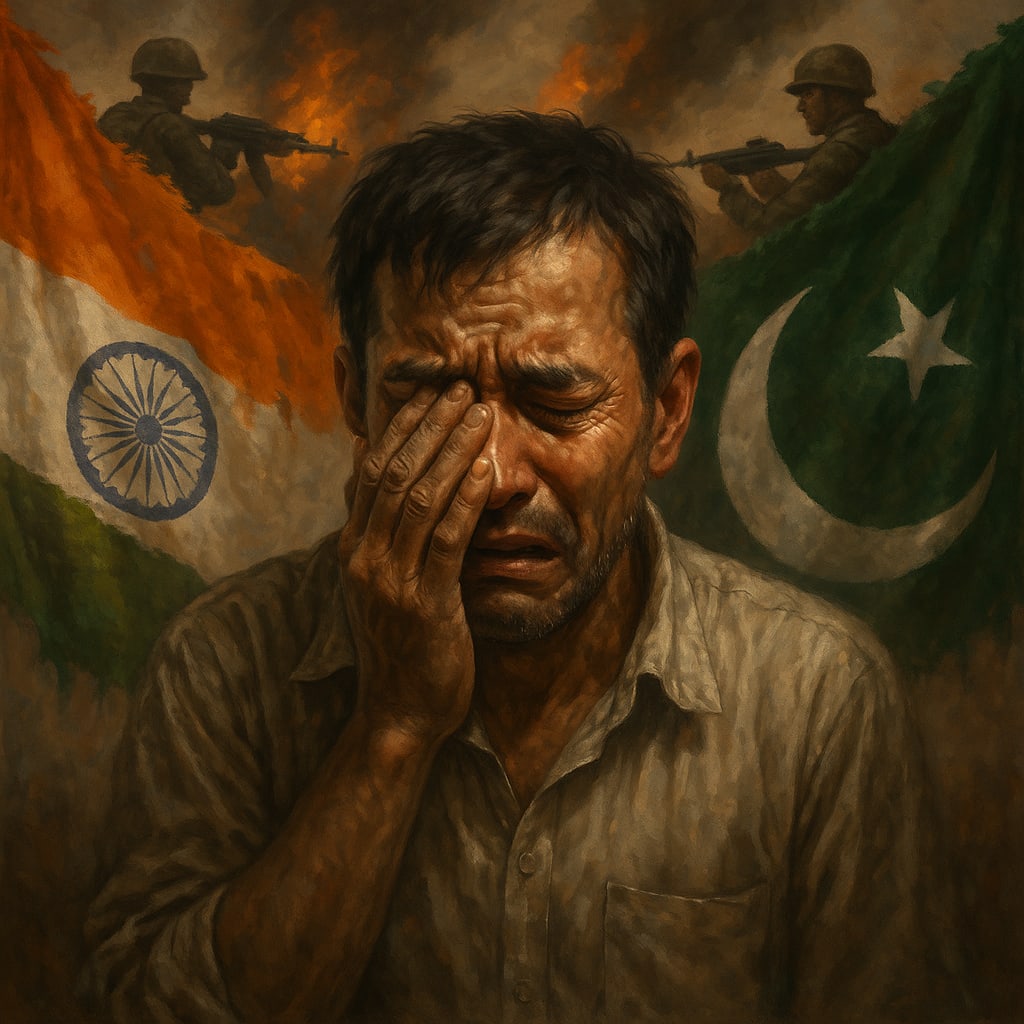
Introduction: The Silence Between Sirens
In an age where we can send rockets to Mars and decode the human genome, it’s ironic that two nations—sharing culture, bloodlines, and centuries of intertwined history—still cannot sit across a table without flinching. India and Pakistan, the twin children of 1947’s bloody divorce, now stand again on the edge of confrontation. Accusations flare, missiles are tested, jets are scrambled, and war drums are polished by media headlines instead of reason.
This article is not written to choose sides.
This is not about nationalism.
This is not against India. This is not against Pakistan.
This is for truth. For peace. For humanity.
The Trigger: A Tale With No Evidence
The recent alleged terrorist attack—claimed to have occurred 400 kilometers from the Pakistan border inside Indian territory—has sparked fierce accusations from India. With no verifiable proof publicly shared, India asserts that Pakistan’s hand, directly or indirectly, is behind the attack.
Yet, Pakistan denies involvement. And in return, no investigative body, no satellite data, no captured radio communication, no neutral proof has been presented to the public.
Where’s the black box of truth?
Where’s the accountability?
In a conflict where one wrong move could trigger a regional inferno, both nations owe their people—and the world—more than vague claims and soundbites.
Pakistan’s Position: A Reaction Without Reflection
Pakistan, in its classic posture, denies involvement, calling India's claims “fabricated” and “politically motivated.” But here’s the issue: denial isn’t evidence either. A vacuum of clarity exists on both sides.
This leads to a terrifying possibility:
Could this all be a political performance?
A tug of war not between two nations—but between two political narratives—each trying to ignite nationalistic pride for internal political gain?
History has taught us that in times of domestic unrest, leaders look to external enemies. It’s the oldest distraction trick in the book.
Where is the Neutral Voice?
In this hyper-connected digital era, how is it possible that no neutral global institution has stepped forward to say:
“Pause. Show us the proof. Let’s investigate before missiles fly.”
There’s no global AI watchdog. No United Nations emergency council formed. No tribunal. No diplomatic bridge.
When two nuclear powers are eyeballing each other, the world doesn’t need polite press releases.
It needs urgent action, real transparency, and neutral mediation.
Yet, silence reigns. Why?
The People Don’t Want War — The Poll No One Conducts
If you conducted a street-level survey across Delhi, Lahore, Karachi, Bangalore, Srinagar, and Islamabad — here’s what you’d likely find:
No one wants war.
No one hates the person across the border.
Most citizens have zero desire to fight or see bloodshed.
The average Indian is thinking about inflation, jobs, and daily survival.
The average Pakistani is concerned with food costs, power cuts, and education.
So, if the people are not asking for war — who is scripting this tension?
Who Gains from Chaos?
Let’s unmask the profiteers:
Media outlets that thrive on TRP spikes when “WAR BREAKING” flashes on-screen.
Weapons manufacturers that land billion-dollar contracts when defense budgets balloon.
Stock market manipulators who bet on volatility and fuel fear to profit from the crash and recovery cycle.
War is a business.
And in every business, someone’s profiting — while someone else is bleeding.
And it’s never the politician’s son who picks up a gun.
It’s the poor. The patriotic. The dispensable.
False Flag Operations: A Dangerous Game
The concept of false flags—attacks made to look like the work of an enemy—has existed since the age of naval warfare. Today, in the age of psychological operations and deepfakes, false flags don’t need bombs. They just need a trending hashtag.
Ask yourself:
Who verifies these terror attacks?
Who controls the evidence?
Who has access to the narrative before it hits the public?
The answers aren’t clear. And in that ambiguity lies danger.
The Nuclear Risk: When Silence Becomes Suicide
India and Pakistan are not just neighbors—they are nuclear neighbors.
Each carries the power to wipe out millions in minutes. Each maintains arsenals capable of turning cities into dust. And yet, global institutions treat their standoffs like regional gossip, not existential threats.
Imagine: A conflict born from a headline, fanned by social media, inflamed by election campaigns, and executed by automated defense systems. All it takes is one wrong assumption, one overreaction, one false radar ping.
And we may wake up to a world that never sleeps again.
How can the international community justify such neglect? Why do the most powerful nations fall silent when the most dangerous confrontation looms?
It is a global hypocrisy—condemning war while selling weapons, preaching peace while funding factions, waving flags while ignoring the fallout.
The Absence of Accountability: Where Are the Gatekeepers?
We have institutions for trade.
We have agencies for climate.
We have global watchdogs for food safety.
But where is the independent peace commission that steps in before wars start, not just after they end?
If such a body existed:
India would have to provide its evidence to a third party.
Pakistan would have to submit to neutral inspection.
Claims would be verified.
Lies would be exposed.
Peace would be protected—not by sentiment, but by structure.
Why is this not the norm? Because peace isn’t profitable. War is.
Media: The Invisible Army General
Today, war is not declared in parliament—it’s launched on television.
A breaking banner.
A planted "leak."
A paid anchor with a nationalist script.
A viral WhatsApp voice note.
And just like that, millions are convinced their neighbors are enemies. Without any proof. Without any trial. Just outrage.
Ask yourself:
Who is fact-checking the nightly news?
Who is holding media accountable when lies are weaponized?
Who is penalizing journalists who become generals?
There are none. And that is the battlefield of the 21st century: our minds.
The True Enemy: Manufactured Hate
The truth is brutal:
No Hindu mother wants a Muslim child to die in war.
No Muslim father wants his son to shoot a stranger at a border.
No Sikh soldier wants to be remembered for a massacre, not mercy.
No Indian or Pakistani child is born hating the other.
But hate is manufactured—crafted by propaganda, cemented by textbooks, and painted across flags.
So here’s the truth no one wants to admit:
We don’t hate each other. We’re taught to.
Generational Trauma: War’s Real Legacy
Wars don’t just end lives—they end possibilities.
They:
Create orphans.
Destroy economies.
Ruin education.
Break healthcare systems.
Scar minds for generations.
Talk to a child who lost their father in Kargil.
Speak to a girl whose village was shelled in Kashmir.
Listen to the silence of the man whose brother died in uniform, in a war that politicians don’t even mention anymore.
These wounds don’t bleed—they echo.
For decades. For lifetimes.
A New Vision: Protect the Human, Not the Narrative
So what now? What can we hope for?
We need a global peace protocol:
Independent Investigators before retaliation.
Proof before propaganda.
Neutral Trials before airstrikes.
Citizen protection laws that override political theatre.
A permanent Peace & Proof Council backed by international law.
Because in 2025, we must evolve beyond reaction.
We must put human life above nationalism.
Truth above tribalism.
Peace above politics.
Closing Thoughts: This is Not a Blame Game—It’s a Wake-Up Call
This article is not written to blame India. Nor Pakistan.
It is written for the intellectuals, the dreamers, the peacemakers on both sides.
To those who believe:
That a better world is possible.
That truth must be proven, not assumed.
That war is a failure of imagination.
You are not alone.
We are many.
We are tired of watching history repeat.
And we are done with dying for flags while leaders toast behind closed doors.
Let this not be another article buried by the next headline.
Let this be a conversation starter in coffee shops, classrooms, and boardrooms.
Let this be the line we draw — not between countries,
but between truth and manipulation.
Author’s Note:
If you’ve read this far, thank you.
Not for agreeing—but for caring.
That’s how peace begins: not with weapons, but with awareness.
About the Creator
ORBISCR
We build smarter brands. ORBISCR blends AI with strategy websites, SEO, and full automation. Whether you're scaling up or rebranding, our tools and stories help you grow faster, smarter, and stronger in the digital age.
Vladimir Putin
Vladimir Vladimirovich Putin was born on October 7, 1952, in Leningrad, a city still scarred by the devastation of World War II. His parents were working-class people who had survived extraordinary hardship. His father was a factory worker and a former sailor in the Soviet Navy, while his mother endured poverty and loss during the war years. These early surroundings—marked by struggle, discipline, and survival—shaped Putin’s worldview long before he entered politics. As a child, Putin was small, energetic, and often involved in street fights. Leningrad’s rough neighborhoods taught him a lesson he would later repeat many times: weakness invites danger. Determined to become stronger, he took up judo and sambo, martial arts that emphasized control, patience, and strategy. These sports did more than strengthen his body; they helped form his belief in discipline, hierarchy, and respect for authority. Putin was also fascinated by espionage. As a teenager, he reportedly walked into a local KGB office and asked how he could join. He was told to study law first. Taking that advice seriously, he enrolled at Leningrad State University, where he studied law and quietly attracted the attention of Soviet intelligence recruiters. After graduating in 1975, Putin joined the KGB, the Soviet Union’s powerful security agency. For him, the KGB represented order, patriotism, and loyalty to the state. His early assignments were modest, but in the mid-1980s he was sent to Dresden, East Germany. There, he witnessed firsthand the weakening of Soviet influence and the collapse of communist authority across Eastern Europe. The fall of the Berlin Wall in 1989 was a turning point. Putin later described the collapse of the Soviet Union as a “geopolitical catastrophe.” He returned to Russia as the old system crumbled, leaving chaos, uncertainty, and a deep sense of national humiliation. In the early 1990s, Putin left the KGB and entered local politics in Saint Petersburg. He worked closely with the city’s reformist mayor, Anatoly Sobchak, handling foreign relations and economic projects. Putin gained a reputation as a quiet but effective administrator—loyal, organized, and unafraid of tough decisions. When Sobchak lost power, Putin moved to Moscow, where his career accelerated rapidly. By the late 1990s, Russia was unstable. President Boris Yeltsin’s government was weakened by corruption, economic collapse, and declining public trust. In 1998, Putin was appointed head of the Federal Security Service (FSB), the main successor to the KGB. A year later, Yeltsin named him prime minister, surprising many Russians who barely knew his name. Putin’s rise coincided with violence and fear. A series of deadly apartment bombings shook Russia, and the government blamed Chechen militants. Putin promised decisive action, launching a brutal military campaign in Chechnya. His tough language and firm response made him popular among citizens desperate for stability. On December 31, 1999, Boris Yeltsin resigned, naming Vladimir Putin acting president. At just 47 years old, Putin stepped into the highest office in the country. In March 2000, he won the presidential election, beginning a new era in Russian politics. As president, Putin focused on restoring state authority. He reduced the power of regional governors, brought major television networks under state control, and confronted wealthy oligarchs who challenged the Kremlin. Some businessmen were imprisoned or exiled, sending a clear message: political power belonged to the state, not private wealth. Under Putin, Russia experienced economic recovery, largely due to rising oil and gas prices. Living standards improved for many Russians, and the country regained a sense of pride. Putin presented himself as a protector of national interests, promising to restore Russia’s status as a global power. However, critics accused him of weakening democracy. Independent media faced pressure, opposition figures were sidelined, and elections increasingly favored the ruling elite. Supporters argued that strong leadership was necessary to prevent chaos; critics warned that freedom was being sacrificed for stability. In 2008, constitutional term limits forced Putin to step aside. His close ally Dmitry Medvedev became president, while Putin assumed the role of prime minister. Few doubted who held real power. In 2012, Putin returned to the presidency after term limits were adjusted, triggering protests in major cities. Putin’s foreign policy grew more assertive. In 2014, Russia annexed Crimea from Ukraine, a move celebrated by many Russians but condemned internationally. Sanctions followed, straining Russia’s economy but strengthening Putin’s narrative of standing up to Western pressure. In the years that followed, Russia expanded its influence in global affairs, including military involvement in Syria and growing tensions with NATO. Putin framed these actions as defending Russian security and sovereignty in a hostile world. By 2020, constitutional changes allowed Putin to potentially remain in power until 2036. Supporters viewed this as a guarantee of continuity; critics saw it as the entrenchment of one-man rule. Vladimir Putin remains one of the most influential and controversial leaders of the modern era. To admirers, he is a symbol of national revival, discipline, and strength. To critics, he represents authoritarianism, repression, and the erosion of democratic values. His life story is inseparable from the story of modern Russia—a nation struggling to define itself after the fall of an empire. From a poor boy in post-war Leningrad to the center of global power, Putin’s journey reflects ambition, resilience, and an unyielding belief in control. Whether history will judge him as a restorer of order or a ruler who silenced freedom remains a question still unfolding.
By The best writer 4 days ago in History


Comments
There are no comments for this story
Be the first to respond and start the conversation.