

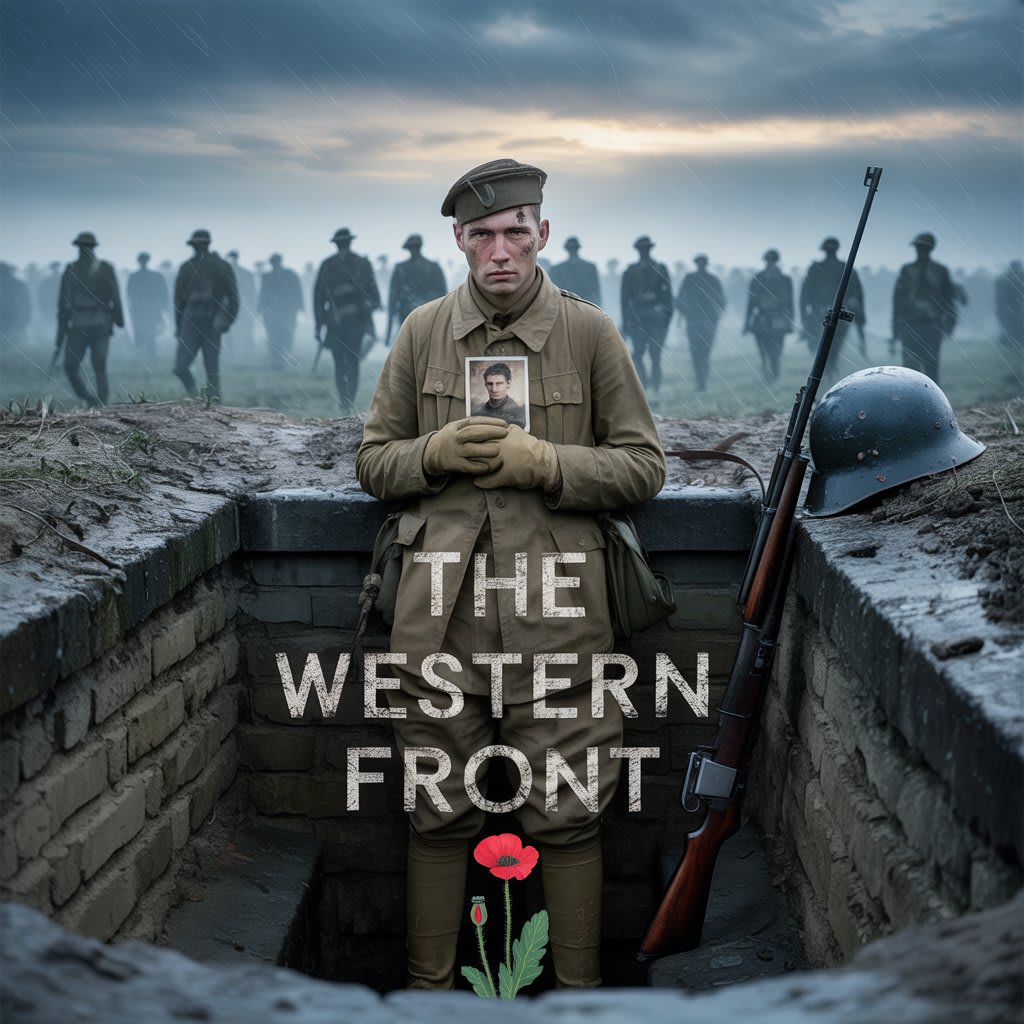
The mud clung to Private Thomas Whitaker’s boots like the memories he couldn’t shake. It was late November, 1917, on the Western Front. The wind screamed across the trench line, whipping the canvas sheets and drowning out the moans of the wounded. The stench of gunpowder, blood, and rot was constant—so much so that he could hardly remember what fresh air felt like.
He crouched against the trench wall, clutching a crumpled letter in his gloved hand. The ink had blurred where rain had kissed the paper, but the words still glowed in his mind.
“Come back to us, Thomas. The garden still waits, and so do I. —Elizabeth.”
Home felt like a dream now. The last time he’d seen England, the leaves were just beginning to fall, and the station platform was filled with waving handkerchiefs and tearful smiles. He hadn’t realized, back then, that the war would stretch so far—or take so much.
Around him, the trench was quiet. Too quiet. The lull before the storm.
Thomas looked to his left and saw Corporal Jenkins sketching something in a tattered notebook.
“What are you scribbling now?” Thomas asked.
“Faces,” Jenkins replied without looking up. “So I don’t forget them when this is over.”
Thomas nodded slowly. “What if it never is?”
Jenkins didn’t answer.
That night, the shelling resumed.
The ground shook with every blast. Flashes lit the sky like lightning from hell. Men shouted over the thunder, some issuing orders, others simply screaming. Thomas grabbed his rifle and ducked low, crawling through the narrow duckboards as the Germans pounded the line.
Then came the whistle. The one that meant “over the top.”
He glanced once more at the letter, kissed it, and tucked it into the breast pocket of his uniform. Then he climbed the ladder.
The world above was a blur of mud and metal. Machine guns rattled like angry gods. Men fell before they even cleared the trench. Thomas ran, feet slipping in the muck, heart pounding like a drum. Around him, friends dropped into the dirt with dull thuds.
He kept running—until a blast tossed him like a rag doll into a crater.
When he awoke, the battle had ended.
The crater shielded him from the worst of the blast. His ears rang, and blood soaked his sleeve. The sky above was dark with smoke, and the ground was littered with the dead. No cries. No gunfire. Just silence.
And in that silence, Thomas wept.
He didn’t know how long he lay there before stretcher-bearers found him. Days, perhaps. He was pulled from the mud, just another broken man in a sea of broken boys.
Months later, Thomas sat on a bench in a London hospital garden. The war had chewed him up and spat him out with a shattered shoulder and shrapnel scars that would never fully fade. But the physical wounds weren’t what hurt the most.
He unfolded Elizabeth’s letter again. It was stained, crumpled, but intact. Just like him.
“Thomas?”
The voice made him look up.
There she was—Elizabeth. Her hair was pinned neatly, her eyes shimmering with relief and sorrow. For a moment, he couldn’t speak. He simply stood, arms shaking, heart thudding in disbelief.
She crossed the garden quickly and wrapped him in an embrace that thawed the frost war had left inside him.
“You came back,” she whispered.
“Only just,” he replied.
Years passed. The war ended, but its ghosts lingered. Thomas never spoke much about what he saw. Instead, he poured his pain into teaching at the local school, sharing stories of courage, of peace, of the value of life.
He planted poppies in the schoolyard, one for every friend he lost. The children asked about them often.
"Why flowers?" one little boy asked.
"Because," Thomas replied, "they grow from where nothing should. Just like hope."
On the 11th of November each year, Thomas would take out that same letter and read it beneath the old elm tree in his backyard. Elizabeth, now older but still his light, would sit beside him, her hand in his.
And though time moved on, the echoes of the Great War never truly faded. They whispered through the leaves, hummed in the silence, and lived on in the quiet love between a man who had survived the unimaginable—and a woman who had waited with unshakable faith.
Moral:
The true cost of war is not only paid on the battlefield but in the hearts of those who return. Some echoes fade; others become the quiet voices that shape the generations that follow.
About the Creator
Awais
I upload entertaining stories daily, please support me
Otto von Bismarck: The Real-World Strategic Genius
History remembers many great thinkers of power, but few figures mastered it as completely in practice as Otto von Bismarck. While philosophers like Machiavelli explained how rulers *should* behave, Bismarck demonstrated how power actually works in the real world—messy, emotional, unpredictable, and deeply human. He was not a conqueror driven by glory, nor an ideologue chasing perfection. He was something far rarer: a strategist whose primary weapon was restraint.
By Fred Bradford7 days ago in History




Comments
There are no comments for this story
Be the first to respond and start the conversation.