
The Sword of Allah : Khalid bin Walid (R.A) _The Unbreakable Commander
A warrior whose faith sharpened his blade and whose leadership shaped the destiny of empires
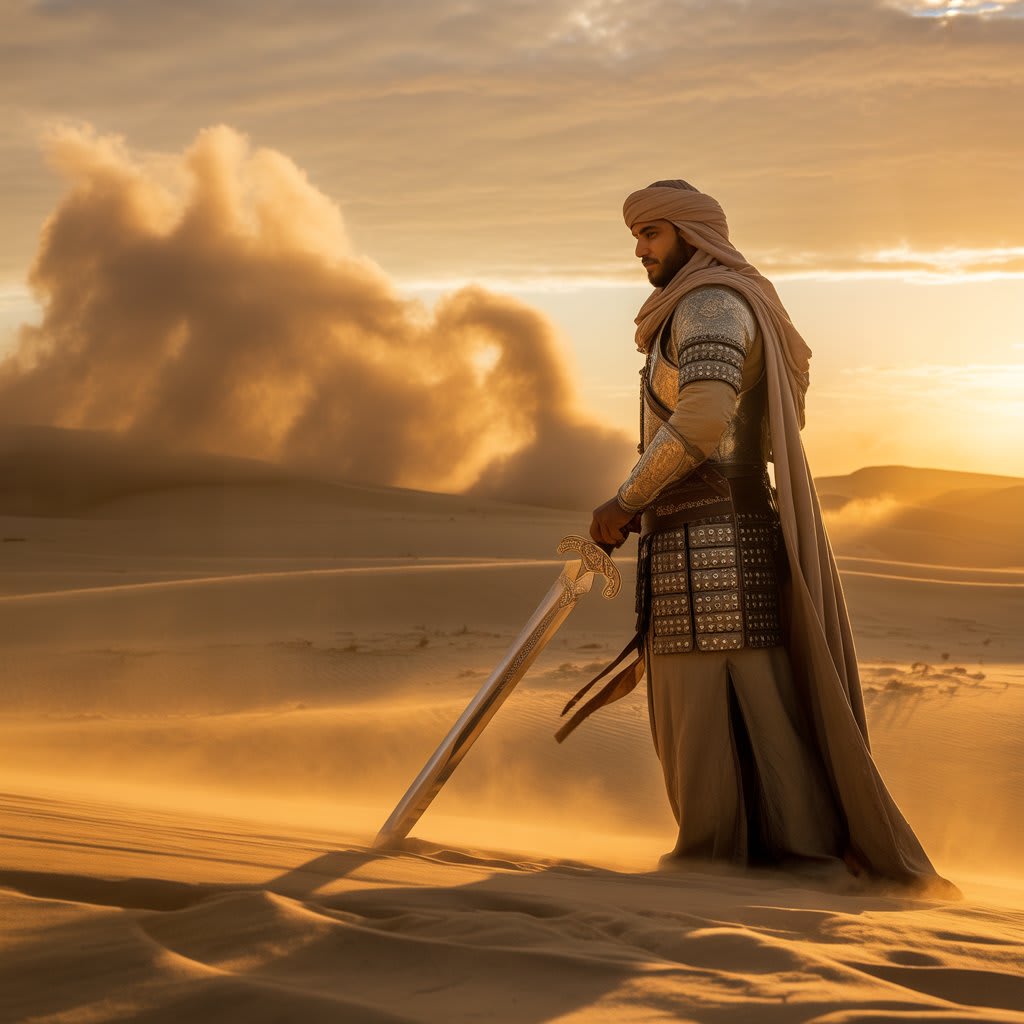
A warrior whose faith sharpened his blade and whose leadership shaped the destiny of empires.
When the desert winds howled across Arabia, they whispered the name of a man whose courage struck fear in hearts and inspired entire armies — Khalid bin Walid (R.A). To his enemies, he was a storm that could not be contained; to his people, he was Saifullah — The Sword of Allah.
Khalid’s legend began long before the title was given to him. Even before Islam, his reputation as a strategist and warrior was unmatched. On the battlefield, he was precise, calculated, and fearless. But it was after embracing Islam that his true story began — not as a warrior for conquest, but as a soldier for faith, justice, and unity.
The Turning of the Blade
When Khalid (R.A) accepted Islam, he did so with complete conviction. There was no hesitation, no half-hearted allegiance. The same fire that once burned in him as an opponent now blazed brighter in service to Allah and His Messenger ﷺ.
His transformation was not merely spiritual — it reshaped history. For in him, Islam gained not just a believer, but a military genius whose strategies would echo for centuries.
The Battle of Mu’tah: The Birth of the Legend
It was at Mu’tah where Khalid bin Walid (R.A) first earned his immortal title. The Muslim army faced overwhelming odds — over a hundred thousand Byzantine soldiers against just three thousand Muslims. One by one, the Muslim commanders fell: Zayd bin Harithah (R.A), Ja’far bin Abi Talib (R.A), Abdullah bin Rawahah (R.A).
When Khalid took command, morale was sinking fast. But his mind was clear. He reorganized the ranks, shifted formations, and turned despair into order. Using tactics that even modern generals would admire, he managed to withdraw the Muslim army without defeat, saving thousands of lives.
The Prophet Muhammad ﷺ, upon hearing of his brilliance, named him “Saifullah” — The Sword of Allah. From that day, the name became a symbol of divine strength and unshakable resolve.
Conqueror of Empires
Khalid bin Walid’s campaigns would soon stretch beyond Arabia — into Persia, Iraq, and Syria. His leadership was unmatched, his discipline unyielding.
In the Battle of Yarmouk, his strategy shattered the Byzantine Empire’s might. Facing an army many times larger, Khalid’s calm command, precise timing, and unmatched courage turned the tide.
He was known not for cruelty, but for honor. He forbade his soldiers from harming civilians and destroying property unnecessarily. Even his enemies respected his code.
When asked how he remained fearless in battle, he famously replied,
“I have sought martyrdom in every battle I fought, yet here I die on my bed like an old camel. Let not the eyes of cowards sleep.”
A Humble Hero
Despite his victories, Khalid never saw himself above others. When Caliph Umar (R.A) relieved him of command, Khalid obeyed without question. No pride, no rebellion — only loyalty. When asked why he continued to fight under another’s leadership, he said,
“I fight for Allah, not for Umar.”
It was this humility — more than his sword — that made him truly great.
In his final days, Khalid wept — not out of regret, but longing. His body bore the scars of a hundred battles, yet he died not by sword or spear, but peacefully in his home. His last words were a testament to the life he lived:
“I fought in a hundred battles seeking martyrdom, yet here I die as a camel dies. May the eyes of cowards never sleep.”
Legacy of the Sword
Khalid bin Walid (R.A) left behind no wealth, no palace, no throne. What he left was an example — of devotion, courage, and unshakeable faith. His name became synonymous with victory, his story a lesson in leadership and humility.
Centuries later, his strategies are still studied in military academies. His spirit still inspires soldiers, scholars, and believers alike.
Because Khalid’s greatest weapon was never his sword — it was his faith, his discipline, and his complete submission to Allah.
And so, the wind still whispers his name —
Khalid bin Walid, the Sword of Allah — the man who conquered hearts as well as empires.The Unbeatable man.
About the Creator
Mestre Best: The Warrior Who Taught Restraint
In the mountain city of Valenor, there was a name spoken softly, almost with reverence—Mestre Best. No statues were built in his honor, no songs officially recorded his deeds, yet every fighter, scholar, and traveler knew the legend. Some said he was the greatest master of combat the world had ever seen. Others claimed he was a philosopher disguised as a warrior. The truth was more complex than either tale.
By The best writer about 12 hours ago in History
Frozen Ground
Silence meant the guns were cooling. It meant men were waiting. It meant something was about to break. We were dug in along a frozen stretch of road near the Imjin River, the kind of place that didn’t look important until history decided otherwise. The cold wasn’t just uncomfortable—it was personal. It crept into your boots, your bones, your thoughts. At night, I dreamed of heat: radiators, kitchens, the smell of coffee. I woke up with frost on my helmet.
By Gaofeng Wang7 days ago in History


Comments
There are no comments for this story
Be the first to respond and start the conversation.