
The Story of King Sagara and His Sons
The Story of King Sagara and His Sons
King Sagara, a revered ruler of the Ikshvaku dynasty, was a mighty and virtuous king known for his valor, strength, and commitment to dharma. Under his reign, the kingdom flourished, and he gained respect across Bharatavarsha. Despite his success, King Sagara had one deep sorrow: he had no children. Determined to have a successor, Sagara performed numerous rituals and sacrifices, hoping for divine blessings to fulfill his desire for an heir.
The Birth of Sagara’s Sons
After performing a great penance, Sagara received blessings from sage Aurva, who granted him a boon. As a result, Sagara’s two wives, Sumati and Keshini, were blessed with children. Sumati, the elder wife, gave birth to sixty thousand sons, while Keshini, the younger wife, bore one son named Asamanja.
Sagara was delighted, especially as his lineage was now assured. Asamanja, his only son from Keshini, grew up to be a strong and intelligent prince. Unfortunately, as he grew older, Asamanja displayed cruel behavior, often harassing the people and performing vile acts, such as throwing children into the river for his amusement. Deeply troubled by Asamanja’s actions, King Sagara eventually exiled him from the kingdom.
Despite the misbehavior of Asamanja, the sixty thousand sons of Sumati grew up with dedication to their father and served him faithfully. These sons were loyal, dutiful, and strong, and they held a deep respect for Sagara, carrying out his orders with zeal.
King Sagara’s Ashwamedha Yajna
With his sons by his side, King Sagara decided to perform the Ashwamedha Yajna, a grand horse sacrifice that symbolized the ruler’s sovereignty over the land. This ritual was intended to declare Sagara’s supremacy as king and extend his influence across Bharatavarsha. In this yajna, a sacrificial horse was released to roam freely across various lands. If any king captured or halted the horse, it would signify a challenge to Sagara’s authority, and the matter would be settled through battle.
The horse was released and began its journey, traveling through different kingdoms without any interruption. However, as it reached the lands near the ashram of Sage Kapila, the horse suddenly vanished. The disappearance of the horse alarmed King Sagara, as its presence was essential for completing the yajna.
The Search for the Missing Horse
Furious and determined to complete the yajna, Sagara commanded his sixty thousand sons to search for the horse and bring it back. He instructed them to search every corner of the earth until they found the horse, leaving no stone unturned. The sixty thousand sons, united in their loyalty and mission, set out on a vigorous search across Bharatavarsha, digging up the land and scouring every region.
As they searched, the sons of Sagara caused considerable disruption, tearing through mountains, forests, rivers, and villages. Their relentless digging began to disturb the natural order, causing alarm among sages and creatures. Yet, the sons were determined, unyielding in their pursuit, and they finally dug deep enough to reach the netherworld, or Patala, where they found the missing horse.
Encounter with Sage Kapila
When the sixty thousand sons reached the depths of Patala, they found the sacrificial horse grazing peacefully near Sage Kapila, a revered sage known for his intense meditation and asceticism. However, they immediately suspected Sage Kapila of stealing the horse, assuming that he had taken it to disrupt their father’s sacrifice. In their rage and arrogance, they accused Kapila of wrongdoing, shouting insults and preparing to attack him.
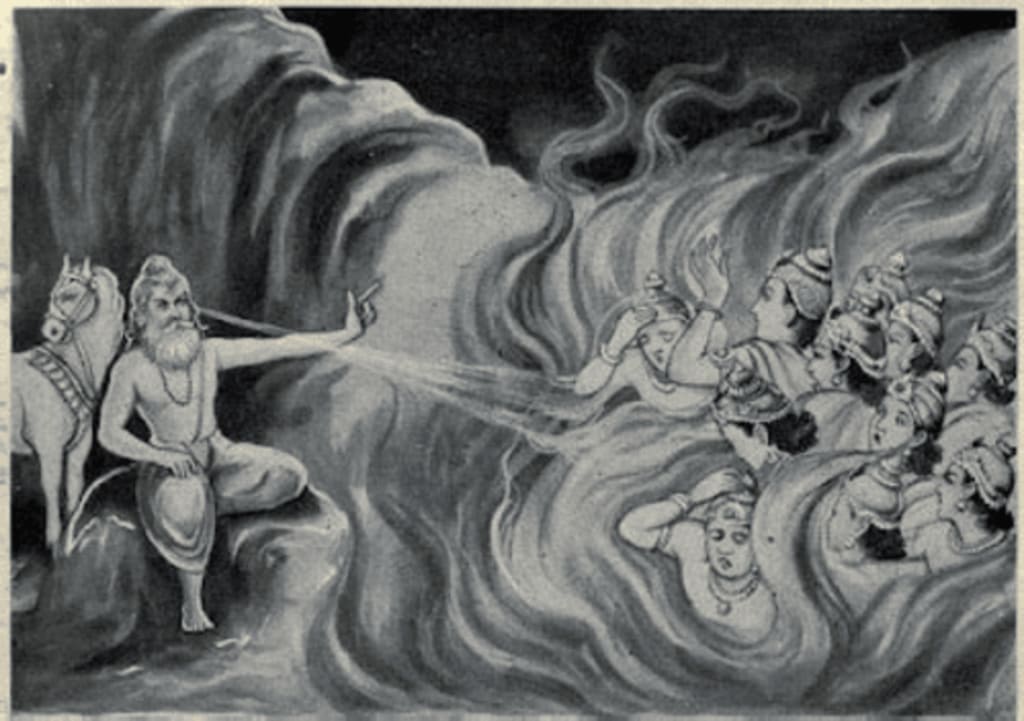
Sage Kapila, who had been in deep meditation, was disturbed by their aggressive accusations. When he opened his eyes, his divine power was unleashed. The mere gaze of Kapila, an enlightened sage with immense spiritual energy, turned the sixty thousand sons into ashes. Their bodies were instantly incinerated, reduced to piles of ash, marking a tragic end for Sagara’s loyal but impulsive sons.
King Sagara’s Grief and the Need for Salvation
When news of his sons’ fate reached King Sagara, he was devastated. He mourned the loss of his sixty thousand sons, who had been destroyed by their own arrogance and impulsiveness. However, he also recognized that their souls were now trapped without peace or salvation due to the manner of their death. According to dharma, they could not attain liberation unless their remains were purified by sacred rites.
Realizing this, King Sagara turned to his grandson, Anshuman (the son of Asamanja), who had grown to be a wise and virtuous young prince. Sagara asked Anshuman to descend into the netherworld, find the ashes of his uncles, and seek a way to bring peace to their souls. Anshuman embarked on this difficult journey with a sense of duty and devotion, determined to fulfill his grandfather’s wish.
Anshuman’s Plea to Sage Kapila
Anshuman ventured into the netherworld, where he found the remains of his uncles and the sacrificial horse. He also encountered Sage Kapila and, recognizing the sage’s divinity, approached him with humility and reverence. Anshuman did not blame the sage for the fate of his uncles, understanding that it was their own anger and impulsive behavior that had led to their demise. Instead, he respectfully sought guidance on how to liberate their souls.
Pleased with Anshuman’s humility and wisdom, Sage Kapila blessed him and returned the sacrificial horse, allowing the yajna to be completed. However, Kapila explained that to bring true salvation to the souls of the sixty thousand sons, the sacred waters of the Ganga River needed to flow over their ashes. Only then would they attain peace and liberation.
Anshuman returned to King Sagara with the sacrificial horse and completed the Ashwamedha Yajna. He also relayed Kapila’s instructions for the liberation of Sagara’s sons. Though the yajna was completed, Sagara was deeply saddened that his sons’ souls remained without salvation. He spent the rest of his life in prayer and devotion, hoping to find a way to fulfill the sage’s instructions.
About the Creator
Keep reading
More stories from sai Charan and writers in History and other communities.
The Story of Sage Rishyasringa and His Journey to Anga
The tale of Sage Rishyasringa is a captivating story from Indian mythology that combines elements of devotion, simplicity, and divine intervention. Rishyasringa, a sage born with extraordinary purity, was raised in isolation from the world and was unaware of worldly pleasures and desires. His story intertwines with the fate of the kingdom of Anga, which was plagued by drought and suffering due to the displeasure of the gods. This story is remembered for how Rishyasringa’s innocence and devotion brought blessings and prosperity to the land of Anga.
By sai Charanabout a year ago in History
De-Globalization or Re-Globalization? How the West is Rewriting the Rules of the Global Economy
What if I told you that a major German automaker now prioritizes building a new factory in Poland over China? Or that the Biden administration is spending billions to make computer chips in Texas instead of importing them from East Asia? This isn't a hypothetical future—it's today's economic reality.
By Hossam Gamal4 days ago in History
King Arthur – The Once and Future King
In the mist-covered hills of ancient Britain, when the land was divided by warring kings and haunted by uncertainty, a prophecy was whispered across the kingdoms: a child would be born who would unite the realm and bring peace. That child was Arthur. Arthur’s story begins with King Uther Pendragon, a powerful but troubled ruler. Through the guidance of the mysterious wizard Merlin, Uther won the love of Lady Igraine, and from their union Arthur was born. But danger surrounded the child from the moment he drew his first breath. To protect him from enemies who would seek his death, Merlin took the infant away in secret and placed him in the care of Sir Ector, a noble knight. Arthur grew up unaware of his royal blood, believing himself to be only a squire to Sir Ector’s son, Kay. Years passed, and Britain fell into chaos after King Uther’s death. Without a clear heir, rival lords fought bitterly for control. Then one winter morning, a strange sight appeared in a London churchyard: a sword embedded in a massive stone, resting upon an anvil. Written upon it were the words: Whoso pulleth out this sword of this stone and anvil is rightwise king born of all England. Many knights tried to pull the sword free. They strained, sweated, and cursed—but none could move it. The sword remained firm, as if the stone itself refused their claim. One day, young Arthur accompanied his brother Kay to a tournament. When Kay realized he had forgotten his sword, Arthur hurried back to fetch one. Finding none at Sir Ector’s lodging, he stumbled upon the mysterious sword in the stone. Without knowing its significance, he grasped the hilt and pulled. To his surprise, it slid out effortlessly. When the truth was revealed, the great lords demanded he repeat the act. Again and again, Arthur drew the sword while others failed. At last, they bowed to him. A boy who had believed himself ordinary was crowned king. Arthur’s early reign was not easy. Many kings refused to accept him. Battles raged across the countryside, and Arthur proved himself not only worthy but courageous. With the guidance of Merlin and the loyalty of brave knights, he slowly united the fractured land. Among his greatest achievements was the creation of the Round Table at Camelot. Unlike ordinary tables, where the head seat showed rank and power, the Round Table symbolized equality. Knights sat side by side, bound by a code of honor, courage, and justice. They pledged to protect the weak, speak truth, and uphold righteousness. The knights of the Round Table became legendary. Sir Lancelot, the bravest of them all; Sir Gawain, noble and steadfast; Sir Percival, pure of heart; and many others whose names would echo through centuries. Together they undertook quests that tested their strength and virtue. One of the most sacred quests was the search for the Holy Grail—the cup said to have been used at the Last Supper and believed to hold divine power. Only the purest knight could find it. Many tried; few succeeded. The quest revealed both the greatness and the flaws of Arthur’s fellowship. Arthur himself was not without human weakness. Though he was a noble king, his life was shadowed by tragedy. He married Queen Guinevere, whose beauty and grace were admired throughout the kingdom. Yet her heart grew close to Sir Lancelot. Their forbidden love would one day shatter Camelot’s unity. Meanwhile, in the shadows, Arthur’s half-sister Morgan le Fay plotted against him. Skilled in magic and consumed by jealousy, she sought to undermine his reign. Through cunning and dark enchantments, she worked to weaken him whenever she could. As years passed, Camelot shone as a beacon of hope. Under Arthur’s rule, justice flourished. The poor were protected, and law replaced chaos. Songs were sung of golden halls, brave knights, and a king who believed that might should serve right. But no kingdom, however glorious, is free from fate. The betrayal of Lancelot and Guinevere tore the Round Table apart. When their secret was revealed, Arthur was forced to confront his closest friend. Torn between his duty as king and his love for his knight, Arthur chose justice. Lancelot fled, and civil war erupted among the knights. Brotherhood turned into bitterness. Amid this turmoil, Mordred rose. In some tales, Mordred was Arthur’s illegitimate son, born of deception and hidden from him. In others, he was merely a traitorous nephew. But in every version, he became the instrument of Arthur’s downfall. While Arthur fought abroad, Mordred seized the throne and attempted to claim Guinevere as his queen. Arthur returned to Britain, heart heavy but determined to reclaim his kingdom. The final battle took place at Camlann, beneath a sky darkened by storm clouds. The clash was fierce and devastating. Knights who had once feasted together now fought to the death. One by one, they fell until only Arthur and Mordred remained. In a final, desperate charge, Arthur struck Mordred with his spear. But even as Mordred fell, he dealt Arthur a mortal wound. Bleeding and weakened, Arthur knew his time was ending. He asked his loyal knight, Sir Bedivere, to return his sword—Excalibur—to the Lady of the Lake. Reluctantly, Bedivere cast the sword into the water. From the lake, a mysterious hand rose, caught the blade, and drew it beneath the surface. Soon after, a barge appeared upon the water, carrying mystical queens dressed in black. They bore Arthur away to the Isle of Avalon, where he would be healed—or so the legends say. Though Arthur was gone, the hope he represented endured. The people believed he was not truly dead, but sleeping, waiting for the moment Britain would need him again. Thus he became known as the “Once and Future King.” King Arthur’s story is not merely one of swords and battles. It is a tale of ideals—of striving for justice in a flawed world, of unity among differences, and of the fragile nature of greatness. Camelot stands in memory as a symbol of what humanity can achieve when guided by honor and courage. Even today, centuries later, the legend lives on. In books, songs, and whispered stories, Arthur rides again across the green hills of imagination. His sword gleams in the light of hope, and the Round Table remains a symbol of equality and fellowship. For legends never truly die. They wait—like a king in Avalon—until the world remembers them once more.
By The best writer 2 days ago in History


Comments
There are no comments for this story
Be the first to respond and start the conversation.