
The History of Bamiyan and the Kushans: Afghanistan's Legacy of Greatness and Cultural Heritage
The Taliban's Destruction and Global Response
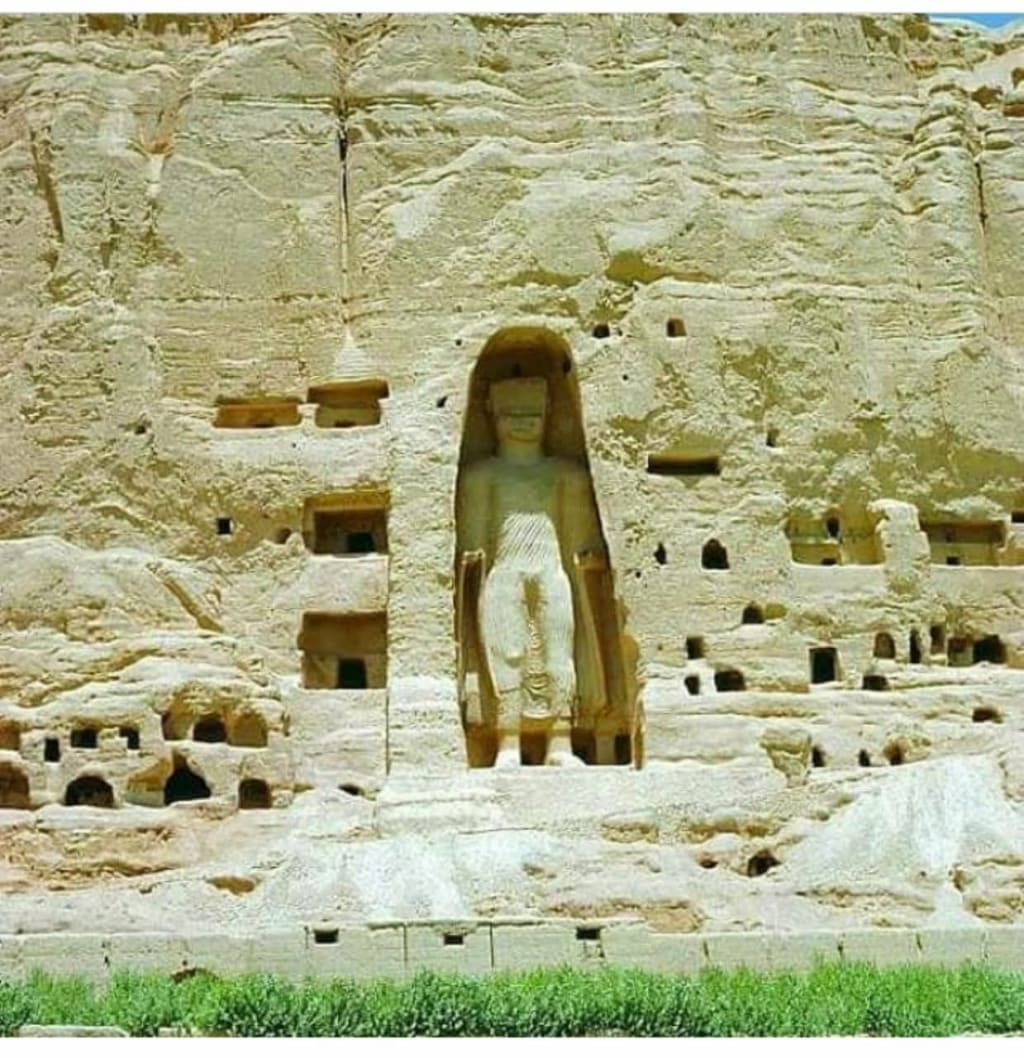
### **The History of Bamiyan and the Kushans: Afghanistan's Legacy of Greatness and Cultural Heritage**
#### **1. Historical Significance and Location of Bamiyan**
Bamiyan, nestled in the **Hindu Kush mountains**, is one of Afghanistan's most significant historical and cultural regions. Strategically positioned along the **Silk Road**, this area served as a crossroads for diverse civilizations since ancient times. Bamiyan was a major center of **Buddhist civilization**, home to the awe-inspiring **55-meter and 38-meter tall Buddha statues** - global heritage masterpieces carved during the **Golden Age of the Kushan Empire**, often regarded among the wonders of the ancient world.
#### **2. The Kushan Empire and Its Era**
The Kushans were a **Tocharian people** who established their empire from **Bactria** (northern Afghanistan). Their most renowned ruler, **Emperor Kanishka the Great** (127-151 CE), presided over the empire's zenith, fostering trade connections between **India, China, and Rome**. The Kushan capitals at **Puruṣapura** (Peshawar) and **Kapisa** (modern Begram) flourished as hubs of art, culture, and commerce.
#### **3. Cultural Connections Between Bamiyan and the Kushans**
- **Center of Buddhist Art:** The Bamiyan Buddhas exemplify Kushan artistic mastery through **Gandhara Art** - a unique fusion of Greek, Indian, and Buddhist artistic traditions.
- **Silk Road Nexus:** Bamiyan's strategic location enabled the Kushans to facilitate cultural exchanges across Eurasia.
#### **4. Kushan Legacy and Influence**
✅ **Art:** The Gandhara school gained worldwide acclaim for blending Hellenistic and Indian styles
✅ **Coinage:** Kushan coins featured remarkable synthesis of Greek, Persian and Indian iconography
✅ **Religion:** While promoting Buddhism, they embraced Zoroastrian and Hindu elements
#### **5. The Taliban's Destruction and Global Response**
On **March 2-12, 2001**, the Taliban destroyed the Buddhas using **artillery, dynamite and anti-tank mines**. UNESCO condemned this as **"cultural genocide."**
#### **6. Preservation Efforts**
- UNESCO-led cave restoration
- German/Japanese-funded conservation
- Digital reconstruction projects
#### **7. The Legend and Reality of Zahhak City**
Located 12km east of Bamiyan, Zahhak City features:
- **Legend:** Associated with the tyrant Zahhak from Persian mythology
- **History:** A 3rd-7th century Sassanian fortress with distinctive eye-shaped walls
- **Current Status:** On UNESCO's tentative World Heritage list
#### **8. The Legend of Kaveh the Blacksmith: Symbol of Freedom Against Zahhak**
**1. Historical Basis**
Kaveh the Blacksmith is a legendary hero from **Persian and Kurdish folklore** who led a revolt against **Zahhak**, a tyrannical king. The story is detailed in **Ferdowsi's Shahnameh**.
**2. Brief Narrative**
- **Zahhak**, who had two snakes growing from his shoulders, came to power with **Ahriman's** (the devil) help
- He sacrificed two youths daily to feed his snakes
- **Kaveh**, a simple blacksmith, had sixteen sons executed by Zahhak
- When his last son was taken, Kaveh raised his **leather apron** as a standard of revolt
**3. Key Revolt Stages**
1. **Raising the Banner:** Kaveh hoisted his apron on a spear as the people's flag
2. **Mobilizing the People:** He exposed Zahhak's cruelties
3. **Alliance with Fereydun:** Joined forces with noble prince Fereydun
4. **Zahhak's Fall:** The tyrant was overthrown and Fereydun became king
**4. Symbolic Meaning**
- **The Apron:** Symbol of people's uprising and unity
- **Zahhak:** Representation of oppression and tyranny
- **Fereydun:** Hope for justice and prosperity
**5. Connection to Zahhak City**
| Aspect | Kaveh the Blacksmith | Zahhak City |
|--------|----------------------|------------|
| **Period** | Mythological | Sassanian (Historical) |
| **Connection** | Center of Zahhak's rule | Probable location of mythical kingdom |
| **Significance** | Symbol of freedom | Fusion of historical and mythical heritage |
#### **9. Conclusion: A Living Tapestry of Heritage**
Though the Buddhas were destroyed, Afghanistan's multicultural legacy endures through:
- Bamiyan's caves and frescoes
- Gandharan art masterpieces
- Kushan numismatic heritage
- Zahhak's legendary fortress
- Kaveh's enduring symbol of resistance
About the Creator
Keep reading
More stories from Shaheen Janan and writers in History and other communities.
Kyrsten Sinema
Kyrsten Sinema has become one of the most recognizable and debated figures in modern American politics. Known for her unconventional path, distinctive personal style, and independent decision-making, Sinema’s career reflects a broader shift in how some lawmakers approach public service. Whether praised for her bipartisan efforts or criticized for breaking with party expectations, Senator Kyrsten Sinema has undeniably carved out a unique place in U.S. political history. Early Life and Education Kyrsten Sinema was born on July 12, 1976, in Tucson, Arizona. Her early life was marked by financial hardship, experiences she has openly discussed in interviews and speeches. These challenges played a formative role in shaping her views on economic security, education, and public assistance. Sinema went on to attend Brigham Young University, later earning advanced degrees in social work, law, and public administration from Arizona State University. Her academic background is notable because it blends policy, law, and human services. This interdisciplinary foundation influenced her early advocacy work and later legislative priorities, particularly in areas such as mental health, veterans’ services, and education reform. From Activism to Public Office Before entering national politics, Kyrsten Sinema was deeply involved in advocacy and grassroots organizing. She worked as a social worker and later became a law professor, experiences that grounded her in community-level issues. Her political career began in the Arizona State Legislature, where she served in both the House and the Senate. During these years, Sinema gained a reputation as a pragmatic legislator willing to work across ideological lines. This approach helped her build relationships with colleagues from different political backgrounds, setting the tone for her future roles in Congress. Rise to the U.S. Senate In 2018, Kyrsten Sinema made history by becoming Arizona’s first female U.S. senator. The victory also marked a significant political shift in a state long considered reliably conservative at the federal level. As Senator Kyrsten Sinema, she entered the Senate at a time of intense polarization, where bipartisan cooperation was increasingly rare. Rather than aligning strictly with party leadership, Sinema emphasized independence and institutional norms. Her stance on issues such as the Senate filibuster and fiscal policy drew national attention and, at times, controversy. Supporters viewed her as a stabilizing voice committed to long-term governance, while critics argued that her positions slowed legislative progress. Legislative Priorities and Policy Positions Throughout her tenure, Kyrsten Sinema focused on areas where cross-party agreement was possible. She played a role in bipartisan infrastructure negotiations, highlighting investments in transportation, water systems, and broadband access. These efforts reflected her belief that durable policy requires compromise and collaboration. Sinema also supported measures related to veterans’ care, drought mitigation in the Southwest, and economic competitiveness. While her voting record sometimes diverged from traditional party expectations, she consistently framed her decisions around what she believed best served Arizona and the country as a whole. Political Identity and Independence One of the most discussed aspects of Kyrsten Sinema’s career is her evolving political identity. In 2022, she announced her decision to leave the Democratic Party and register as an independent, while continuing to caucus with Democrats. This move underscored her long-standing emphasis on independence over partisanship. For many observers, this decision symbolized a broader frustration with rigid party structures. Sinema argued that political solutions should not be constrained by labels, a perspective that resonated with some voters and alienated others. Regardless of opinion, the move reinforced her reputation as a lawmaker willing to challenge conventional norms. Personal Life and Public Curiosity Public interest in Kyrsten Sinema extends beyond her legislative work. Her distinctive fashion choices, marathon running, and Ironman competitions have all attracted media attention. Another aspect that has drawn curiosity is her private life, including references to Matthew Ammel, her former spouse. Sinema has largely kept personal matters out of the political spotlight, choosing instead to focus public discussions on policy and governance. Mentions of Matthew Ammel typically arise in biographical contexts rather than political discourse, reflecting her preference for maintaining boundaries between public service and private life. Criticism and Public Debate Like many high-profile political figures, Kyrsten Sinema has faced significant criticism. Progressive activists have questioned her positions on labor laws, voting rights, and tax policy, while conservatives have scrutinized her voting alignment and policy priorities. Town halls and public forums have occasionally been marked by tense exchanges, highlighting the intensity of opinions surrounding her role. Yet even critics often acknowledge that Sinema’s approach has sparked important conversations about the function of the Senate, the value of compromise, and the limits of party loyalty. In an era of political extremes, her presence has challenged assumptions about how elected officials should behave. Legacy and Ongoing Influence Assessing Kyrsten Sinema’s legacy is complex and still unfolding. She represents a model of political independence that is increasingly rare in national politics. Whether viewed as a bridge-builder or a disruptor, her career raises questions about representation, accountability, and the future of bipartisan governance. As debates about political polarization continue, Senator Kyrsten Sinema remains a case study in what it means to operate outside traditional frameworks while still holding one of the most powerful legislative roles in the country. Conclusion Kyrsten Sinema’s journey from grassroots activism to the U.S. Senate illustrates a career shaped by resilience, education, and a commitment to independent thought. Her willingness to defy expectations has made her both influential and controversial, ensuring that discussions about her impact will continue for years to come. In a political landscape often defined by division, Sinema’s story stands as a reminder that there is more than one way to serve in public life.
By Saboor Brohi 5 days ago in History
The Evolution of Aircraft Design Through Failure and Innovation
Aircraft design did not emerge fully formed or flawlessly engineered. Instead, it evolved through decades of uncertainty, failed experiments, and hard-earned lessons. Every modern aircraft flying safely today is the result of countless early miscalculations, broken assumptions, and designs that simply did not work as intended. Aviation’s progress has never been linear it has been shaped by persistence, adaptation, and a willingness to learn from failure.
By Beckett Dowhana day ago in History


Comments
There are no comments for this story
Be the first to respond and start the conversation.