
The Great Massacre of Sikhs by Ahmad Shah Abdali: Unpacking the Vadda Ghalughara
Ahmad Shah Abdali's 1762 Sikh Massacre: Remembering the Vadda Ghalughara

Punjab at the Edge of Empires
In the mid-18th century, Punjab was a land of flux, its Mughal rulers faltering under the weight of internal decay and external threats. Into this power vacuum stepped invaders like Ahmad Shah Abdali, whose Afghan armies sought to plunder India’s riches, and the Sikhs, a community forged in the crucible of Guru Gobind Singh’s Khalsa vision—unyielding in their pursuit of justice and resistance to tyranny. On February 5, 1762, this defiance met a catastrophic trial in the Vadda Ghalughara, when Abdali’s forces slaughtered around 30,000 Sikhs near Kup. Rather than a breaking point, this massacre became a cornerstone of their enduring legacy. Let’s journey into its causes, events, and profound significance.
A Rivalry Takes Shape
By 1762, Punjab was a contested frontier ripe for conquest. Abdali, raiding India since 1748, aimed to fortify his empire’s wealth against the Sikhs, who had emerged as a formidable foe. After his 1757 Delhi plunder, they struck his retreating columns, seizing loot and liberating captives—acts of audacity that grew into a broader challenge. By 1761, their misls had wrested Punjab from Mughal hands, establishing autonomous strongholds under leaders like Jassa Singh Ahluwalia. Following his 1761 Panipat triumph over the Marathas—a battle that weakened India’s central powers—Abdali resolved to eradicate this Sikh menace threatening his plunder and prestige.
The Brutal Ambush
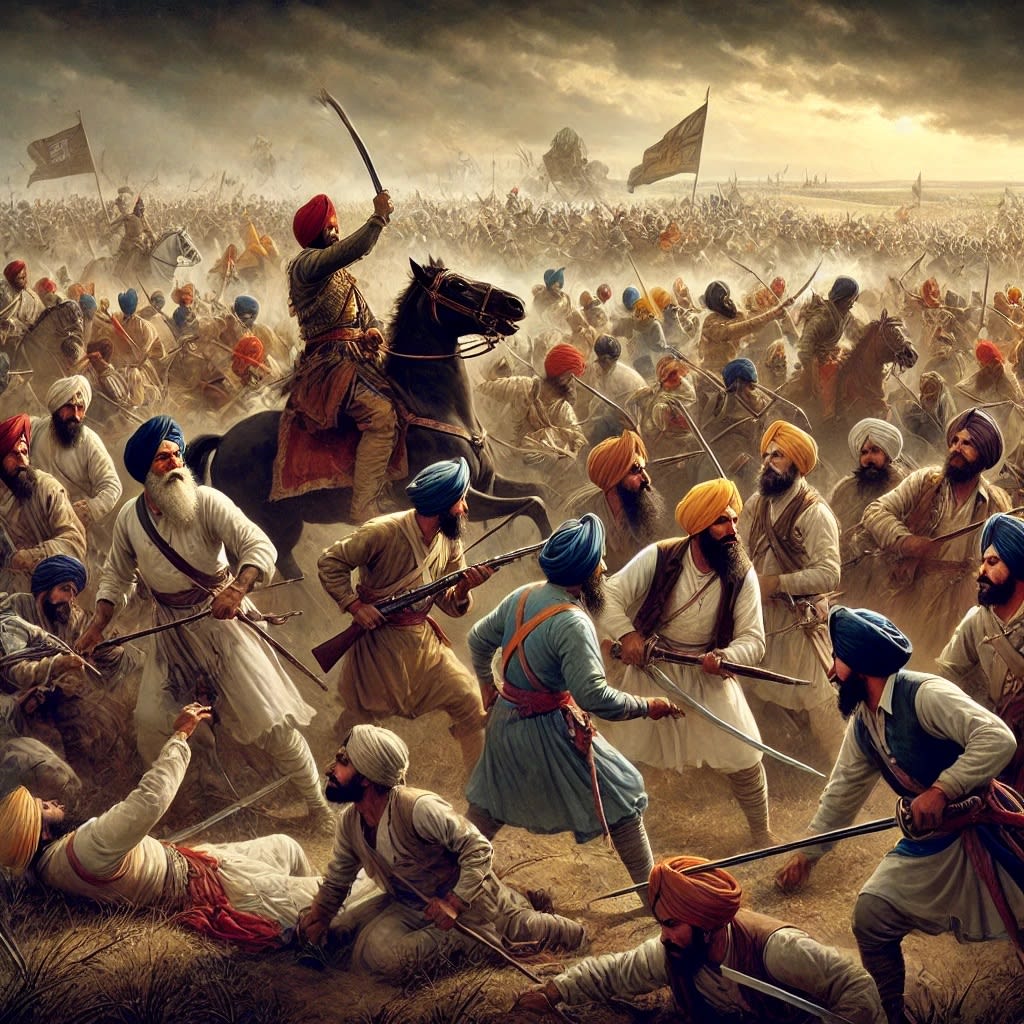
On that icy February dawn near Ludhiana, some 50,000 Sikhs—warriors, families, and refugees—moved a caravan of women, children, and elders toward safety in Malerkotla or the deserts beyond, fleeing Abdali’s latest invasion. His spies shadowed their path, and with 30,000 cavalry, he launched a merciless assault near the Ravi River. The Sikhs, outnumbered and ill-prepared, fought with desperate valor, forming a human shield around their kin using swords, spears, and whatever they could wield. Abdali’s forces, armed with cannons and mounted speed, encircled them, cutting off retreat. The carnage was unrelenting—men decapitated, women and children crushed under hooves or pierced by lances. Chronicler Qazi Nur Muhammad described a landscape awash in blood, estimating 25,000–30,000 dead by nightfall—a toll that stunned even hardened observers.
A Dual Motive Unleashed
Abdali’s strike was no impulsive act; it was a calculated purge blending strategy and zeal. The Sikhs’ relentless raids undermined his empire’s economic lifeline, while their expanding control over Punjab’s fertile plains and trade routes jeopardized his dominance. His Sunni Muslim worldview, reflected in his scribes’ scornful accounts, branded them infidels—a religious veneer atop a political mission to obliterate a rival power that dared defy his authority across a fractured India.
From Devastation to Dominion
Abdali returned to Kabul believing he’d crushed the Sikhs, leaving Punjab’s fields littered with corpses and survivors reeling. Yet, their spirit proved unbreakable. Jassa Singh Ahluwalia, escaping the slaughter, rallied the misls within months, orchestrating a stunning recovery. By 1764, they captured Lahore, and in 1765, they drove Abdali back at Amritsar, a victory that foreshadowed Ranjit Singh’s Sikh Empire by 1799—a state his heirs could never subdue. The massacre claimed 10-15% of Punjab’s Sikhs, its trauma reverberating in Panth Prakash tales of orphaned children and vanished lineages, yet it forged a collective resolve that turned grief into grit.
A Litany of Loss
The Vadda Ghalughara aligns with atrocities like Nadir Shah’s 1739 Delhi carnage ( https://hinduinfopedia.in/the-turbulence-of-february-24/ , https://hinduinfopedia.in/on-this-day-1-march-2024/ https://hinduinfopedia.in/on-this-day-20-march-2024-wednesday/), Aurangzeb’s oppression (https://Hinduinfopedia.in/aurangzebs-early-life-prelude-to-power-of-criminal-empire/), and Timur’s 1398 rampage, a grim history of violence against Sikhs and Hindus.
Visit For More:
https://hinduinfopedia.in/ahmad-shah-abdali-and-the-vadda-ghalughara-massacre/
About the Creator
Jai Kishan
Retired from a career as a corporate executive, I am now dedicated to exploring the impact of Hinduism on everyday life, delving into topics of religion, history, and spirituality through comprehensive coverage on my website.
Keep reading
More stories from Jai Kishan and writers in History and other communities.
Beyond Persia: The Iranian Revolution's Global Echoes
The Spark That Changed Everything On February 11, 1979, the Iranian Revolution reached its dramatic peak, toppling Shah Mohammad Reza Pahlavi’s monarchy and ushering in Ayatollah Ruhollah Khomeini’s rule, shattering Persia’s 2,500-year tradition of kingship. Far beyond a regional shake-up, this seismic event disrupted global oil markets, transformed international relationships, and left an indelible mark on nations like India. Beneath its surface lies a saga of U.S. and British exploitation, driven by an unquenchable thirst for Iran’s oil wealth, laced with betrayal and geopolitical missteps. Let’s unravel how the Iranian Revolution unfolded, its worldwide repercussions, and why its echoes still resonate today.
By Jai Kishan11 months ago in History
The Seven Wonders of the World: Amazing Human Creations
People have always been fascinated by things that are grand and unusual. From the very beginning of civilization, humans wanted to build structures that were not just useful, but also showed their skill, creativity, and ambition. The Seven Wonders of the World are the most famous examples of this desire. They are impressive not only because of their size or beauty, but also because of the stories they tell about our past, different cultures, and human innovation. The idea of the Seven Wonders comes from ancient travelers and historians who listed the most remarkable human creations. Even though some of these wonders no longer exist, their legacy continues to inspire people around the world. Let’s explore each one, looking at their history, significance, and why they remain unforgettable. 1. The Great Pyramid of Giza (Egypt) The Great Pyramid of Giza is the only surviving wonder of the original Seven Wonders. Built around 2560 BCE as the tomb of Pharaoh Khufu, it is an extraordinary engineering achievement. Made from more than two million limestone blocks, some weighing over 15 tons, the precision of its construction is still astonishing today. The pyramid shows the power and beliefs of ancient Egypt and continues to attract visitors from all over the world. It is a true symbol of human skill and vision. 2. The Hanging Gardens of Babylon (Iraq) The Hanging Gardens of Babylon are famous for their beauty and clever design, though historians still debate whether they really existed. Ancient stories say King Nebuchadnezzar II built these stepped gardens for his wife, Amytis, who missed the green hills of her homeland. The gardens, described as terraces full of trees, flowers, and shrubs, appeared to float above the city. Whether real or partly mythical, they show how ancient people combined nature and architecture in extraordinary ways. 3. The Statue of Zeus at Olympia (Greece) Around 435 BCE, the sculptor Phidias created the Statue of Zeus at Olympia. This huge statue of the Greek god Zeus, seated on a throne, was over 12 meters tall and made of ivory and gold-plated bronze. It represented both artistic skill and religious devotion. Even though it was destroyed long ago, records and artistic depictions keep its memory alive, showing the Greeks’ dedication to beauty, religion, and craftsmanship. 4. The Temple of Artemis at Ephesus (Turkey) The Temple of Artemis, built around 550 BCE, was dedicated to the Greek goddess of the hunt and wilderness. Known for its enormous size, detailed sculptures, and beautiful design, it was rebuilt several times after destruction, reflecting its cultural importance. People traveled from across the Mediterranean to see it, making the temple a center of religion, art, and commerce. Today, its ruins still tell the story of a civilization that valued beauty and spiritual devotion. 5. The Mausoleum at Halicarnassus (Turkey) Built between 353 and 350 BCE, the Mausoleum at Halicarnassus was the tomb of Mausolus and his wife Artemisia. Combining Greek, Egyptian, and Lycian styles, it stood around 45 meters tall and was decorated with intricate sculptures. Its design influenced monumental tombs for centuries. Even after earthquakes destroyed it, the Mausoleum remains a symbol of human creativity and architectural achievement. 6. The Colossus of Rhodes (Greece) The Colossus of Rhodes, built between 292 and 280 BCE, was a massive bronze statue of the sun god Helios, celebrating Rhodes’ victory over an invading army. Over 30 meters tall, it was one of the tallest statues of the ancient world. Although it only stood for 54 years before an earthquake toppled it, the Colossus became a symbol of triumph, resilience, and artistic achievement, inspiring large statues throughout history. 7. The Lighthouse of Alexandria (Egypt) The Lighthouse of Alexandria, or Pharos, was built around 280 BCE on the small island of Pharos. Standing over 100 meters tall, it served as both a landmark and a guide for sailors entering Alexandria’s busy harbor. Its elegant design combined functionality and beauty. Though earthquakes destroyed it long ago, it remains a symbol of human ingenuity and innovation in maritime engineering. The Legacy of the Seven Wonders The Seven Wonders are more than just buildings; they are symbols of human creativity, ambition, and achievement. Each wonder tells a story about the people who built it, the culture it came from, and the new ideas of its time. Even though some no longer exist, their stories continue to live through historical records, art, and the fascination of people worldwide. These wonders still inspire architects, artists, engineers, and travelers today. From the pyramids of Egypt to the Hanging Gardens of Babylon, they remind us that imagination and effort can create something that lasts for thousands of years. They are examples of determination, vision, and the pursuit of excellence. Conclusion The Seven Wonders of the World are timeless creations that celebrate human creativity and determination. They are more than stones, metals, or ruins—they represent entire civilizations and the marks they left on history. Even after centuries, their stories continue to inspire people to dream, create, and achieve greatness. These wonders remind us that with vision, passion, and effort, humans can build creations that
By Binan Mooona day ago in History
3 Everyday Rules That Exist Because Someone Once Did Something Very Stupid
Everywhere you go, you are surrounded by rules that feel oddly specific. Do not touch. No running. Contents hot. Do not insert body parts. These warnings aren’t theoretical. They weren’t written by pessimists or lawyers with too much free time. They exist because at some point in history, a real human being looked at a situation and thought, “This will probably be fine.”
By Enoch Sagini5 days ago in History



Comments
There are no comments for this story
Be the first to respond and start the conversation.