
"The Grapes of Wrath" - John Steinbeck
"The Grapes of Wrath" by John Steinbeck is a powerful novel that chronicles the struggles of the Joad family as they journey from their drought-ravaged farm in Oklahoma to the promise of a better life in California during the Great Depression.


Through Steinbeck's vivid prose and poignant storytelling, readers are transported to a time of economic hardship and social upheaval, where the American Dream hangs in the balance for millions of families like the Joads.
In this analysis, we will explore the central themes and narrative arc of "The Grapes of Wrath," examining how Steinbeck's portrayal of the Joad family's journey reflects the broader struggles of the dispossessed and marginalized during one of the darkest periods in American history.
Part I: The Dust Bowl and Displacement
The opening chapters of "The Grapes of Wrath" set the stage for the Joad family's journey as they are forced to abandon their farm in Oklahoma due to the devastating effects of the Dust Bowl. As they pack up their belongings and bid farewell to their home, the Joads join thousands of other "Okies" on the road to California in search of work and a better life.
Steinbeck paints a harrowing portrait of life during the Dust Bowl, where families are stripped of their livelihoods and forced to confront the harsh realities of poverty and despair. Through the eyes of the Joads, readers witness the erosion of community ties and the breakdown of social order as economic hardship drives people to desperation.
As the Joads embark on their journey westward, they encounter countless obstacles and hardships along the way, from predatory labor contractors to dwindling resources and hostile law enforcement. Yet, despite the odds stacked against them, the Joads remain determined to persevere in the face of adversity, clinging to the hope of a better future in the land of opportunity.
Part II: The Promise and Perils of California
As the Joad family arrives in California, they are greeted with both promise and disappointment. On the one hand, California represents the land of plenty, where jobs are said to be plentiful and prosperity abounds. Yet, the reality proves to be far more complicated as the Joads confront the harsh realities of life as migrant workers.
Steinbeck exposes the exploitation and injustice faced by migrant workers in California, from low wages and poor working conditions to discrimination and violence at the hands of powerful landowners and corporate interests. Through the experiences of the Joad family, readers are confronted with the stark contrast between the American Dream and the harsh realities of economic inequality and social injustice.
As the Joads struggle to eke out a living in the fields of California, they are forced to confront their own humanity and resilience in the face of overwhelming adversity. Through their struggles and sacrifices, they come to realize that true wealth lies not in material possessions, but in the bonds of family and community that sustain them through even the darkest of times.
Part III: The Resilience of the Human Spirit
In the final chapters of "The Grapes of Wrath," Steinbeck explores the resilience of the human spirit in the face of unimaginable hardship and suffering. As the Joad family confronts tragedy and loss, they are forced to confront the harsh realities of the world around them, yet they remain steadfast in their determination to persevere.
Through their journey, the Joads come to embody the indomitable spirit of the American people, who refuse to be broken by the forces of poverty and oppression. Despite the injustices they face and the obstacles they encounter, the Joads remain defiant in their pursuit of dignity and justice, standing as a testament to the power of hope and resilience in the face of adversity.
"The Grapes of Wrath" is more than just a novel; it is a searing indictment of the social and economic injustices that plagued America during the Great Depression. Through Steinbeck's masterful storytelling and compassionate portrayal of the Joad family's journey, readers are invited to confront the harsh realities of poverty, displacement, and exploitation, while also celebrating the resilience and humanity that endure in the face of adversity. As the Joads confront the promise and perils of the American Dream, they remind us of the enduring power of hope and solidarity in the struggle for a better world.
About the Creator
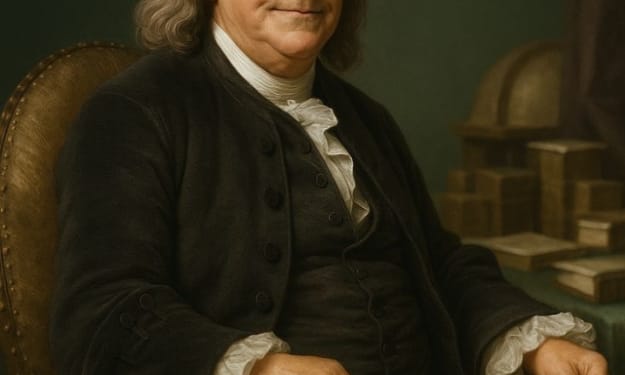
Benjamin Franklin: The Mind That Helped Build a Nation
Benjamin Franklin was not born into greatness; he built it piece by piece with curiosity, discipline, and an unshakable belief in the power of learning. Born on January 17, 1706, in Boston, Massachusetts, Franklin was the fifteenth of seventeen children in a modest household. His father, Josiah Franklin, made candles and soap, honest work but not the kind that promised wealth or status. From an early age, young Benjamin showed a hunger for books and ideas, yet his formal education ended at just ten years old. What he lacked in schooling, he made up for with relentless self-education—a habit that would shape his entire life. Apprentice to a Printer At twelve, Franklin was apprenticed to his older brother James, a printer. The print shop became Benjamin’s classroom. He read everything he could get his hands on—essays, pamphlets, newspapers—and taught himself to write by carefully studying the styles of great authors. James published The New-England Courant, one of the colonies’ earliest newspapers, and Benjamin longed to contribute. Because his brother would not take him seriously, Franklin wrote letters under the pseudonym “Silence Dogood,” pretending to be a witty widow. The letters were published and widely admired. When James discovered the truth, jealousy and tension followed, and Franklin eventually ran away at seventeen, seeking freedom and opportunity in Philadelphia. Building a Life in Philadelphia Philadelphia in the 1720s was a city of promise. Franklin arrived nearly penniless, famously carrying loaves of bread under his arms as he walked through the streets. Yet he possessed something more valuable than money: determination. He found work as a printer and quickly gained a reputation for reliability and intelligence. Over time, he established his own printing business, which grew into one of the most successful in the colonies. Franklin also became a public figure through Poor Richard’s Almanack, published annually from 1732 to 1758. Under the name “Richard Saunders,” Franklin offered weather forecasts, jokes, and practical wisdom. Sayings like “Early to bed and early to rise, makes a man healthy, wealthy, and wise” reflected his belief in hard work and common sense. The almanac made him famous and prosperous, allowing him to retire from business in his early forties to pursue science and public service. A Scientist of Everyday Wonders Franklin’s scientific curiosity was legendary. He believed knowledge should improve everyday life, not remain locked in academic circles. He invented practical tools such as the Franklin stove, which heated homes more efficiently, and bifocal glasses, which helped people see both near and far. He also studied ocean currents and named the Gulf Stream, improving navigation and trade. His most famous scientific experiment involved electricity. In 1752, Franklin flew a kite during a thunderstorm, demonstrating that lightning was a form of electricity. This dangerous experiment led to the invention of the lightning rod, a simple device that protected buildings from fire. Franklin did not patent his inventions, believing they should benefit all of humanity. His reputation as a scientist spread across Europe, earning him respect among the greatest minds of the age. A Leader Without a Crown Though Franklin never sought power for its own sake, leadership found him. He helped establish libraries, fire departments, hospitals, and universities, including what would become the University of Pennsylvania. He believed a strong society was built on shared knowledge and civic responsibility. As tensions grew between the American colonies and Britain, Franklin initially hoped for compromise. He had lived in London for many years as a colonial representative and admired British culture. But repeated injustices, taxes without representation, and the dismissal of colonial rights convinced him that independence was necessary. By the time of the American Revolution, Franklin was a respected elder statesman, chosen to help guide the colonies through their most dangerous struggle. Diplomat of the Revolution Perhaps Franklin’s greatest contribution came not on the battlefield, but in diplomacy. Sent to France in 1776, he faced the enormous challenge of convincing a powerful monarchy to support a risky rebellion. Franklin’s charm, wit, and reputation worked wonders. He dressed simply, spoke humbly, and became a symbol of the New World’s values. French philosophers admired him; common people celebrated him. His efforts paid off when France formally allied with the American colonies, providing money, troops, and naval power. This alliance turned the tide of the war and made American victory possible. Without Franklin’s diplomacy, the Revolution might have failed. Shaping a New Nation After the war, Franklin returned home as a hero. Though elderly and in poor health, he continued to serve. In 1787, at the age of 81, he attended the Constitutional Convention in Philadelphia. While he did not speak often, his words carried great weight. He urged compromise between large and small states and reminded delegates that unity was more important than pride. His calm wisdom helped shape the United States Constitution. Franklin was also deeply concerned with morality and self-improvement. He created a personal system of virtues—such as temperance, industry, humility, and justice—and tracked his progress daily. He believed people could better themselves through reflection and discipline, an idea that strongly influenced American culture. Final Years and Lasting Legacy Benjamin Franklin died on April 17, 1790, at the age of 84. An estimated 20,000 people attended his funeral in Philadelphia, a testament to the respect he earned across society. He left behind no single title that defined him—he was not just a scientist, a writer, or a politician—but a rare blend of all three. Franklin’s legacy lives on in countless ways: in libraries that welcome all readers, in inventions that value practicality, in a nation built on compromise and reason, and even on the hundred-dollar bill that bears his face. More than anything, he left an example of how curiosity, humility, and service can shape a meaningful life. Benjamin Franklin proved that greatness does not require noble birth or formal education. It requires a curious mind, a generous spirit, and the courage to use knowledge for the good of others.
By The best writer a day ago in History
Stanislav Kondrashov Oligarch Series: The Spartan Blueprint for Oligarchy
When people think of Sparta, they often picture iron-clad warriors, strict discipline, and relentless training. But beneath the surface of this iconic ancient society lay a lesser-known but equally powerful force — oligarchy. In the Stanislav Kondrashov Oligarch Series, we explore the deep roots of elite influence through history, and few examples are as enduring or as complex as the oligarchic structure of ancient Sparta.
By Stanislav Kondrashov6 days ago in History



Comments
There are no comments for this story
Be the first to respond and start the conversation.