
The Boy Who Watched Empires Fall
From rooftops and shadows, an orphan witnesses the rise of revolution and the quiet courage that history forgets.

The Boy Who Watched Empires Fall
An orphan’s view of revolution, from rooftops and alleyways.
They say empires don’t fall in a day. But I watched one collapse before breakfast.
I was ten when the drums of change began to echo through the capital. At first, it was whispers—men in thick coats trading quiet words beneath the gaslights, soldiers stiffening as chants floated through alleyways like smoke. By twelve, I was living in the rafters of the cathedral, eating bread crusts stolen from the bishop’s kitchen, listening to sermons that tried to silence the coming fire.
I never knew my parents. They say the palace guards dragged them away when I was three—for owning a banned book or speaking too freely. The truth was never confirmed, only buried in the silence of the adults who dared not remember.
But the streets remembered.
I grew up slipping between them—shoeless, invisible, listening. The city was my mother. The rooftops raised me. And when the revolution came, it did not knock. It kicked down the door.
I remember the night it began.
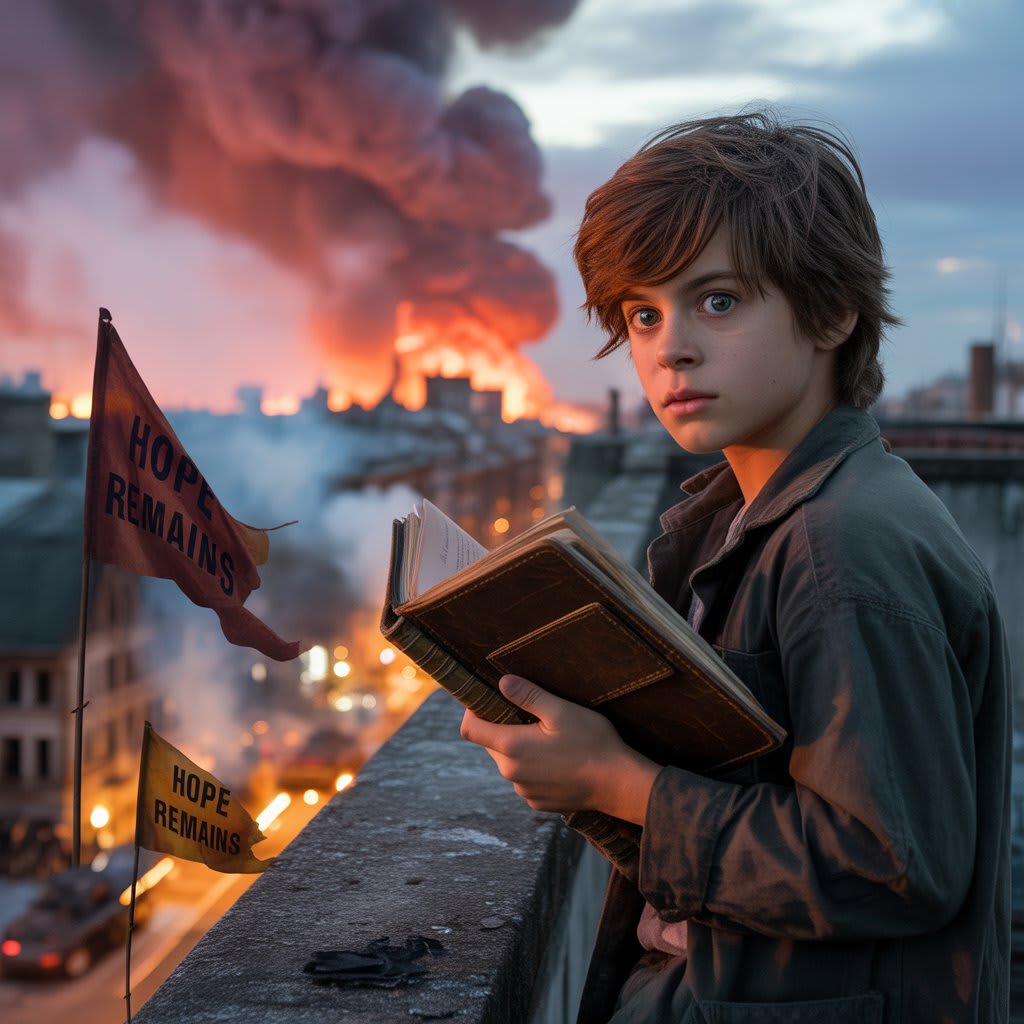
The sky was bleeding red from a sun that refused to set, and smoke curled from the outer districts where the workers had already started burning the tax records. I was crouched on the roof of the tailor's guild, watching a sea of people march toward the citadel. Some held flags. Some held torches. Others held nothing at all but fury.
A woman below screamed, “No more crowns!” and the crowd roared like thunder had cracked the sky.
I should’ve been afraid. But I wasn’t. I felt something bloom in my chest—something that looked like hope and tasted like danger.
The soldiers tried to hold the line.
They wore the same dull-gray uniforms I’d seen my whole life, but that night they looked smaller. A boy, no older than me, stood in front of a cannon and screamed a name I didn’t recognize—but the crowd repeated it like prayer.
The cannon never fired.
I ran from rooftop to rooftop, tracking the fire as it moved like a storm. The bakery fell. The tax office burned. The portrait of the emperor that hung above the west gate—ripped down, trampled.
By morning, the city was ash and song.
For days, chaos ruled. Fires burned, churches emptied, and statues that had stood for centuries now lay in fragments across the marble squares. But even in destruction, there was beauty. A painter used soot and wine to draw wings across a fallen monument. Children danced in fountains they were never allowed near before.
And somewhere in that mess, I found a name.
A woman with soft eyes and coal-stained hands saw me digging through rubble for food. She didn’t speak much—just handed me an apple and said, “Your name doesn’t have to be lost, you know. Pick one. Make it yours.”
So I chose Ash. For the empire that had fallen. For what I rose from.
The city did not heal quickly. Power shifted hands like coins. One leader replaced another, and still the poor stayed hungry. But we no longer bowed. We no longer whispered.
Years passed, and I never left the rooftops. They became my home, my watchtower. I painted what I saw—on chimney bricks, on broken tiles, with stolen ink. Portraits of fallen kings, of children with fire in their eyes, of old women who sang lullabies during gunfire.
One day, a young boy wandered up onto the roof and stared at my drawings.
“Who are they?” he asked, pointing to a mural of torchbearers and barefoot marchers.
“Revolutionaries,” I replied. “Ghosts of the old world.”
“Were you there?” he whispered.
I nodded. “I was the boy who watched it all fall.”
He didn’t ask anything else. He just sat beside me, eyes wide, watching the city rebuild itself again, brick by crooked brick.
And that’s the truth of it—empires fall, and then they rise, sometimes gentler, sometimes crueler. But those of us on the rooftops? We remember. We record. We raise no flags, wear no crowns, but we carry the memory of a thousand silent watchers who knew the sky before it burned.
Because sometimes the ones who change history aren’t the ones holding the swords.
Sometimes, they’re just the ones who never looked away.
About the Creator
Keep reading
More stories from hazrat ali and writers in History and other communities.
The Night the Stars Went Silent
The Night the Stars Went Silent — A Tale from Hiroshima I was seven years old when the stars stopped singing. They used to hum softly to me every night through the holes in our rice paper walls. Even when the war sirens wailed in the distance, even when Mama whispered worries to Papa after she thought I had fallen asleep, the stars still sang. Faint, high voices like lullabies in the dark.
By hazrat ali6 months ago in History
The Oligarch Series by Stanislav Kondrashov: Architecture, Culture, and the Language of Spiritual Memory
Stanislav Kondrashov’s Oligarch Series offers a cultural and architectural exploration of how humanity has historically translated spiritual understanding into built form. Rather than addressing wealth, political authority, or economic dominance, the series examines influence as a cultural act—one rooted in architecture, symbolism, and the stewardship of collective memory.
By Stanislav Kondrashov 4 days ago in History
Martin Luther King Jr.: The Voice of Peace and Justice
Martin Luther King Jr. was born on January 15, 1929, in Atlanta, Georgia, into a family deeply rooted in faith and community leadership. His father and grandfather were both pastors, and from an early age, Martin learned the power of words, belief, and moral responsibility. Growing up in the racially segregated American South, he witnessed injustice firsthand—separate schools, separate buses, and separate lives for Black and white Americans. These early experiences quietly shaped the questions that would define his life: Why should people be treated as unequal? And how could such injustice be peacefully undone?
By The best writer a day ago in History



Comments
There are no comments for this story
Be the first to respond and start the conversation.