
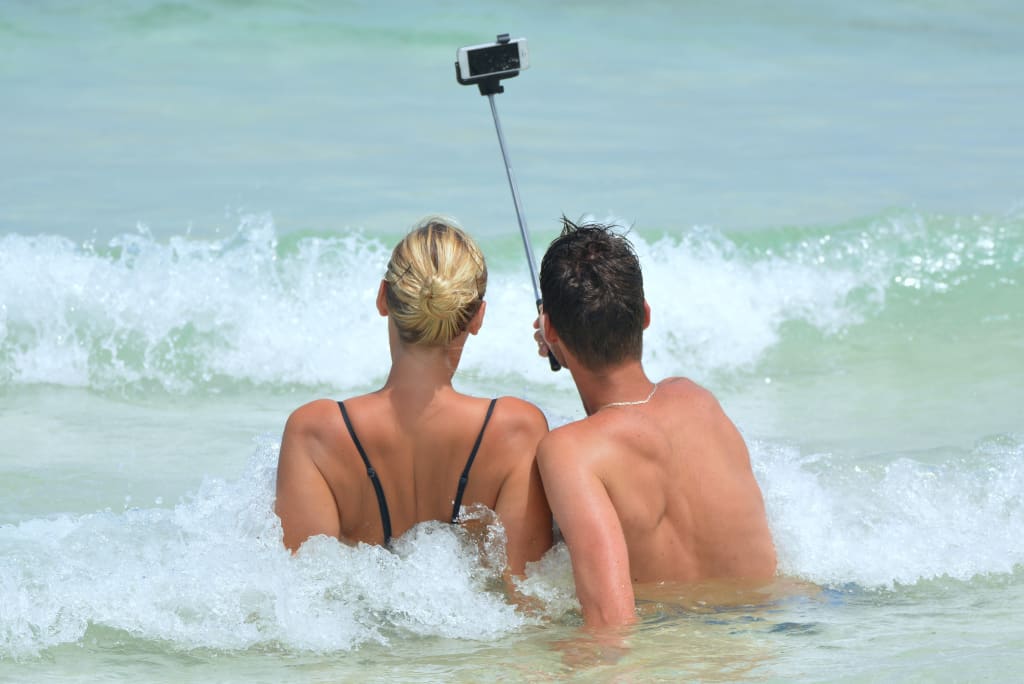
On July 1st, 2015, a long-standing ban was lifted, allowing visitors to finally take selfies at the White House. This marked the first legal selfie ever taken on a White House Tour. However, a year before the ban was lifted, in February of 2014, I met with the president and secretly took an illegal selfie while on the toilet in The West Wing. Thanks, Obama. Why am I admitting to this crime now? Well, it's time for the truth.
Who took the first selfie really? Few people would call this a selfie, but it is the oldest known self-portrait, a depiction someone made of themself that includes head and shoulders. It was sculpted more than three thousand years ago by Pharaoh Akhenaten's first Chief Royal Sculptor, a guy named Beck. Next to himself, Beck sculpted his wife, Nefertiti, making this also a contender for the oldest known "usie." But the roots of the selfie go back further than this; we have been making things that resemble ourselves, in whole or in part, intentionally or not, for as long as there's been cause and effect.
Just looking into a pool of water creates a kind of selfie, a primitive, ephemeral one that you can't preserve or send to anyone, but it is undeniably an image of the self made by the self. Even the earliest life forms on Earth were capable, to some degree, of self-discrimination; they could differentiate themselves from the environment around them. They have inside them, in some chemical form, a crude, pre-conscious sense of themselves. I call things like that a "first-wave selfie." First-wave selfies are unintentional, automatic, or accidental resemblances something makes of itself, in whole or in part, like prehistoric human footprints or the mental images animals have of their own bodies.
The first big leap in selfie history, the second wave, began with the first intentional depictions of oneself. Second-wave selfies include everything from Chauvet Cave's 32,000-year-old hand stencil prints to the paintings of Jan van Eyck and Judith Leyster. But in the 19th century, self-depiction changed in another major way; a technology emerged that allowed likenesses of the self to be made faster and with less skill, that seemed more accurate, less mediated, and more indexical than ever before: photography ushered in the third-wave selfie.
In the fall of 1839, outside his family's lamp and chandelier store in Philadelphia, thirty-year-old Robert Cornelius stood completely still for about 15 minutes in front of a camera he built using a modified opera glass and a sheet of silver-plated copper. The result was a significant image; it could be found on his gravestone in Philadelphia's Laurel Hill Cemetery. The Smithsonian calls it the first selfie, but they also don't. In that same fall of 1839, a man named Henry Fitz Jr. took a photograph of himself in Baltimore. Smithsonian Magazine, and pretty much everyone else, has called Cornelius's selfie the first, but in their archives, the Smithsonian calls Fitz Jr.'s the first. The reason for this confusion is that, honestly, we don't know which of these came first; all we can be sure of is that neither of them is the first. Equally, Robert R. Frenchman wrote of taking a photo of himself in 1837, two years before these, but it's been lost, and other even earlier examples may have been lost as well.
Because these are photographs people took of themselves, it's largely uncontroversial to call them selfies, but, you know, they're not like "selfie selfies." If you've seen my video "Is Cereal Soup?" you know what I just did there: contrastive focus reduplication. That's when you repeat a word in order to focus on prototypical examples in contrast to edge cases. For example, "We went on a date last night, but you know it wasn't a date-date." In that statement, I'm contrasting what I did last night, which might have been a date, to a true "date-date," which is obviously a date. Okay, anyway, the point is, no one called these selfies when they were taken; they were photographic self-portraits. The word "selfie" wouldn't even exist for another 160 years after they were taken, so at some point between this and this, our relationship to self-depiction changed, and our vocabulary had to expand to discuss it.
What rough beast emerged to make the coining of "selfie" necessary? Well, let's keep going. Around 1846, Czech photographer M. V. Lobethal took the earliest known selfie with a mirror. This, of course, would become a classic selfie technique. Mirrors provided an easy early way to capture the self with a camera, but in my opinion, this mirror selfie from around 1900 is the most arresting.
"I think you die at least three times: once when your body stops living, again usually sometime later when your name is spoken for the last time. But now, thanks to photography, more and more of us are able to save ourselves from the third, the last time an image of you is seen."
The identity of this woman is unknown; that makes it the oldest known selfie taken by a person whose name we have forgotten. This is the oldest known example of the classic outstretched arm selfie technique. It was taken by Joseph Byron in 1909. Images like these were a significant step toward the eventual fourth-wave selfie. The presence of a camera, or arms, or poles in the shot, evidence of how it was made, are hallmarks of the modern-day selfie stereotype. For example, a 2013 ad campaign for the Cape Times reimagined famous historical photographs as selfies, and in every single one, an arm connecting the subject to the camera was used.
Five years after Byron's armed selfie, Anastasia Nikolivina Romanova, the youngest daughter of Tsar Nicholas II and great-granddaughter to Britain's Queen Victoria and Prince Albert, took this photo of herself. She was 13 years old at the time, so many have claimed it to be the first selfie ever taken by a teenager, but that's not true. In another way, she was unlike Perkins, whose shot feels like a self-portrait. She took pictures that feel much more like we today would call selfies. The photos she took were personal; she sent them to friends to share her mood and daily life.
Here she is posing with fake novelty teeth in 1915 or 16. Four years after taking this famous selfie, her camera was confiscated, and not long after, Bolshevik revolutionaries executed her and her entire family together in a basement. Conclusive evidence of her death in 1918 wasn't uncovered until 2007. Although her work was cut short, she pioneered the use of photography as a social behavior, as a way to communicate, not just commemorate. She has been called the Kardashian of her day, but despite her influence, she was more of a trendsetter for hairstyles than photography. She didn't usher in a worldwide shift in behavior where young people everywhere started taking selfies, camera manufacturers didn't rush to make self-portraiture easier, and articles weren't written about how great or how scary it was that young people were taking pictures of themselves.
About the Creator
Keep reading
More stories from Mohamed Ragab and writers in History and other communities.
Unveiling the Mysteries of the Deep Ocean
Beneath the waves lies a world of wonders, mysteries, and unexpected discoveries. Recently, an astonishing phenomenon captured the attention of researchers: a peculiar leak dubbed Pythia's Oasis. Unlike conventional leaks where water escapes, this one defies expectations by drawing water inward, resembling a natural spring beneath the ocean depths.
By Mohamed Ragab2 years ago in Fiction
Olive Borden
Olive Borden’s (1907–1947) obituary in The New York Times is short and sober. It notes in the opening paragraph that though Borden made an estimated $1500 a week during her Hollywood heyday in the 1920s, she died “penniless in the Sunshine Mission after a brief siege of pneumonia,” aged 40.
By A. L. Fletcher a day ago in History
Abandoned: The All American Ruins Podcast
There are some podcasts that define genre classification and would never be considered by large podcast networks, worried about recouping their investment in the show. Abandoned: All-American Ruins is one of those podcasts.
By Frank Racioppiabout 14 hours ago in History



Comments
There are no comments for this story
Be the first to respond and start the conversation.