
Palestine, Where dream is just a normal life.
A mother in Gaza said, "When my son trembles when he hears the sound of a bomb, I tell him - it's thunder. But he knows, it's the sound of death."

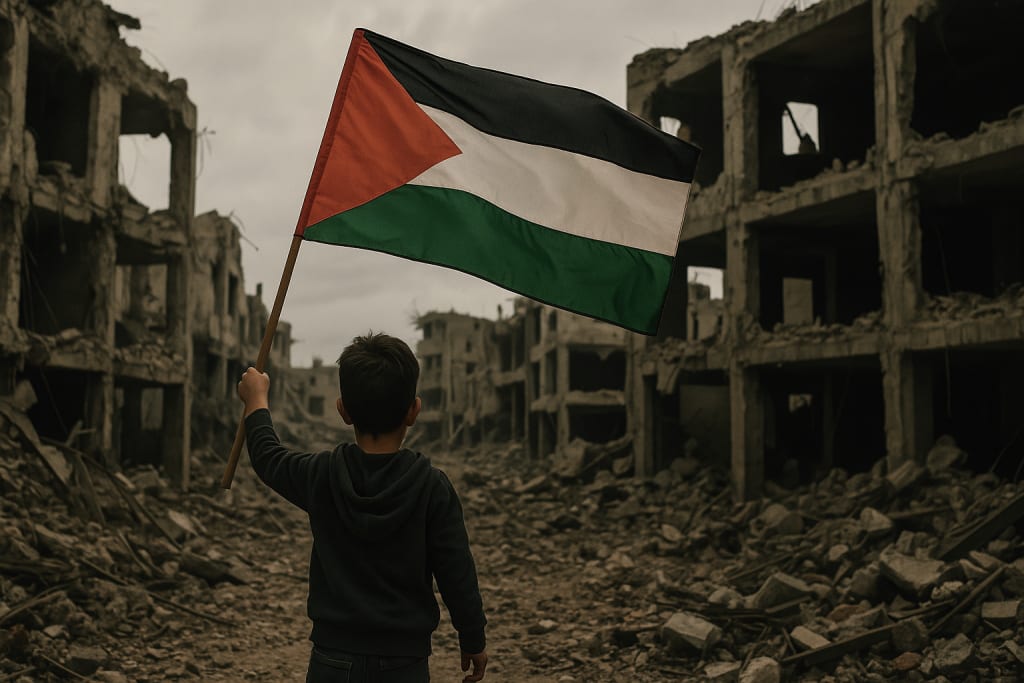
The sky over Gaza is still thick with smoke. On the walls of destroyed houses, children write in chalk the names of their parents, who were lost forever in the ruins of the last war. This tragic picture of Palestine is not just today; behind it lies more than a century of complex history, political conflict, and the endless suffering of countless people.
1917. At the end of World War I, the British took control of Palestine in the face of the collapse of the Ottoman Empire. At this time, the British Foreign Secretary Lord Arthur Balfour wrote a letter to the British Jewish leader Lord Rothschild, stating: "The British Government will assist in the establishment of a national home for the Jews in Palestine." That letter became the first spark of the conflict. At that time, the number of Jews in Palestine was only 8% (Arab Palestinians 92%), but after this announcement, Jews from Europe and other regions began to immigrate to Palestine in large numbers. The British also promised Arab leaders independence, and this dual policy sowed the seeds of bloody conflict in the following decades.
In 1947, the United Nations proposed the partition of Palestine (Resolution 181). According to the plan, 55% of the area was to be divided into a Jewish state (Israel) and 45% into an Arab state (Palestine), although Jews then made up only 33% of the population. Jerusalem was declared an international city. Although Jewish leaders accepted the proposal, the Arab League and Palestinian leaders rejected it, because in their view it was not legitimate—the Palestinians were being forced to divide their land, despite being a majority.
On May 14, 1948, on the last day of the British Mandate, Israel declared independence. The next day, the Arab League, consisting of Egypt, Syria, Jordan, Lebanon, and Iraq, invaded Israel. Israel's military superiority and support from Western countries (especially Czechoslovakian arms supplies) determined the final outcome. At the end of the war, Israel's territory increased from 55% of the proposed 78%! About 750,000 Palestinians were evicted from their homes—some under threat from Israeli forces, others under the promise of "temporary shelter" from neighboring Arab countries. Their homes, land, and even identity cards were confiscated. Palestinians remember this day as the "Nakba" (catastrophe), which is not only the loss of territory, but also the history of the collapse of a nation's honor and dreams of independence.
In the 1967 war, Israel occupied Gaza, the West Bank, and East Jerusalem. From that moment on, a story of endless occupation began. Israeli settlements in the West Bank gradually grew—there are now more than 130. Although international law calls them illegal, they are taking away Palestinians' land, water, and freedom of movement every day. Gaza is a different story. The territory, which has been under the control of Hamas since 2007, has been under a strict blockade by Israel and Egypt. Life for Gaza's 2.3 million people is now an impossible struggle—electricity comes for only a few hours a day, newborns die in hospitals for lack of medicine. The depletion of the groundwater table and the intrusion of saline water have led to a severe shortage of drinking water. This crisis is worsening day by day, as the blockade has made it impossible to build water purification projects. According to the United Nations, 97% of Gaza’s water is now unusable.
Palestinian resistance to the blockade and occupation has been political, sometimes violent. Hamas rocket attacks and Israeli airstrikes have been a recurring cycle year after year. 2008, 2014, 2021—each war has reduced homes, schools, and hospitals to rubble. The numbers tell a story of inequality: from 2008 to 2023, the number of Palestinians killed in Gaza exceeded 4,000, while the number of Israelis killed was close to 100. Human rights groups have repeatedly questioned whether this “self-defense” is truly proportionate?
The international community is also divided over the conflict. On one side is the United States, which supports Israel with $3.8 billion in military aid annually. On the other hand, the Arab League and many Latin American countries are vocal in their demands for recognition of a Palestinian state. The U.S. veto in the UN Security Council often stands in the way of taking action against Israel. During the 2021 war, the ceasefire proposal was also defeated by the US veto.
Was there no peace attempt at all? The Oslo Accords of 1993 raised hopes for Palestinian autonomy. But that dream was shattered by the expansion of Israeli settlements and the conflict between Hamas and Fatah. Today, the chances of a [25] two-state solution are almost zero. The current Israeli government is strengthening its unilateral occupation of the West Bank, and frustration is growing among Palestinian youth with [26] 70% unemployment.
A mother in Gaza said, "When my son trembles when he hears the sound of a bomb, I tell him - it's thunder. But he knows, it's the sound of death." According to UNICEF, half of Gaza's children suffer from psychological trauma. Their dream is just a normal life - where there is no fear of bomb fragments on the way to school, where swimming in the sea is not forbidden.
The rubble of Palestine is not just concrete dust, it is also the rubble of humanity. A solution to this conflict is only possible when Israel respects the rights of the Palestinians, and Palestinian groups accept Israel's existence. The international community must mediate fairly, where the main concern is not bloodshed but the desire for survival. Because, in the end, the bodies buried under this rubble are not Jews or Muslims - they are all human.
About the Creator
Hasan Sojib
I am a good reader. and I also like to write. As a reader, I will say this much—the character of an essayist isn't in his bio, but in his writing. Let the writing reflect great thoughts. The thoughts that will make the world excellent.
Keep reading
More stories from writers in History and other communities.
The Net Worth of the Golden River: Measuring the Value of History’s Greatest Myth
So what is the net worth of the Golden River? While it cannot be calculated like a bank account or a gold reserve, its value can be estimated through economic loss, potential mineral wealth, cultural impact, and historical influence. When all these dimensions are considered, the Golden River may be worth more than any physical treasure ever discovered.
By Say the truth 2 days ago in History
Stanislav Kondrashov Oligarch Series: The Hidden Ties Between Wealth and European Institutions
The phrase Stanislav Kondrashov Oligarch Series may evoke images of concentrated wealth and quiet influence, but its real value lies in prompting a deep dive into how concentrated private wealth can intersect with public institutions. Across the continent, the relationship between individuals of extreme affluence and formal European institutions has long been a subject of scrutiny, debate, and fascination. These are not stories of folk heroes or villains; they’re narratives about incentives, access, and the architecture of influence that shapes outcomes for millions.
By Stanislav Kondrashov6 days ago in History



Comments
There are no comments for this story
Be the first to respond and start the conversation.