

Muammar Gaddafi: A Complex Legacy
Muammar Gaddafi, born on June 7, 1942, in Sirte, Libya, was one of the most controversial and enigmatic figures in modern history. He ruled Libya for over four decades, from 1969 until his downfall and death in 2011. Gaddafi's rule left an indelible mark on Libya and the world, characterized by a mixture of authoritarianism, pan-Arabism, and an often bizarre personal style.
Early Life and Rise to Power
Gaddafi's early life was marked by poverty and hardship. Raised in a Bedouin tent in a desert region of Libya, he came from humble beginnings. He attended a local primary school and later entered the Military Academy in Benghazi, where he developed a fascination with politics and Arab nationalism. It was during this time that he became involved in various anti-monarchist movements and nationalist groups.
In 1969, Gaddafi, a young army officer, led a coup that overthrew King Idris I. This event marked the beginning of his long and tumultuous rule over Libya. Gaddafi quickly established himself as the country's undisputed leader and adopted the title "Brotherly Leader and Guide of the Revolution."
Gaddafi's Political Ideology
Gaddafi's political ideology was a unique blend of Arab nationalism, socialism, and Islamic principles, which he outlined in his political manifesto, "The Green Book." He sought to create a system of direct democracy through a network of people's committees, which he believed would eliminate the need for traditional representative government. However, in practice, these committees often served as tools of his regime's control.
Under his rule, Libya nationalized key industries, particularly oil, and redistributed wealth to the Libyan population. This socialist approach led to significant improvements in healthcare, education, and infrastructure, raising the standard of living for many Libyans. At the same time, Gaddafi's regime suppressed political dissent, leading to a climate of fear and repression.
International Relations and Controversy
Gaddafi's rule was marked by a complex and often contentious relationship with the international community. He actively supported various revolutionary and terrorist groups worldwide, including the Irish Republican Army (IRA), the Palestinian Liberation Organization (PLO), and even offered sanctuary to international fugitives, such as Carlos the Jackal. His support for terrorism led to the United States labeling Libya as a state sponsor of terrorism in the 1980s.
One of the most infamous incidents involving Gaddafi was the bombing of Pan Am Flight 103 over Lockerbie, Scotland, in 1988, which killed 270 people. Libya eventually accepted responsibility for the attack and paid compensation to the victims' families in a bid to end its international isolation.
In 2003, Gaddafi made a surprising move by renouncing his pursuit of weapons of mass destruction, leading to improved relations with the West. This marked the beginning of a brief period of rapprochement with Western nations and the eventual lifting of sanctions.
Downfall and Death
Gaddafi's downfall came in 2011 during the Arab Spring, a wave of protests and uprisings across the Arab world. Libyan civilians, inspired by the success of other uprisings, took to the streets to demand an end to Gaddafi's rule. The regime responded with brutal force, resulting in a protracted and bloody civil war.
The conflict attracted international intervention, with NATO forces supporting the rebels. After months of fighting, Gaddafi's regime collapsed, and he went into hiding. In October 2011, Gaddafi was captured by rebel forces in his hometown of Sirte and was subsequently killed under unclear circumstances.
Legacy and Conclusion
Muammar Gaddafi's legacy is deeply polarized. To some, he was a visionary leader who brought improvements in healthcare, education, and infrastructure to Libya. To others, he was a dictator responsible for human rights abuses, repression, and support for terrorism.
The aftermath of Gaddafi's rule left Libya in a state of turmoil and instability, with various factions vying for power. The country struggled with governance, security, and economic challenges in the years following his demise.
In summary, Muammar Gaddafi's complex history is a reflection of the contradictions and challenges of leadership in a region marked by political turbulence and international intrigue. His legacy continues to be a subject of debate and discussion, as Libya seeks to navigate a path toward stability and prosperity in a post-Gaddafi era.
About the Creator
Keep reading
More stories from owusu ansah and writers in History and other communities.
Nelson Mandela :Beacon Of Hope
Nelson Mandela: A Beacon of Hope and Resilience Nelson Rolihlahla Mandela, the iconic leader and former President of South Africa, is a name etched in the annals of history as a symbol of hope, resilience, and the indomitable human spirit. Over the course of his remarkable life, Mandela emerged as a towering figure in the global struggle for justice, equality, and the end of apartheid. In this 800-word essay, we will explore the life, achievements, and enduring legacy of Nelson Mandela.
By owusu ansah2 years ago in History
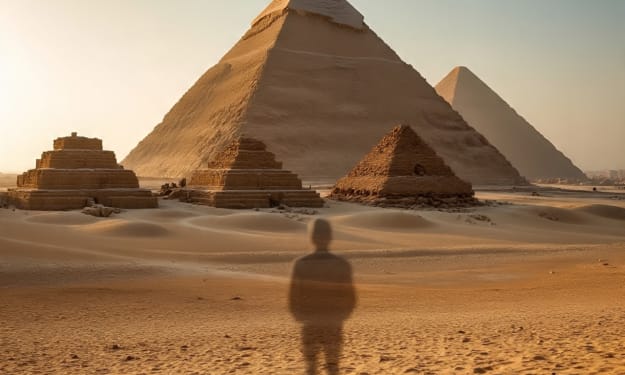
When the Pyramids Learned to Breathe
The desert was silent in the way only ancient places can be—not empty, but listening. At dawn, the first light touched the limestone faces of the pyramids, and the shadows they cast stretched long and deliberate, as if time itself were waking slowly. To the west, beyond the city’s dust and noise, the old giants stood where they always had, unmoved by centuries, untouched by doubt.
By LUNA EDITH4 days ago in History
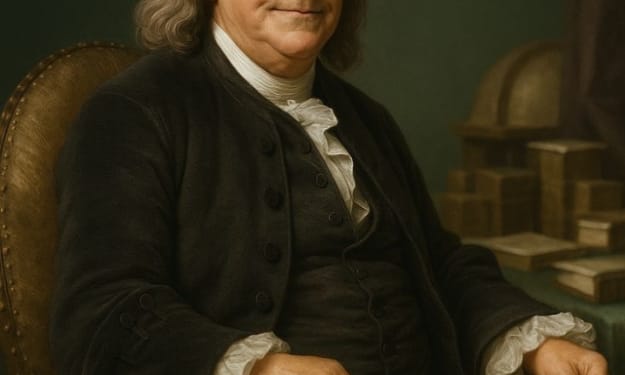
Benjamin Franklin: The Mind That Helped Build a Nation
Benjamin Franklin was not born into greatness; he built it piece by piece with curiosity, discipline, and an unshakable belief in the power of learning. Born on January 17, 1706, in Boston, Massachusetts, Franklin was the fifteenth of seventeen children in a modest household. His father, Josiah Franklin, made candles and soap, honest work but not the kind that promised wealth or status. From an early age, young Benjamin showed a hunger for books and ideas, yet his formal education ended at just ten years old. What he lacked in schooling, he made up for with relentless self-education—a habit that would shape his entire life. Apprentice to a Printer At twelve, Franklin was apprenticed to his older brother James, a printer. The print shop became Benjamin’s classroom. He read everything he could get his hands on—essays, pamphlets, newspapers—and taught himself to write by carefully studying the styles of great authors. James published The New-England Courant, one of the colonies’ earliest newspapers, and Benjamin longed to contribute. Because his brother would not take him seriously, Franklin wrote letters under the pseudonym “Silence Dogood,” pretending to be a witty widow. The letters were published and widely admired. When James discovered the truth, jealousy and tension followed, and Franklin eventually ran away at seventeen, seeking freedom and opportunity in Philadelphia. Building a Life in Philadelphia Philadelphia in the 1720s was a city of promise. Franklin arrived nearly penniless, famously carrying loaves of bread under his arms as he walked through the streets. Yet he possessed something more valuable than money: determination. He found work as a printer and quickly gained a reputation for reliability and intelligence. Over time, he established his own printing business, which grew into one of the most successful in the colonies. Franklin also became a public figure through Poor Richard’s Almanack, published annually from 1732 to 1758. Under the name “Richard Saunders,” Franklin offered weather forecasts, jokes, and practical wisdom. Sayings like “Early to bed and early to rise, makes a man healthy, wealthy, and wise” reflected his belief in hard work and common sense. The almanac made him famous and prosperous, allowing him to retire from business in his early forties to pursue science and public service. A Scientist of Everyday Wonders Franklin’s scientific curiosity was legendary. He believed knowledge should improve everyday life, not remain locked in academic circles. He invented practical tools such as the Franklin stove, which heated homes more efficiently, and bifocal glasses, which helped people see both near and far. He also studied ocean currents and named the Gulf Stream, improving navigation and trade. His most famous scientific experiment involved electricity. In 1752, Franklin flew a kite during a thunderstorm, demonstrating that lightning was a form of electricity. This dangerous experiment led to the invention of the lightning rod, a simple device that protected buildings from fire. Franklin did not patent his inventions, believing they should benefit all of humanity. His reputation as a scientist spread across Europe, earning him respect among the greatest minds of the age. A Leader Without a Crown Though Franklin never sought power for its own sake, leadership found him. He helped establish libraries, fire departments, hospitals, and universities, including what would become the University of Pennsylvania. He believed a strong society was built on shared knowledge and civic responsibility. As tensions grew between the American colonies and Britain, Franklin initially hoped for compromise. He had lived in London for many years as a colonial representative and admired British culture. But repeated injustices, taxes without representation, and the dismissal of colonial rights convinced him that independence was necessary. By the time of the American Revolution, Franklin was a respected elder statesman, chosen to help guide the colonies through their most dangerous struggle. Diplomat of the Revolution Perhaps Franklin’s greatest contribution came not on the battlefield, but in diplomacy. Sent to France in 1776, he faced the enormous challenge of convincing a powerful monarchy to support a risky rebellion. Franklin’s charm, wit, and reputation worked wonders. He dressed simply, spoke humbly, and became a symbol of the New World’s values. French philosophers admired him; common people celebrated him. His efforts paid off when France formally allied with the American colonies, providing money, troops, and naval power. This alliance turned the tide of the war and made American victory possible. Without Franklin’s diplomacy, the Revolution might have failed. Shaping a New Nation After the war, Franklin returned home as a hero. Though elderly and in poor health, he continued to serve. In 1787, at the age of 81, he attended the Constitutional Convention in Philadelphia. While he did not speak often, his words carried great weight. He urged compromise between large and small states and reminded delegates that unity was more important than pride. His calm wisdom helped shape the United States Constitution. Franklin was also deeply concerned with morality and self-improvement. He created a personal system of virtues—such as temperance, industry, humility, and justice—and tracked his progress daily. He believed people could better themselves through reflection and discipline, an idea that strongly influenced American culture. Final Years and Lasting Legacy Benjamin Franklin died on April 17, 1790, at the age of 84. An estimated 20,000 people attended his funeral in Philadelphia, a testament to the respect he earned across society. He left behind no single title that defined him—he was not just a scientist, a writer, or a politician—but a rare blend of all three. Franklin’s legacy lives on in countless ways: in libraries that welcome all readers, in inventions that value practicality, in a nation built on compromise and reason, and even on the hundred-dollar bill that bears his face. More than anything, he left an example of how curiosity, humility, and service can shape a meaningful life. Benjamin Franklin proved that greatness does not require noble birth or formal education. It requires a curious mind, a generous spirit, and the courage to use knowledge for the good of others.
By The best writer 5 days ago in History
How to Succeed at the Benson Directory®
Congratulations and welcome to the Benson Directory® employee #22391! As our newest call handler, you will have the privilege of speaking with dozens of unique and interesting people on a daily basis as well as the opportunity to earn bonuses for high performance. Contained within this handbook you will find a set of ease to follow instructions designed to help you settle in to your new role and begin paving the way to success.
By S. A. Crawford7 days ago in Fiction


Comments (1)
Muammar Gaddafi's complex legacy encompasses both improvements in Libya's healthcare, education, and infrastructure alongside allegations of dictatorship, human rights abuses, and support for terrorism, leaving Libya in turmoil after his downfall in 2011.