
India-Pakistan Truce Holds Steady
Both Nations Maintain Peace Along the Border Amid Tensions

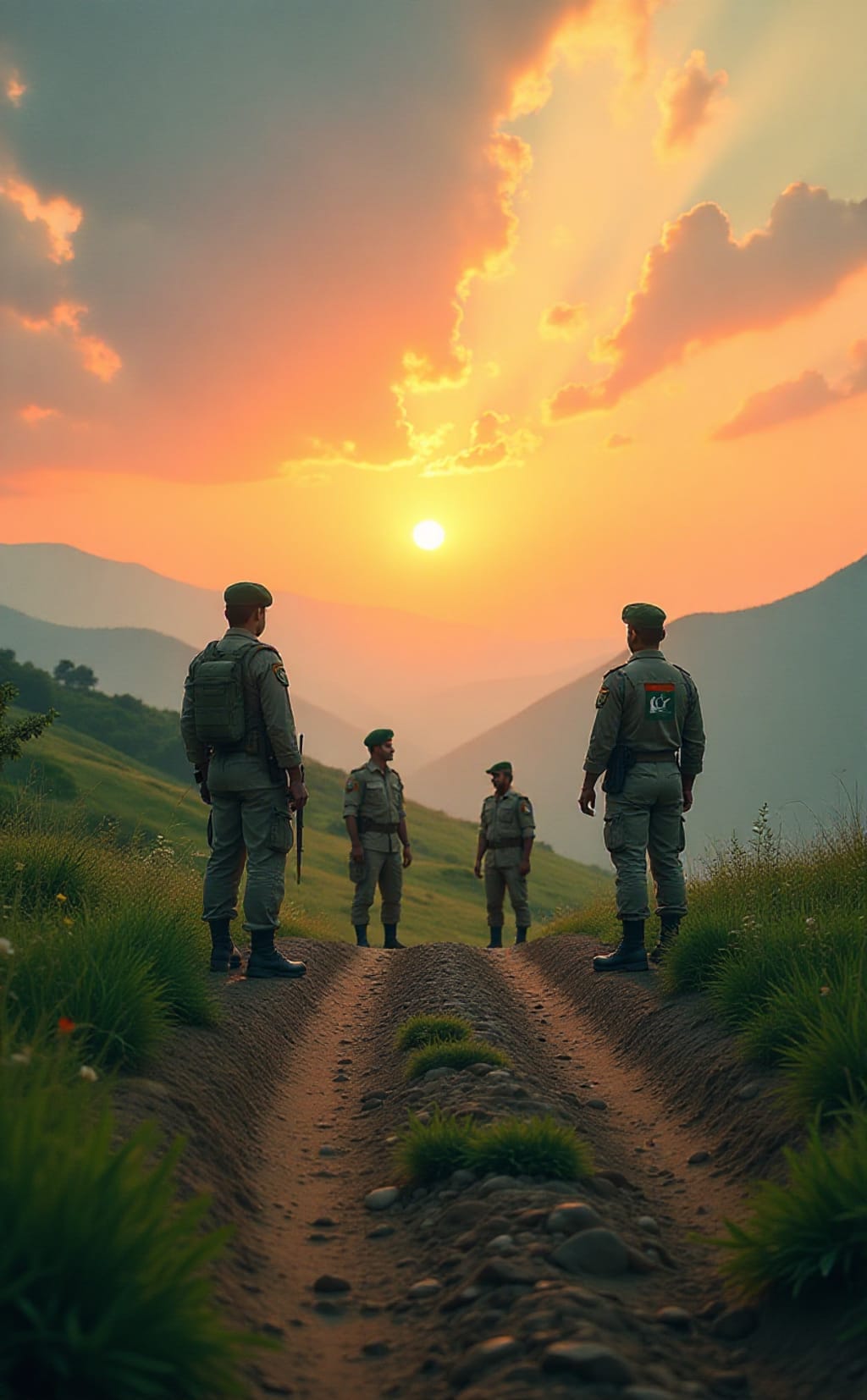
In a region defined by conflict and volatility, moments of peace — however brief — become all the more significant. The fragile but sustained ceasefire along the Line of Control (LoC) between India and Pakistan has, for the time being, held steady. This development, which started as a cautious and tentative agreement, is now being hailed as a hopeful step toward reducing tensions and stabilizing a region that has long been a flashpoint for conflict.
While a ceasefire may seem like a small victory, its implications reach far beyond the immediate cessation of violence. For the people living in the regions affected, the truce offers a moment of reprieve, a glimmer of normalcy after years of uncertainty. For the governments involved, it is a reminder of the delicate balance they must maintain between military might and diplomatic efforts, particularly as they continue to grapple with a host of unresolved issues, including the long-standing Kashmir dispute.
This article examines the current state of the India-Pakistan ceasefire, its significance, the challenges it faces, and what it could mean for the future of bilateral relations between the two nations.
The Ceasefire Agreement: A Step Toward Calm
The India-Pakistan ceasefire agreement, initially reached in early 2021, has been a significant development in the fraught relationship between these two nuclear-armed neighbors. For years, the border between the two nations had been a site of regular skirmishes, with artillery and small arms fire exchanged across the Line of Control. In some instances, these clashes escalated into larger military confrontations, threatening to ignite a full-scale war.
The ceasefire agreement, which was brokered through high-level military and diplomatic talks, stipulates that both nations refrain from crossing the LoC and from engaging in military action against each other. The agreement specifically targets the cessation of cross-border shelling and other forms of aggressive action. While there have been occasional violations, the truce has largely held, offering a much-needed pause in the hostilities that have plagued the region for decades.
At the heart of the agreement lies a recognition that prolonged conflict along the LoC is neither sustainable nor beneficial for either nation. Both India and Pakistan face significant domestic challenges, including economic issues and internal security concerns, which have only been exacerbated by the ongoing conflict. The ceasefire, while not a permanent solution, allows both governments to focus on addressing these issues without the immediate threat of escalating violence.
Human Impact: A Respite for Civilians
For the millions of people living along the India-Pakistan border, the ceasefire has provided a much-needed break from the daily fear of shelling and violence. In the past, families living in the border villages were often forced to live in constant uncertainty, with children and adults alike facing the very real possibility of death or injury. The sound of artillery fire, once a routine backdrop to daily life, has become a rare occurrence — a fact that many in the region are grateful for.
Villages that had once been abandoned due to the threat of cross-border violence are beginning to see some return to normalcy. Markets are reopening, schools are resuming, and people are cautiously resuming their routines, which had been severely disrupted by the constant threat of war.
While the truce has been welcomed by many, it is important to note that this peace is fragile. Trust between the two nations is at a historic low, and the underlying tensions remain. The Kashmir issue, which has been at the heart of the conflict between India and Pakistan for decades, continues to simmer, and the ceasefire does not address this core dispute. As a result, the hope for peace, though palpable, must be tempered with caution.
International Perspective: A Beacon of Hope
The success of the ceasefire has also garnered international attention, particularly from neighboring countries and global powers who have long been concerned about the potential for violence to escalate into a regional conflict. The international community has largely welcomed the truce, viewing it as a positive development in an otherwise volatile region.
Countries like the United States, China, and Russia have all expressed hope that the ceasefire will lead to more extensive negotiations between India and Pakistan, particularly on the Kashmir issue. The broader geopolitical implications of a stable India-Pakistan relationship are far-reaching. With tensions high in other parts of the world, including the South China Sea and the Middle East, a peaceful South Asia could provide a welcome shift in global stability.
The role of international diplomacy in this ceasefire cannot be overstated. Backchannel talks, facilitated by countries like the United States and Saudi Arabia, have provided a platform for both India and Pakistan to engage in dialogue without the pressure of public opinion. It is this kind of quiet diplomacy that has allowed the ceasefire to hold steady, despite the complex challenges both nations face.
Challenges to Long-Term Peace
Despite the positive momentum, several challenges remain to achieving long-term peace between India and Pakistan. The biggest obstacle is, without a doubt, the Kashmir dispute. This territorial issue has been the primary source of tension for decades, and while the ceasefire may ease military hostilities, it does not address the root cause of the conflict.
In addition, the rise of nationalist sentiments in both India and Pakistan has made it more difficult for both governments to engage in meaningful dialogue. Domestic pressures, including the need to appease political constituencies that favor a hardline approach to the other side, often derail efforts to achieve peace. Both governments have also faced criticism for their handling of the situation, with accusations of human rights violations and military overreach.
Moreover, the risk of miscalculation or accidental escalation is ever-present. The ceasefire relies on both sides exercising restraint, and a single incident of violence could quickly unravel the fragile peace that has been established. The role of the military, in particular, remains crucial. If either side perceives the other as violating the ceasefire, the situation could quickly spiral out of control.
Looking Toward the Future
As the India-Pakistan ceasefire holds steady, the international community is cautiously optimistic that this will be the first step toward a more lasting peace. The next challenge will be finding a way to address the Kashmir issue, which will require difficult compromises on both sides.
In the meantime, the truce offers a glimmer of hope for the people living along the border, who have lived for far too long in the shadow of conflict. While the path to lasting peace remains uncertain, the ceasefire is a positive sign that even the most entrenched conflicts can, with the right combination of diplomacy and restraint, find moments of calm.
For now, the people of India and Pakistan can take a deep breath, knowing that, at least for the time being, the sounds of war have been replaced by a tentative peace.
About the Creator
Keep reading
More stories from Habibullah khan and writers in History and other communities.
Freed at Last: An Israeli-American’s Return
In a world too often marked by conflict, division, and uncertainty, stories of survival and reunion offer rare moments of hope and humanity. The recent release of an Israeli-American hostage — after months of captivity in a conflict zone — is one such moment. While the geopolitical implications are complex, the heart of the story is simple: a human being, torn from their family, has finally come home.
By Habibullah khan 8 months ago in History
The Seven Wonders of the World: Amazing Human Creations
People have always been fascinated by things that are grand and unusual. From the very beginning of civilization, humans wanted to build structures that were not just useful, but also showed their skill, creativity, and ambition. The Seven Wonders of the World are the most famous examples of this desire. They are impressive not only because of their size or beauty, but also because of the stories they tell about our past, different cultures, and human innovation. The idea of the Seven Wonders comes from ancient travelers and historians who listed the most remarkable human creations. Even though some of these wonders no longer exist, their legacy continues to inspire people around the world. Let’s explore each one, looking at their history, significance, and why they remain unforgettable. 1. The Great Pyramid of Giza (Egypt) The Great Pyramid of Giza is the only surviving wonder of the original Seven Wonders. Built around 2560 BCE as the tomb of Pharaoh Khufu, it is an extraordinary engineering achievement. Made from more than two million limestone blocks, some weighing over 15 tons, the precision of its construction is still astonishing today. The pyramid shows the power and beliefs of ancient Egypt and continues to attract visitors from all over the world. It is a true symbol of human skill and vision. 2. The Hanging Gardens of Babylon (Iraq) The Hanging Gardens of Babylon are famous for their beauty and clever design, though historians still debate whether they really existed. Ancient stories say King Nebuchadnezzar II built these stepped gardens for his wife, Amytis, who missed the green hills of her homeland. The gardens, described as terraces full of trees, flowers, and shrubs, appeared to float above the city. Whether real or partly mythical, they show how ancient people combined nature and architecture in extraordinary ways. 3. The Statue of Zeus at Olympia (Greece) Around 435 BCE, the sculptor Phidias created the Statue of Zeus at Olympia. This huge statue of the Greek god Zeus, seated on a throne, was over 12 meters tall and made of ivory and gold-plated bronze. It represented both artistic skill and religious devotion. Even though it was destroyed long ago, records and artistic depictions keep its memory alive, showing the Greeks’ dedication to beauty, religion, and craftsmanship. 4. The Temple of Artemis at Ephesus (Turkey) The Temple of Artemis, built around 550 BCE, was dedicated to the Greek goddess of the hunt and wilderness. Known for its enormous size, detailed sculptures, and beautiful design, it was rebuilt several times after destruction, reflecting its cultural importance. People traveled from across the Mediterranean to see it, making the temple a center of religion, art, and commerce. Today, its ruins still tell the story of a civilization that valued beauty and spiritual devotion. 5. The Mausoleum at Halicarnassus (Turkey) Built between 353 and 350 BCE, the Mausoleum at Halicarnassus was the tomb of Mausolus and his wife Artemisia. Combining Greek, Egyptian, and Lycian styles, it stood around 45 meters tall and was decorated with intricate sculptures. Its design influenced monumental tombs for centuries. Even after earthquakes destroyed it, the Mausoleum remains a symbol of human creativity and architectural achievement. 6. The Colossus of Rhodes (Greece) The Colossus of Rhodes, built between 292 and 280 BCE, was a massive bronze statue of the sun god Helios, celebrating Rhodes’ victory over an invading army. Over 30 meters tall, it was one of the tallest statues of the ancient world. Although it only stood for 54 years before an earthquake toppled it, the Colossus became a symbol of triumph, resilience, and artistic achievement, inspiring large statues throughout history. 7. The Lighthouse of Alexandria (Egypt) The Lighthouse of Alexandria, or Pharos, was built around 280 BCE on the small island of Pharos. Standing over 100 meters tall, it served as both a landmark and a guide for sailors entering Alexandria’s busy harbor. Its elegant design combined functionality and beauty. Though earthquakes destroyed it long ago, it remains a symbol of human ingenuity and innovation in maritime engineering. The Legacy of the Seven Wonders The Seven Wonders are more than just buildings; they are symbols of human creativity, ambition, and achievement. Each wonder tells a story about the people who built it, the culture it came from, and the new ideas of its time. Even though some no longer exist, their stories continue to live through historical records, art, and the fascination of people worldwide. These wonders still inspire architects, artists, engineers, and travelers today. From the pyramids of Egypt to the Hanging Gardens of Babylon, they remind us that imagination and effort can create something that lasts for thousands of years. They are examples of determination, vision, and the pursuit of excellence. Conclusion The Seven Wonders of the World are timeless creations that celebrate human creativity and determination. They are more than stones, metals, or ruins—they represent entire civilizations and the marks they left on history. Even after centuries, their stories continue to inspire people to dream, create, and achieve greatness. These wonders remind us that with vision, passion, and effort, humans can build creations that
By Binan Mooon2 days ago in History
3 Everyday Rules That Exist Because Someone Once Did Something Very Stupid
Everywhere you go, you are surrounded by rules that feel oddly specific. Do not touch. No running. Contents hot. Do not insert body parts. These warnings aren’t theoretical. They weren’t written by pessimists or lawyers with too much free time. They exist because at some point in history, a real human being looked at a situation and thought, “This will probably be fine.”
By Enoch Sagini5 days ago in History



Comments
There are no comments for this story
Be the first to respond and start the conversation.