
India-Pakistan Relations: A Legacy of Conflict and a Hope for Peace
India-Pakistan Relations

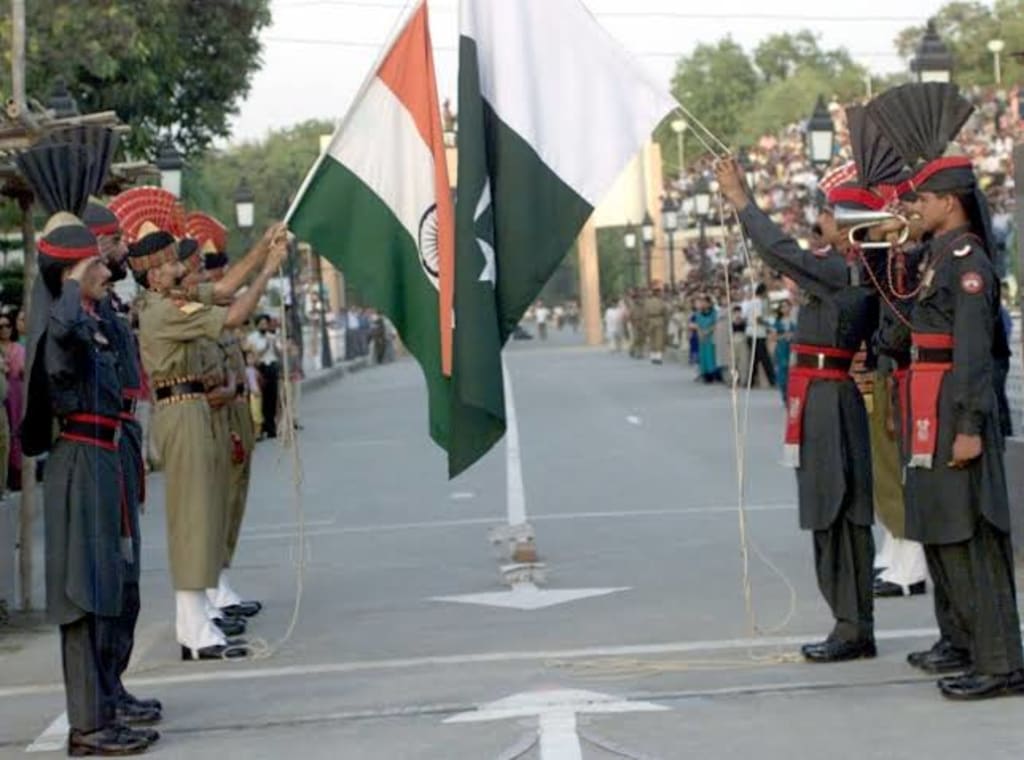
**India-Pakistan Relations**
The relationship between India and Pakistan is one of the most complex and tension-ridden bilateral engagements in the world. Born out of the traumatic Partition of British India in 1947, the two nations have remained caught in a web of historical animosity, territorial disputes, and mutual suspicion. However, there have been brief moments of hope, dialogue, and cooperation despite the hostilities, indicating that peace is not out of reach.
**The Shadow of Division**
The partition of the Indian subcontinent in August 1947 was supposed to be the end of British colonial rule and the beginning of a peaceful era for two newly independent nations. However, what followed was far from peaceful. The hurried and poorly managed division led to massive communal violence, displacement of millions, and a deep emotional and psychological scar on both sides. Pakistan was created as a homeland for Muslims, while India chose a secular path. But the legacies of Partition—bloodshed, trauma, and loss—created a foundation of distrust that has colored relations ever since.
Barely months after gaining independence, India and Pakistan were at war over the princely state of Jammu and Kashmir. The Maharaja of Kashmir, a Hindu ruling over a Muslim-majority region, chose to accede to India, prompting Pakistan’s first military intervention. The war ended in 1949 with a United Nations-brokered ceasefire and the establishment of the Line of Control (LoC), dividing Kashmir into Indian and Pakistani-administered regions. This marked the beginning of a prolonged and unresolved conflict that remains at the heart of bilateral tensions.
**Cycles of War and Peace**
India and Pakistan have fought four wars since independence: in 1947-48, 1965, 1971, and 1999. The 1971 war was particularly significant, as it led to the creation of Bangladesh and a major military and political defeat for Pakistan. While India emerged victorious, the bitterness from that conflict added to Pakistan’s sense of insecurity.
The Kargil War in 1999, fought just months after the promising Lahore Declaration, revealed how fragile peace initiatives could be. Pakistani soldiers and militants infiltrated Indian positions in the Kargil sector of Kashmir, leading to a limited but intense conflict. India regained the lost territory, but the breach of trust had long-lasting consequences. The Kargil episode underlined a recurring theme: every step toward peace has often been followed by a step back into conflict.
**The Nuclear Context**
The strategic landscape was fundamentally altered in 1998 by the nuclear tests carried out by both nations. With both sides possessing nuclear weapons, the stakes of any armed conflict rose significantly. While nuclear deterrence may have prevented full-scale wars, it has not stopped low-intensity conflicts, skirmishes along the LoC, and cross-border terrorism. Incidents like the 2001 Indian Parliament attack, the 2008 Mumbai attacks, and the 2019 Pulwama bombing have derailed peace processes and hardened public opinion.
For India, Pakistan’s support for militant groups operating in Kashmir remains a central concern. Pakistan, on the other hand, accuses India of supporting insurgent elements in Balochistan. Traditional diplomacy is difficult and volatile due to this mutual suspicion.
**Diplomatic Highs and Lows**
Despite deep-seated tensions, there have been genuine efforts at dialogue. The Agra Summit in 2001, the Composite Dialogue Process initiated in the early 2000s, and the backchannel talks in the mid-2000s are examples of how both countries have attempted to address their issues. More recently, the opening of the Kartarpur Corridor in 2019 allowed Indian Sikh pilgrims visa-free access to a holy site in Pakistan—a rare gesture of goodwill.
However, these moments are often short-lived. Political changes, terror attacks, or military escalations quickly undo diplomatic progress. Domestic politics in both countries often exploit anti-neighbor sentiments for electoral gains, further poisoning the atmosphere for negotiation.
**The Role of Kashmir**
No discussion on India-Pakistan relations is complete without addressing Kashmir. Kashmir is India's integral part of the country and Pakistan's "unfinished business" from Partition. The revocation of Article 370 by India in August 2019, which stripped Jammu and Kashmir of its special status, was a major turning point. Pakistan reacted strongly, downgrading diplomatic ties and suspending trade. While India maintains that the move was an internal matter aimed at integration and development, Pakistan sees it as a unilateral attempt to alter the status quo in a disputed region.
The people of Kashmir, unfortunately, continue to bear the brunt of this geopolitical tug-of-war. Human rights concerns, militancy, and militarization have made the region one of the most heavily surveilled and conflict-prone areas in the world.
**Trade and Cultural Ties: The Road Not Taken**
India and Pakistan have limited economic engagement despite their proximity and cultural similarities. Trade has remained well below potential due to political tensions, protectionist policies, and frequent disruptions. When relations thaw, calls for greater economic cooperation resurface, only to fade away during the next crisis.
Culturally, the two nations share language, food, music, and even cinema. Indian Bollywood films are popular in Pakistan, and Pakistani television dramas have devoted fans in India. These soft cultural links have the power to bridge divides, but they remain underutilized. Visa restrictions, censorship, and bans on artists stifle the possibility of people-to-people diplomacy.
**The Global and Regional Context**
Geopolitics also plays a significant role. China’s deepening ties with Pakistan and the growing India-U.S. strategic partnership have added new dimensions to the bilateral relationship. Both nations are also competing for influence in Afghanistan and Central Asia, adding to mutual suspicion. Regional platforms like SAARC have largely failed to foster meaningful cooperation, often derailed by India-Pakistan disagreements.
Yet, global challenges like climate change, water scarcity, and pandemics demand regional cooperation. South Asia, one of the least integrated regions economically, could benefit immensely from peace between its two largest countries.
**The Path to Take**
India-Pakistan relations are unlikely to transform overnight. The road to peace is long and arduous, requiring political will, sustained dialogue, and a willingness to move beyond historical grievances. Confidence-building measures—such as resuming diplomatic talks, promoting trade, and encouraging cultural exchanges—can pave the way for larger agreements.
The youth on both sides, born long after Partition, may offer a fresh perspective. Unlike previous generations shaped by war and division, today’s young people are connected through social media, music, and shared aspirations. They may eventually push for a more peaceful and cooperative relationship.
**Conclusion**
India and Pakistan are more than just adversaries—they are neighbors with intertwined histories and futures. The relationship has been marred by mistrust and bloodshed, but it has also seen moments of warmth and reconciliation. While the past cannot be changed, the future remains unwritten. With courage, empathy, and a long-term vision, both nations can work toward turning a page in their shared history—from hostility to harmony.
About the Creator
Keep reading
More stories from It's Nikko and writers in History and other communities.
The Sculptor of Silence
In a quiet village tucked between misty hills and ancient woods, lived a young man named Elian. Like many in the village, he spent his days wandering the trails, staring up at the stars, and asking the same question that had echoed through generations: “What is my purpose?” Elian was a seeker. He sought meaning in the clouds, answers in books, wisdom from elders. He visited temples, meditated for hours, even climbed to the top of the Windspire—a jagged peak the villagers believed brought visions to the worthy. However, he returned empty-handed each time. One afternoon, as he sat by the riverside, skipping stones and sighing with frustration, an old woman approached. Her back was bent like a bow, her hands speckled with clay, and her eyes shimmered with something that felt like certainty. “You look like a man waiting for something,” she said. “I’m waiting for purpose,” Elian replied. “Everyone says it’s out there. I’ve searched, but all I find is silence.” The woman chuckled. “Silence is not absence. It’s invitation.” She placed a lump of clay in his hands. “Come,” she said. Elian followed her to a modest hut on the edge of the woods. Inside, shelves were lined with strange, beautiful sculptures—twisted forms, laughing faces, sorrowful creatures. They weren’t perfect. Some were cracked. Others tilted awkwardly. But all of them seemed to breathe. “This is what I do,” the woman said. “I shape the silence.” Elian watched her knead the clay, her fingers moving without hesitation. It wasn’t graceful, but it was alive. Something in him stirred. “But how do you know what to make?” he asked. “I don’t,” she said. “I start. The rest follows.” She handed him a small block of clay. “Stop seeking. Start shaping.” For weeks, Elian returned to the hut. At first, his hands fumbled. He made crooked bowls, wobbly figures, lumps that looked like nothing. But the old woman never criticized. “It’s not about making something great. It involves creating something. Slowly, Elian began to feel it—the quiet thrill of bringing form from formlessness. He stopped asking what his purpose was and started pouring himself into the clay. His thoughts, his fears, his dreams—they all surfaced through his fingers. One day, while sculpting, he paused. Before him stood a figure—tall, uncertain, one hand reaching forward, the other curled to the chest. It looked just like him. Imperfect, confused… but becoming. The elderly woman surveyed the scene. “That’s your first true creation.” Elian blinked. “What do you mean? I’ve made dozens.” “Those were practice. This one… came from within.” In that moment, Elian understood. All his life he had been chasing answers like wind—trying to catch something invisible, intangible. But when he stopped chasing and started creating, the answers had found him. Years passed. The old woman passed on. Elian inherited the hut, the tools, and the silence. He became the village sculptor—not because of fame or talent, but because his creations spoke to people. They saw themselves in his work: the hesitant child, the grieving mother, the restless traveler. Travelers still visited the Windspire, still asked the stars for purpose. Some stopped at Elian’s hut, curious about the sculptures. He welcomed them all. Some he taught. Others just watched. He would answer those who inquired about how he found his calling: “I stopped seeking meaning and started making meaning. Life isn't about finding what’s already there. It’s about shaping what isn’t yet.” One day, a young girl named Lira came to him, eyes full of questions, palms empty. “I don’t know what I’m meant to do,” she whispered. He smiled, handed her a lump of clay, and said, “Good. Then you’re ready to begin.”
By It's Nikko9 months ago in Fiction
Emily Dickinson – The Poet of Quiet Fire
In a small town called Amherst, Massachusetts, on December 10, 1830, a girl was born who would one day change the course of American poetry—though the world would barely notice her while she was alive. Her name was Emily Elizabeth Dickinson. Emily was born into a respected and educated family. Her father, Edward Dickinson, was a lawyer and later a congressman. He was strict, serious, and deeply concerned with reputation and duty. Her mother, Emily Norcross Dickinson, was quieter, gentle, and often unwell. The Dickinson household was orderly and disciplined, but it was not overly affectionate. From an early age, Emily learned to live within herself, building a rich inner world that would later bloom into poetry. As a child, Emily was bright and curious. She attended Amherst Academy, where she studied literature, science, botany, and even astronomy. She loved learning and showed a particular interest in language. Words fascinated her—their sounds, their hidden meanings, their power to reveal and conceal truth at the same time. Later, she briefly attended Mount Holyoke Female Seminary, but she did not stay long. The religious intensity of the school made her uncomfortable, and she soon returned home. Emily lived most of her life in her family home in Amherst. Unlike many writers who traveled and met famous people, Emily rarely left her town. As she grew older, she became increasingly reclusive. She began dressing almost entirely in white and avoided social gatherings. Visitors to the Dickinson home sometimes spoke to her through a partially opened door. Many people wondered why she chose such a quiet and hidden life. But inside that quiet house, a powerful creative force was awakening. Emily began writing poetry in her twenties. She wrote not for fame, not for applause, but because she had to. Poetry was her way of understanding life, death, love, nature, faith, and the mystery of existence. She wrote on scraps of paper, envelopes, and small booklets she carefully stitched together by hand. Her room became a secret workshop of words. Her poetry was different from anything written at the time. While many poets used long, flowing lines and traditional structures, Emily wrote short, sharp verses. She used unusual punctuation—especially dashes—and capitalized words in surprising ways. Her poems often seemed simple at first glance, but beneath the surface they held deep philosophical questions. One of her most famous themes was death. But Emily did not write about death in a dark or frightening way. Instead, she explored it as a natural part of life, sometimes even as a companion. In her poem “Because I could not stop for Death,” she imagines death as a polite gentleman who takes her on a carriage ride toward eternity. The poem is calm and thoughtful, not fearful. Through such works, Emily showed that death was not just an end, but also a transition. Another powerful theme in her poetry was nature. She observed the smallest details—a bee in the garden, the changing seasons, the light of dawn. For Emily, nature was not just scenery; it was a living teacher. She found meaning in birdsong, in a blade of grass, in the quiet movement of clouds. Her poems captured the beauty of simple moments and turned them into reflections on eternity. Love also played a mysterious role in her life and writing. Scholars have long debated whether Emily experienced a great romantic love. She wrote passionate letters and poems that suggest deep emotional connections, possibly to a man named Charles Wadsworth or to her sister-in-law Susan Gilbert Dickinson. However, much of her personal life remains a mystery. Emily kept her feelings private, pouring them instead into her poetry. Despite writing nearly 1,800 poems, Emily saw only a handful published during her lifetime. And even those few were changed by editors to fit conventional styles. Her unique punctuation and structure were altered, smoothing out the sharp edges that made her work special. Emily seemed to accept this limited recognition. She once wrote, “Publication—is the Auction of the Mind of Man.” Fame did not tempt her. She valued truth in expression more than public approval. As the years passed, Emily withdrew further from society. After her father’s death in 1874 and her mother’s illness, she rarely left the house. She maintained friendships through letters, which were thoughtful, witty, and sometimes playful. Through these letters, we see her intelligence and warmth—qualities hidden from the public eye. On May 15, 1886, Emily Dickinson died at the age of 55, likely from a kidney disease. Her funeral was simple, just as she would have wanted. Few people knew the full extent of her creative life. But the true surprise came after her death. Her younger sister, Lavinia Dickinson, discovered a locked chest filled with Emily’s carefully preserved poems. Lavinia had known that her sister wrote, but she had no idea how much. Determined not to let the poems disappear, Lavinia worked to have them published. In 1890, the first collection of Emily Dickinson’s poems was released. Readers were astonished. Here was a voice unlike any other—bold, mysterious, intense. Over time, editors restored her original punctuation and style, allowing the world to see her poetry as she intended it. Slowly but surely, Emily Dickinson became recognized as one of the greatest American poets of all time. Today, her poems are studied in schools and universities across the world. Lines such as “Hope is the thing with feathers” and “I dwell in Possibility” have become part of literary history. Her work speaks to readers of every generation because it touches universal emotions—fear, wonder, loneliness, joy, doubt, and faith. What makes Emily Dickinson’s story so powerful is not just her talent, but her courage to be different. In a society that expected women to marry, socialize, and live openly, she chose a life of independence and inner exploration. She did not follow literary trends. She did not seek attention. She trusted her own voice. Her life reminds us that greatness does not always come with applause. Sometimes, it grows quietly, in a small room, behind a closed door. Sometimes, the loudest voices are the ones that speak softly but with deep truth. Emily Dickinson once wrote, “Forever – is composed of Nows.” Through her poems, she captured countless small “nows” and turned them into something eternal. Though she lived a life of silence, her words continue to echo across centuries. She may have walked only the narrow paths of Amherst, but her imagination traveled through infinity. And in that infinity, Emily Dickinson found her immortality.
By The best writer about 24 hours ago in History
The Calvine Photo: Best UFO Picture Ever Taken... or the Best-Kept Secret?
Picture this: It's a crisp August evening in 1990, deep in the Scottish Highlands near the tiny hamlet of Calvine. Two young guys-let's call them friends out for a simple hike, nothing fancy-are trudging along a quiet road, probably chatting about the weather or where to grab a pint later. The sun's dipping low, casting long shadows over the rolling hills. Then, out of nowhere, a low humming sound starts. Not mechanical exactly. More like... something alive, but silent in a way that makes the hair on your arms stand up.
By KWAO LEARNER WINFREDabout 5 hours ago in History



Comments
There are no comments for this story
Be the first to respond and start the conversation.