
In the Shadows of History: The Enigmatic Civilizations That Disappeared
Exploring the Rise and Fall of History's Lost Civilizations: Unraveling the Mysteries of Their Achievements, Culture, and Legacy
Introduction
Human history is a mosaic of stories, achievements, and mysteries. For every well-documented civilization, there are countless others that vanished into the sands of time, leaving us with fragments of their existence. These lost cultures, with their breathtaking monuments and cryptic artifacts, challenge our understanding of the past and the nature of human achievement.
What makes these civilizations so intriguing is not only their accomplishments but also the questions they leave unanswered. How did they achieve such greatness with the limited tools and knowledge available to them? What were their societies like, and what values drove their advances? And most compellingly, why did they disappear?
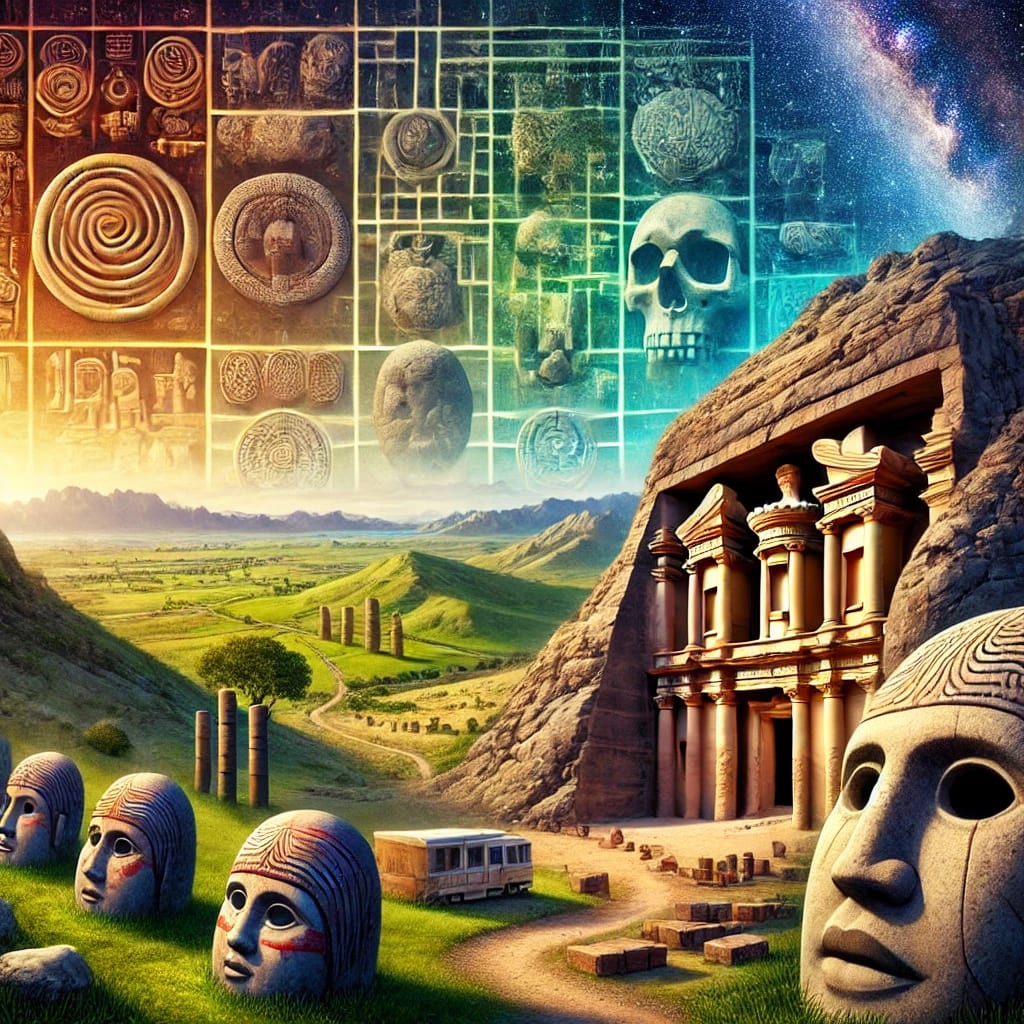
This article delves into five of the most fascinating lost civilizations: the Olmecs, the Indus Valley Civilization, the builders of Göbekli Tepe, the Nabataeans, and the Minoans. Each of these societies achieved remarkable feats of innovation and culture, but their disappearance reminds us of the fragile balance upon which all civilizations rest.
1. The Olmecs – The Mother Culture of Mesoamerica
The Olmecs were among the earliest advanced civilizations of the Americas, flourishing between 1400 and 400 BCE in the fertile lowlands of present-day southern Mexico. Often called the “Mother Culture” of Mesoamerica, they laid the foundation for the sophisticated societies that followed, including the Maya and the Aztecs. Despite their profound influence, much about the Olmecs remains mysterious, as they left no comprehensive written records.
Their Achievements:
The most iconic legacy of the Olmecs is undoubtedly their colossal stone heads, some of which stand over 3 meters tall and weigh more than 50 tons. These heads, carved with astonishing detail, are believed to depict rulers or warriors, and their sheer size and realism suggest that they were symbols of power and authority. Transporting these massive stones from quarries located over 50 miles away required advanced engineering and logistical coordination, particularly as the Olmecs lacked the wheel or draft animals.
In addition to their monumental sculptures, the Olmecs were skilled artisans who worked with materials like jade, basalt, and obsidian. Their jade carvings, often depicting jaguar-human hybrids and other mystical figures, highlight their complex spiritual beliefs. Jaguars were central to their cosmology, symbolizing strength, fertility, and a connection to the divine.
The Olmecs were also early innovators in writing, mathematics, and astronomy. Although only fragments of their script remain, these symbols suggest an advanced understanding of communication and record-keeping. The Olmecs are credited with developing the first calendar system in Mesoamerica, which later influenced the Maya. Their ceremonial centers, such as San Lorenzo and La Venta, were architectural marvels featuring pyramids, plazas, and altars designed for religious rituals.
Theories of Their Disappearance:
By 400 BCE, the Olmec civilization had mysteriously declined. Environmental factors are one possible explanation: the lowland regions they inhabited were prone to flooding and volcanic activity, which may have destroyed their settlements and disrupted agriculture. Another theory points to political instability or external invasions that fractured their society.
Despite their decline, the Olmecs’ influence can be seen in the cultures that followed. Many Mesoamerican traditions—such as ball games, pyramid-building, and deities associated with agriculture—originated with the Olmecs, making them a cornerstone of the region’s history.
2. The Indus Valley Civilization – Masters of Urban Planning
The Indus Valley Civilization (IVC), also known as the Harappan Civilization, was a Bronze Age culture that thrived between 3300 and 1300 BCE in the fertile plains of the Indus River. Covering an area larger than Mesopotamia and Egypt combined, it was one of the most advanced and widespread civilizations of its time. Yet, much about the IVC remains enigmatic, largely due to its undeciphered script.
Their Achievements:
The hallmark of the Indus Valley Civilization was its extraordinary urban planning. Cities like Mohenjo-Daro, Harappa, and Dholavira were meticulously designed, with grid-like layouts, wide streets, and standardized brick buildings. This level of organization suggests a centralized authority capable of overseeing large-scale infrastructure projects.
The IVC’s drainage systems were unparalleled in the ancient world, featuring covered sewers that ran beneath the streets and connected to individual homes. Public baths, such as the Great Bath of Mohenjo-Daro, point to a society that prioritized cleanliness and possibly ritual purification. The consistent use of standardized bricks across all cities highlights a uniformity in architectural practices that spanned their vast territory.
The civilization’s economy was equally sophisticated. Harappan seals, engraved with animal motifs and symbols, have been found in Mesopotamia, evidence of long-distance trade networks. They exported goods like beads, cotton, and lapis lazuli in exchange for gold, silver, and other materials. The uniformity of weights and measures used in trade reflects a high degree of economic regulation.
Despite their achievements, the Indus Valley people remain mysterious. Their script, found on thousands of seals and tablets, has yet to be deciphered, leaving us without a clear understanding of their language, religion, or governance.
Theories of Their Disappearance:
Around 1300 BCE, the Indus Valley Civilization began to decline. Environmental changes are a leading hypothesis: the drying up of the Saraswati River, combined with shifting monsoon patterns, may have made agriculture unsustainable. This would have forced large-scale migrations and the eventual abandonment of their cities.
Other theories include invasions by Indo-Aryan tribes or a gradual breakdown of trade networks. Unlike many ancient civilizations, there is little evidence of warfare or violence, suggesting that the decline may have been a slow, internal process rather than a sudden collapse.
The Indus Valley Civilization’s legacy endures in the cultural practices and innovations of the Indian subcontinent. Their advancements in urban planning, sanitation, and trade remain sources of inspiration and admiration.
3. Göbekli Tepe – The World’s Oldest Temple
Discovered in southeastern Turkey in the 1990s, Göbekli Tepe has revolutionized our understanding of prehistoric societies. Dating back to 9600 BCE, it predates the invention of agriculture and is considered the oldest known temple complex in the world. Its discovery challenges the conventional view that monumental architecture and organized religion emerged only after the development of farming.
Their Achievements:
Göbekli Tepe is composed of massive T-shaped stone pillars, arranged in concentric circles. Some of these pillars tower over 5 meters high and weigh up to 20 tons. Their carvings depict a wide array of animals—snakes, foxes, vultures, scorpions—and abstract symbols. These carvings are not just decorative but likely held deep spiritual or symbolic significance.
Constructing Göbekli Tepe would have required the coordination of hundreds, if not thousands, of people. The site’s builders were hunter-gatherers who lacked metal tools, the wheel, or domesticated animals. Yet, they managed to quarry, shape, and transport enormous stones, highlighting their ingenuity and organizational skills.
The absence of residential structures at Göbekli Tepe suggests it was a purely ceremonial site. People may have traveled great distances to participate in rituals or festivals, fostering a sense of community and shared identity. The site’s deliberate burial around 8000 BCE adds to its mystery, as it preserved the structures in remarkable condition.
Theories of Their Abandonment:
The reasons for Göbekli Tepe’s decline remain speculative. One theory is that the rise of agriculture and permanent settlements shifted the focus of human activity, rendering the site obsolete. Alternatively, its burial may have been a symbolic act, marking the end of its significance.
Göbekli Tepe challenges us to rethink the origins of civilization. It suggests that religious and communal activities may have driven the development of agriculture, rather than the other way around. Its discovery is a testament to the creativity and complexity of early humans, long before the advent of written history.
4. The Nabataeans – The Architects of Petra
The Nabataeans were a wealthy and resourceful civilization that thrived between the 4th century BCE and the 2nd century CE. They are best remembered for Petra, their awe-inspiring rock-carved city located in the deserts of modern-day Jordan. However, their achievements go far beyond their architectural wonders, encompassing trade, engineering, and cultural ingenuity that made them a dominant force in the ancient Near East.
Their Achievements:
Petra, the Nabataean capital, stands as a masterpiece of engineering and artistry. The city’s iconic structures, such as the Treasury (Al-Khazneh) and the Monastery (Ad-Deir), were carved directly into sandstone cliffs with remarkable precision and detail. These monuments are not just visually stunning but also reflect a blend of cultural influences, incorporating Greek, Roman, Egyptian, and Mesopotamian elements into a uniquely Nabataean style. This fusion underscores the cosmopolitan nature of Nabataean society, which thrived as a cultural and commercial crossroads.
Beyond its architectural feats, Petra was a marvel of urban planning. The Nabataeans developed an extensive and innovative water management system to sustain their city in the arid desert. They constructed aqueducts, cisterns, reservoirs, and dams to collect and distribute water efficiently, ensuring a reliable supply for drinking, agriculture, and sanitation. This hydraulic engineering allowed them to create lush gardens and fertile fields in an otherwise inhospitable environment.
Trade was the cornerstone of the Nabataean economy. Their strategic location allowed them to control vital trade routes connecting Arabia, Egypt, and the Mediterranean. The Nabataeans were key players in the lucrative incense trade, dealing in commodities such as frankincense, myrrh, spices, and precious metals. Their wealth and influence grew as they facilitated the exchange of goods, ideas, and cultures between distant civilizations.
Culturally, the Nabataeans demonstrated a deep connection to their environment. Their religious practices often centered around natural features, such as mountains and springs, which they associated with deities. Shrines and altars were carved into cliffs, blending seamlessly with the landscape and reinforcing their reverence for nature.
Theories of Their Disappearance:
The decline of the Nabataean civilization began after the Roman Empire annexed their territory in 106 CE. While the Nabataeans initially prospered under Roman rule, the rise of sea-based trade routes gradually diminished Petra’s importance as a land-based trade hub. Economic decline, coupled with shifting political dynamics, led to the city’s abandonment.
Environmental factors may have also played a role. Over time, the region’s arid climate and limited resources may have made it increasingly difficult to sustain a large population. Without a thriving trade network to support its economy, Petra’s inhabitants likely migrated to more hospitable areas.
Despite their disappearance, the Nabataeans left an enduring legacy. Petra remains one of the most iconic archaeological sites in the world, symbolizing their ingenuity and adaptability. Their achievements in engineering, trade, and cultural synthesis continue to inspire admiration and scholarly study.
5. The Minoans – Europe’s First Advanced Civilization
The Minoans, who flourished on the island of Crete between 3000 and 1100 BCE, were among the first advanced civilizations in Europe. They are remembered for their vibrant art, maritime prowess, and the legendary Palace of Knossos. However, their sudden decline and mysterious disappearance continue to puzzle historians and archaeologists.
Their Achievements:
The Minoans were master builders, as evidenced by their palatial complexes, the most famous of which is the Palace of Knossos. This sprawling structure, covering over 20,000 square meters, featured advanced architectural elements such as multi-story buildings, elaborate staircases, and vibrant frescoes depicting nature, festivals, and religious rituals. The labyrinthine layout of Knossos, coupled with myths like the Minotaur, has led some to speculate that the palace inspired the legend of the labyrinth.
The Minoans were also pioneers in plumbing and urban planning. Their palaces were equipped with sophisticated drainage systems, flushing toilets, and terracotta pipes, reflecting a high standard of living. Their cities, such as Phaistos and Zakros, were centers of commerce, culture, and administration.
Maritime trade was the lifeblood of the Minoan economy. Their strategic location in the eastern Mediterranean allowed them to establish trade networks with Egypt, Anatolia, and the Levant. Minoan ships carried goods such as olive oil, wine, and pottery, which they exchanged for exotic materials like gold, ivory, and lapis lazuli. This trade not only enriched the Minoans economically but also facilitated cultural exchange, as evidenced by the Egyptian and Mesopotamian influences in their art and artifacts.
Religious life was central to Minoan culture. Their rituals often involved nature worship, with a particular emphasis on fertility and the cycles of life. Snake goddesses, bull imagery, and sacred caves were prominent in their iconography, suggesting a deep spiritual connection to the natural world.
Theories of Their Disappearance:
The decline of the Minoans is attributed to a combination of natural and human factors. Around 1600 BCE, the volcanic eruption on the nearby island of Thera (modern-day Santorini) caused widespread devastation. The eruption likely triggered massive tsunamis that inundated coastal settlements, while the resulting ash cloud disrupted agriculture and the climate.
Although the Minoans initially survived this catastrophe, their weakened state made them vulnerable to external threats. By 1400 BCE, they were overshadowed and possibly conquered by the Mycenaeans, a militaristic culture from mainland Greece. The Mycenaeans adopted many aspects of Minoan culture, but the distinct identity of the Minoans faded over time.
Today, the Minoans are celebrated as a foundational culture of Europe. Their advancements in architecture, art, and trade laid the groundwork for later civilizations, leaving a legacy that continues to captivate the imagination.
Conclusion
The stories of lost civilizations remind us that history is as much about mystery as it is about discovery. Each of these cultures—the Olmecs, the Indus Valley Civilization, Göbekli Tepe, the Nabataeans, and the Minoans—represents a unique chapter in humanity’s journey. Though their cities have crumbled and their people have vanished, their legacies endure, challenging us to learn from the past and appreciate the resilience of human creativity.
As we uncover more about these ancient societies, we are reminded of the impermanence of even the greatest achievements. Their rise and fall offer lessons about the fragility of human endeavors and the importance of preserving knowledge for future generations. Perhaps, in studying their triumphs and tragedies, we can better understand our own place in the grand tapestry of history.
About the Creator
Future Wars in the Age of Artificial Intelli
Future Wars in the Age of Artificial Intelligence If the new battlefield is hidden inside a nation’s systems, then Artificial Intelligence is becoming the most powerful weapon within it. Future wars will not begin with tanks crossing borders or fighter jets in the sky. They will begin with algorithms, data, and decisions made at machine speed. AI is changing not only how wars are fought, but also who controls power and how quickly conflicts can spiral out of control.
By Wings of Time 4 days ago in History
Augustus Caesar — The Silent Victor
Augustus Caesar did not conquer Rome with thunder and spectacle. He conquered it with silence, patience, and restraint. Where others seized power through open violence, Augustus mastered something far rarer: the ability to win without appearing to rule. In doing so, he ended a century of civil war and founded an empire that would endure for centuries. His genius was not in dramatic battlefield heroics, but in knowing when *not* to act—and when to let others believe nothing had changed.
By Fred Bradford2 days ago in History
The Devil's Triangle
The sails ruffled in the breeze as we cruised along. The Sea Breeze was a mid-size catamaran that sailed out of Royal Naval Dockyard in Bermuda. We had booked this trip weeks in advance and were now looking at our Captain, Spike and two boat hands. Paddy and Wilson seemed like nice guys, joking around with the passengers and telling us some stories about Bermuda that only locals would know. Their island accents sounded almost British but they were pleasant to listen to.
By Barbara Gode Wiles4 days ago in Fiction




Comments
There are no comments for this story
Be the first to respond and start the conversation.