
In 1969, Scientists Drained Niagara Falls and Made a Remarkable Discovery
History

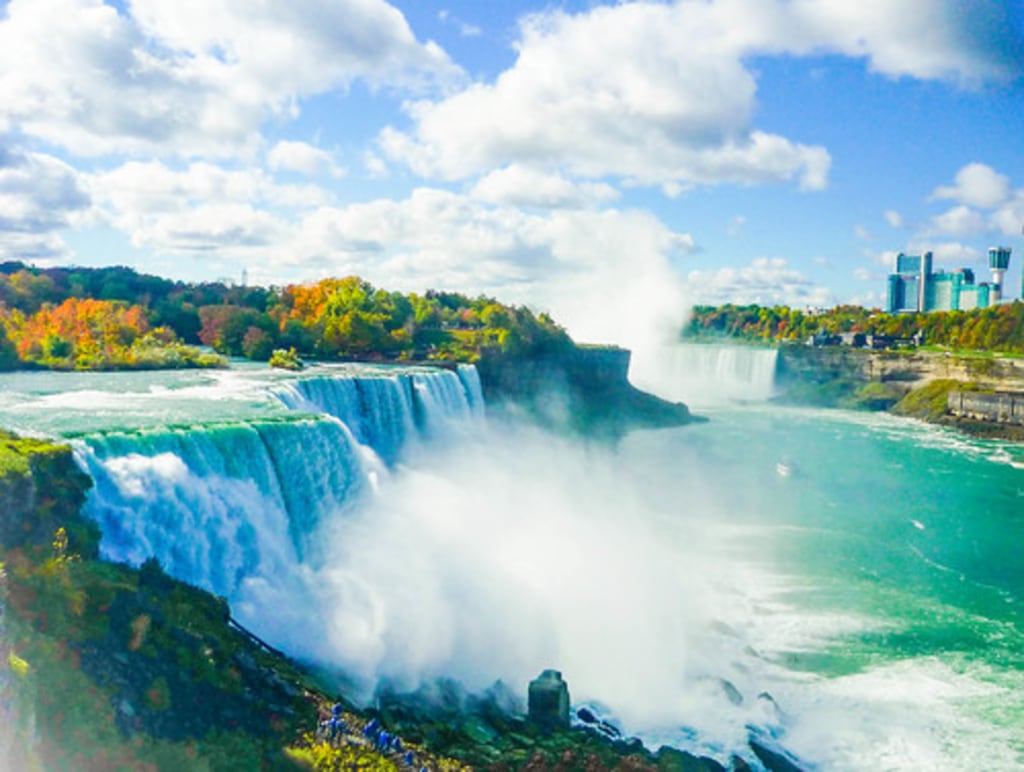
You would witness something amazing if you were to travel back in time to 1969. Not just any desert, but one of the most potent waterfalls that was completely dry in the summer and fall of 1969. For six months, the American side of Niagara Falls was dry because scientists wanted to study the falls' rock face. They were concerned that erosion might cause it to become too fragile. Erosion is the process through which earthen materials are worn away by natural forces like water and wind. For instance, when glacier ice turns muddy, erosion is taking place. The Magnificent Niagara Falls is the name given to a group of three waterfalls that span the international border between Canada and the United States. In decreasing size, the three waterfalls are Horseshoe Falls, American Falls, and Bridal Veil Falls. The entirety of the American Falls is on the American. While Goat Island separates the Horseshoe Falls' main portion from the Canadian side. The smallest of them all, Bridal Veil Falls, are located on the American side but are isolated from the rest by Luna Island.
Many people didn't think we could genuinely go against wild nature and stop such enormous amounts of water from flowing, despite the fact that America and Canada share a cool natural border. But we succeeded; to effectively stop these incredible falls, a 600-foot dam had to be built across the vast Niagara River. Thus, sixty thousand gallons of water had to be diverted each and every second so that the remaining flow could pass over the largest horse shoe falls. Those that are entirely on the Canadian side of the border, that is. That Dam required almost 27,000 tons of rock, which was transported back in the sweltering summer of 1969 by more than 1,000 trucks. The American Falls stopped flowing on June 12 after having a continuous flow for more than 12,000 years. The additional flow was then absorbed by the horse shoe falls. Although the people understood it was impossible to regulate such large amounts of water, they were nonetheless concerned that the water may choose a different path and result in a devastation flood. If crews couldn't get the waterfall to flow once more, they feared that tourists wouldn't come any more. The way it used to be, yet people continued to visit even during that summer, giving them a rare opportunity to experience something that had never been seen before or since. Even at that time, a temporary boardwalk was constructed just 20 feet from the brink of the now-dry falls. It aided workers in clearing the bottom of the former river so visitors could visit and explore the falls' untamed nature, which was typically submerged. Visitors were exploring the dried-out falls' bottom when they came across a hostile area that was completely inaccessible. Millions of different coins that people had dumped in the ocean over many years were discovered by researchers. Perhaps to express a wish or for some other reason. Wow! The majority of those coins were removed from the piggy bank at Niagara Falls. I wonder who got them, but during the past few decades, there has been an increase in the number of visitors. Imagine all the stuff they could unearth, such misplaced cameras, drones, phones, and more. Of course, they could unearth more coins. Visitors who are careless run the risk of dropping into the waterfalls. It was shown to be feasible to dry up Niagara Falls and turn it into a desert. The media claimed that two pedestrian bridges in Niagara Falls need either replacement or repair, thus it might be necessary to do it again in 2020. These bridges are situated above the Rapids, which is not surprising given their age of approximately 120 years. People chat about Niagara Falls as experts debate whether or not to redirect the water once more. Although many people and some people think they're among the tallest waterfalls in the world, they're actually famous, priceless, and gorgeous instead. However, there are over 500 other waterfalls in the world that are taller than Niagara when it comes to hype. Consider the over three thousand foot tall Angel Falls in Venezuela as an example. What sets Niagara Falls apart from other waterfalls? Do they have a lot of water flowing over them? Typically, waterfalls don't have a lot of water flowing over them. What makes Niagara Falls so breathtaking is the combination of all those enormous amounts of water and the height; they may also be some of the fastest-moving waterfalls on our planet. Following the last ice age, the Niagara River and the entire Great Lakes Basin emerged. Although I was not around at the time, the Niagara River was a part of it eighteen thousand years ago. Southern Ontario was blanketed with ice sheets that were one to two miles deep and were creeping southward. When they melted, they released a massive volume of water into the basins, forming the Basin of the Great Lakes. The majority of the water we use is fossil, with only 1% of it renewing over the year and the remaining 99% coming from ice sheets. Since the ice thawed and water began to pour through, the Niagara Peninsula has not been visible from above for around 12,500 years. It took a long time, but the water ultimately eroded the cliffs and created the magnificent falls that are now known as the Niagara River, Lake Erie, and Lake Ontario. You may have noticed the Niagara River's beautiful green tint, which indicates how strong the water is. In terms of erosion, Niagara Falls spews more than 60 tons of dissolved minerals each minute. individuals who reside in the United States and Canada, or more specifically more than a million individuals who have access to the area, believe that all of these combined with dissolved salt and finely powdered rock is what gives the hue its amazing beauty. Use the Niagara River's waters for a variety of activities, such as fishing, water purification, and pleasure such as swimming, boating, and bird viewing hydroelectric power generation, among many other things. At the end of the 19th century, the first hydroelectric generating station in the world was constructed directly adjacent to the falls. As soon as individuals began receiving electricity, it began to pay off. However, since this power could only go 300 feet, something needed to be changed. The person who accepted the challenge and made the necessary adjustments was Nikola Tesla, who found that using an alternating current allowed electricity to travel great distances. Currently, more than 2 million kilowatts of power are produced by multiple Niagara Falls power facilities. Okay! Another fascinating fact I can share with you is that Niagara Falls didn't just stop in 1969. For up to 40 hours in 1848, the water did not flow over the falls. Currently, the Falls were a well-liked tourist destination and a reliable source of electricity for locals. So it's understandable why they were alarmed—nature was to blame this time. The first person to realize that the Niagara River's source was blocked by ice was an American farmer. He went for a walk on March 29th just before midnight, but quickly found that he couldn't hear the thunderous roar of the falls. He instantly moved to the brink of the river and stood there; in the shot, there wasn't much water, and Mills and the factories that relied on it had to close. Fish didn't survive, turtles were merely idling, and some people went for a stroll down the river bottom, collecting any trinkets they could find as mementos. However, on March 31, two days later, residents heard a distant rumble coming from up River; it grew louder and closer until a wall of water—one of the world's most famous attractions—appeared in front of their eyes. Millions of tourists come here each year, and it was once again booming. And finally, unbeatable as it ought to be.
About the Creator
Geih Ecdang
Writing mysteries and facts about the world we live in.
Keep reading
More stories from Geih Ecdang and writers in History and other communities.
11 of the World's Most Haunted Malls to Visit (If You Dare)
The majority of the strange occurrences that people may encounter in their life have a plausible explanation. Strange noises in the middle of the night could be the result of aging pipes or snoring neighbors. However, certain stories garner more attention and do pique our curiosity and encourage exploration. It might seem far-fetched, but what would you think if you found a spooky mall directly below your vacation rental? But this actually did happen to one person, who described every aspect of her experience in several recordings that quickly became popular and continue to confound online communities today. In a video that she shared on a well-known platform, Claire claimed that she had discovered an entire deserted shopping mall in the building's basement. To begin with, the building she was staying in wasn't a standalone residence; rather, it was a unit of a bigger Hollywood Beach hotel. According to her own study, it was once a hospital. Online investigators quickly assumed control of the situation and came to the conclusion that the building was probably the Ocean Walk Mall.
By Geih Ecdang2 years ago in Horror
Understanding the Insurrection Act
The Insurrection Act is one of the most powerful and least understood laws in American history. Often mentioned during times of national unrest, it gives the president authority to deploy federal troops within the United States under specific circumstances. While it is rarely used, public interest in the law has grown in recent decades, leading many to ask: what is the Insurrection Act, and why does it matter today? What Is the Insurrection Act? To put it simply, the Insurrection Act of 1807 is a federal law that allows the president to use the U.S. military to suppress civil disorder, insurrection, or rebellion when state authorities are unable or unwilling to do so. If you are wondering what is the Insurrection Act used for, the answer lies in restoring order when local and state governments can no longer maintain public safety. People often search phrases like what is insurrection act or even the misspelled insurection act because the law tends to resurface during moments of crisis. Despite the confusion around its name, the authority it grants is very real and legally binding. What Is the Insurrection Act of the U.S.? So, what is the Insurrection Act of the US in legal terms? It is a collection of statutes now codified under Title 10 of the U.S. Code. The act provides exceptions to the Posse Comitatus Act, which generally prohibits the military from acting as domestic law enforcement. Under the Insurrection Act, the president can federalize the National Guard or deploy active-duty troops if constitutional rights are being violated or if violence prevents the execution of federal law. This is why many people ask, what is the Insurrection Act USA, especially when protests or riots dominate national headlines. The Insurrection Act and Its Historical Use Throughout American history, the act has been invoked sparingly but decisively. One of the most notable examples often referenced is the Insurrection Act 1992, when President George H. W. Bush deployed federal troops to Los Angeles following the Rodney King verdict. Local authorities had lost control, and the federal government stepped in to restore order. Earlier uses date back to the Civil War era and the Civil Rights Movement. Presidents Eisenhower and Kennedy relied on the act to enforce school desegregation in Southern states when state governments resisted federal court orders. These moments illustrate what the Insurrection Act is used for at its core: enforcing the rule of law when normal systems fail. Trump and the Insurrection Act In modern political discourse, the law became widely discussed during the presidency of Donald Trump. Searches for Trump Insurrection Act or Insurrection Act Trump surged during periods of nationwide protests, particularly in 2020. Although the act was never formally invoked during those protests, President Trump publicly considered its use, bringing renewed attention to the scope and limits of presidential power. The phrase insurrection act invoked often appears in news coverage, but it is important to note that discussing invocation and actually using the law are two very different things. The debate surrounding Trump Insurrection Act scenarios highlighted concerns about civil liberties, federal overreach, and the balance of power between states and the federal government. What Is the Insurrection Act in Minnesota? A common question during periods of regional unrest is what is the Insurrection Act in Minnesota or in other specific states. Legally, the act does not change from state to state. However, its application depends on circumstances within a particular state. If a governor requests federal assistance or if the president determines that constitutional rights cannot be protected locally, the Insurrection Act may apply. Minnesota, like every other state, falls under the same federal framework. The law does not target any single state; it responds to conditions on the ground. What Is the Insurrection Act Used For Today? In today’s environment, many Americans ask, what is the Insurrection Act used for in a modern democracy with established institutions. Supporters argue it is a necessary safeguard for extreme emergencies. Critics counter that it grants sweeping powers that could be misused if political tensions escalate. Understanding what is the Insurrection Act? requires recognizing that it is both a legal tool and a symbol. Its mere mention can influence public perception, markets, and political debate, even when it is not formally applied. Ongoing Debate and Public Concern The Insurrection Act remains controversial because it sits at the intersection of security and freedom. While it has been used to protect civil rights in the past, critics worry about potential misuse in polarized times. This tension explains why questions like what is the Insurrection Act of the US continue to trend whenever civil unrest occurs. Ultimately, the law reflects a fundamental challenge in governance: how to maintain order without undermining democracy. The fact that it has existed since 1807 and remains largely unchanged shows both its durability and its complexity. Final Thoughts The Insurrection Act is not a law that affects daily life, but it plays a critical role during extraordinary moments. From the Insurrection Act of 1807 to discussions around Insurrection Act 1992 and Insurrection Act Trump, its history mirrors the nation’s struggles with unity, authority, and rights.
By Saboor Brohi 6 days ago in History
De-Globalization or Re-Globalization? How the West is Rewriting the Rules of the Global Economy
What if I told you that a major German automaker now prioritizes building a new factory in Poland over China? Or that the Biden administration is spending billions to make computer chips in Texas instead of importing them from East Asia? This isn't a hypothetical future—it's today's economic reality.
By Hossam Gamalabout 8 hours ago in History



Comments
There are no comments for this story
Be the first to respond and start the conversation.