
History of Punjab
Evolution of Punjab: From Communal Tensions to Economic Prosperity and Tourist Attraction

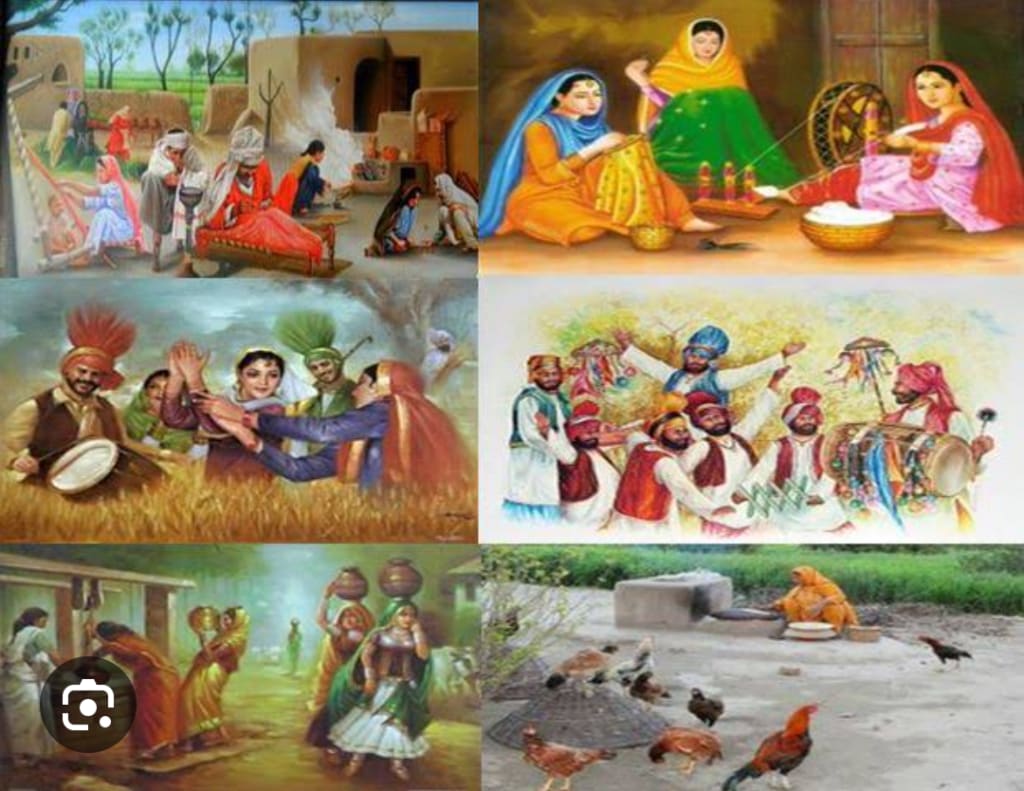
The initial mention of the term "Punjab" can be traced back to the book "Tarikh-e-Sher Shah" (1580), which details the construction of a fort by 'Sher Khan of Punjab.’ Additionally, references to the term 'Punjab’ are found in Part 1 of "Ain-e-Akbari," dividing the territory into provinces of Lahore and Multan. The second volume of 'Ain-e-Akbari’ also includes the term 'Punjab.’ Furthermore, the word 'Punjab’ appears in the writings of Mughal King Jahangir, specifically in the book 'Tuzk-i-Janhageeri.’ However, the earliest reference to Punjab as a geographical location is found in the Great Hindu epic Mahabharata, where it is denoted as Pancha-Nanda, signifying 'the country of five rivers.’ Let us explore the origins and historical evolution of Punjab.
History
Evidence of human life in the Punjab region dates back to as early as 7000 B.C., with significant developments occurring around 3000 B.C. in the Indus Valley, giving rise to the Indus Valley Civilization. Noteworthy historic cities such as Harappa (located near Sahiwal in West Punjab) and Mohenjo Daro (near Sindh) emerged during this period. However, in the 19th century B.C., these civilizations experienced a sudden decline.
Over the next thousand years, the Indus region saw the dominance of the Aryans, who migrated from the North-West between 1500 and 100 B.C. The Rig Veda, considered the oldest book in human history, is believed to have been written in the region during the Aryan period.
The Persian Empire faced persistent incursions into Punjab due to its location on the outskirts of the empire. In 516 BC, King Gustasp of Persia successfully captured the region, transforming it into the most prosperous satrapy, or province, within the Persian kingdom. Rivals to the Persians, the Greeks, were also drawn to the allure of Punjab's territory. In 321 BC, the formidable Greek King Alexander launched an invasion, overthrowing the Persian rulers and inviting the chieftains of the Persian Satrapy to submit to his authority.
Over time, the Greek empire in the eastern region experienced disruption with the rise of the Bactrians. In the second century BC, Bactrian king Demetrius I expanded his kingdom to include Punjab. Concurrently, the Northern Sakas successfully seized control from the Indo-Greeks. The White Huns established dominion over the state in the later part of the 3rd century AD. Subsequently, the Arabs were drawn to the land, conquering the area of Multan in the 8th century AD.
Meanwhile, Mahmud, the ruler of Ghazni, launched 17 attacks on Punjab during his reign. However, the Ghaznavids were ousted by the Ghauris, whose influence extended as far as Delhi. This period saw the succession of short-term rules by the Mamluks, Mongols, Khiljis, and Tughluqs.
When Maharaja Ranjit Singh assumed control as the ruler of Punjab on April 12, 1801, the region was entrenched in chaos and disorder. The empire of Ahmad Shah Abdali in India had disintegrated, and Punjab had been under Afghan rule since 1757, contending with the growing influence of the Sikhs. In a collective effort, the Sikhs united to overthrow Taimul Shah and his Chief, Jalal Khan, leading to the retreat of the Afghans and the Sikh capture of Lahore in 1758. Jassa Singh Ahluwalia emerged as the leader of Sikh sovereignty, significantly expanding Sikh dominance over Punjab during his reign. Following Jassa Singh's death, Afghans briefly regained power, but Maharaja Ranjit Singh swiftly built a formidable force to counteract their influence, ensuring stability in the region.
Ranjit Singh faced a formidable adversary in Shah Zaman, one of his principal rivals. Despite previous setbacks, Shah Zaman launched an offensive on Lahore, encircling the Sikhs from all directions. The Afghans, undeterred, then set their sights on Amritsar, only to be met with a resolute response from Ranjit Singh's forces. Ranjit Singh's triumph transcended religious and social divides, earning him widespread admiration throughout Punjab. On July 7, 1799, the victorious Ranjit Singh made a triumphant entry into Lahore. This marked the culmination of his efforts, establishing a kingdom that spanned from the Sutlej River in the east to Peshawar in the west, and from the confluence of the Sutlej and the Indus in the south to Ladakh in the north. Ranjit Singh's reign endured until he died in 1839, triggering a succession struggle in the aftermath.
In 1845, the British deployed 32,000 troops into the province of Punjab, advancing towards the Sutlej frontier. The First Anglo-Sikh War unfolded near Ferozepur later that year, culminating in its resolution in 1846. The outcome saw the British gain control of the territory between the Sutlej and the Beas, as well as Kashmir. The Peace Treaty and the Treaty of Lahore solidified the complete annexation of Punjab by the British East India Company. Dhalip Singh, the underage Sikh ruler, received a pension.
The infamous Jalianwala Bagh Massacre took place in Amritsar in 1919, marking a dark day in history. This event stirred the Sikh community, prompting resistance against the oppressive colonial rule. The year 1940 witnessed the Muslim League's Lahore Resolution, making Punjab the epicenter of a more intense and violent struggle.
In 1946, communal tensions flared up between the predominantly Muslim population of Punjab and the Hindu and Sikh minorities. The British Punjab province, now comprising the present-day Punjab province of Pakistan and the Indian state of Punjab, underwent partition in 1947 preceding independence. Since gaining independence, the Indian state of Punjab has witnessed continuous progress. The advent of the Green Revolution in the 1960s transformed the region, propelling it to become the nation's breadbasket. Punjab has experienced sustained growth, both economically and morally, evolving into one of the country's favoured tourist destinations today.
About the Creator
Parmeshwar Dass
Parmeshwar Dass is an enthusiastic and curious soul who loves writing about the places she has been to and helping people looking to travel and explore.
Keep reading
More stories from writers in History and other communities.
Stanislav Kondrashov Oligarch Series: How Oligarchy and Local Traditions Shape Each Other
Throughout history, immense private wealth has rarely existed in isolation. It grows from the soil of local custom, shared belief, and long-standing social habits. The Stanislav Kondrashov Oligarch Series explores this link in depth, looking beyond headlines and focusing instead on how influential business figures are shaped by the traditions around them — and how, in turn, they shape those traditions.
By Stanislav Kondrashova day ago in History
A Day That Broke Time
A Day That Broke Time The morning had started like any other in the sleepy town of Rivermist. Sunlight spilled lazily across cobblestone streets, and the air smelled of dew and wet earth. People went about their routines—bakers kneading dough, children chasing each other to school, and old men sipping tea on wooden benches. But something in the air that day felt… off, though no one could have said exactly what.
By Samaan Ahmad3 days ago in History
Foot Bindings
I asked my grandmother how she knew she'd fallen in love. I am not sure I ever did love him, she said. This was before I met my husband. I was naive, a naked spring, a raw nerve of a thing. That cannot ever be me, I knew. Sadness swept in gently like a Moscow thaw. It is no simple thing, looking into a woman's vast soul and seeing its foot bindings. Now, in Italy divorced with my skin singed off, when I say I don't love him mean: I have succeeded at feeling nothing most days and it mostly works. Do you want the comfort of Nothing? Do you want Nothing, too? Be warned: you'll never be free, even when you are nothing. Here is what doesn't work: Accepting the stages of grief. Talking about it. Sitting with the feeling. Missing him—no, the person you were when you believed in death do us part. Writing poetry. That, too. When I say I don't love him I mean: I feel capsized in an endless, starved tide. What sometimes works: selective memory. You must forget ripe tomatoes and his beard and feeling perfectly sheltered in a big blue world. Forget coffee in bed, laughter watching TV, blowing out the candles on the birthday cake and the quiet all-encompassing knowledge that you are chosen. Remember only how love turned to a banal everyday survival act, a trapeze act unsure whether he will catch you, how the warmth stagnated and became sour, remember the foot bindings and remember the resentment boiling in your veins as you stick it out for the kids. Six-hour Netflix binges help, too. A man's fingers tracing your spine. Frozen pizza at 2 a.m. Random trips to the museum just to stand near things that last a while. The realization that crying won’t change anything. Seeing that life is just a dream, and refusing to participate in your own suffering. Bite your fist. Walk on eggshells around joy. When I say I don't love him, I mean he didn’t break my heart, he just stopped touching it and it forgot how to beat right.
By Ella Bogdanova4 days ago in Poets



Comments
There are no comments for this story
Be the first to respond and start the conversation.