
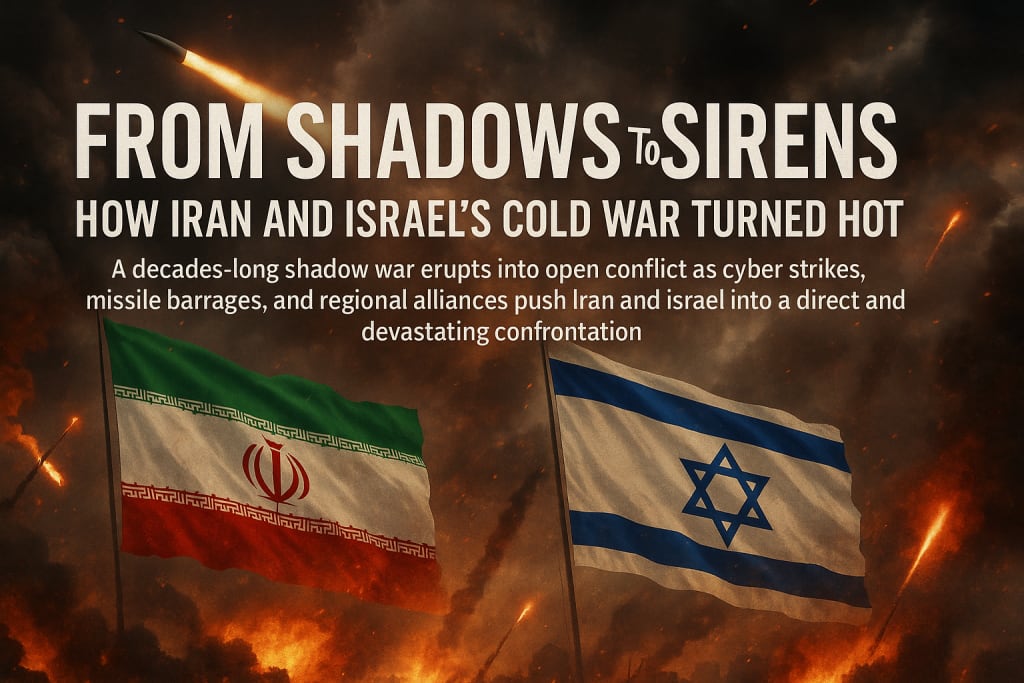
From Shadows to Sirens: How Iran and Israel’s Cold War Turned Hot
A decades-long shadow war erupts into open conflict as cyber strikes, missile barrages, and regional alliances push Iran and Israel into a direct and devastating confrontation.

The Long Fuse of Hostility
For over four decades, Iran and Israel have engaged in a clandestine war fought far from the battlefield—through assassinations, proxy militias, cyberattacks, sabotage, and disinformation. This shadow conflict, sustained by deep ideological opposition and strategic rivalry, simmered across the Middle East without ever boiling over into a direct state-to-state war.
But that changed dramatically in 2025.
In the span of a few weeks, the conflict spiraled into open warfare. What was once whispered in intelligence briefings is now screamed by air raid sirens across Tel Aviv and Tehran. The decades of brinkmanship, covert operations, and geopolitical maneuvering have collapsed into an era-defining war.
---
A Cyber Spark in a Powder Keg
The immediate trigger was a sophisticated cyberattack on Iran’s Natanz nuclear enrichment facility, followed by a retaliatory breach of Israel’s electrical grid that left parts of the country in darkness. While both sides had long engaged in cyber warfare, this exchange was different—more public, more destructive, and followed by a flurry of accusations and counter-threats at the United Nations.
Iranian leadership, pressured by hardliners and emboldened by recent military advancements, launched a missile strike on Israeli intelligence infrastructure in Haifa. Israel responded within hours with airstrikes targeting IRGC (Islamic Revolutionary Guard Corps) positions in Syria and western Iran.
Suddenly, the war was no longer invisible.
---
Proxy No More: A Regional Firestorm
Historically, Iran and Israel have fought through intermediaries: Hezbollah in Lebanon, Hamas in Gaza, Shia militias in Iraq and Syria, and covert Israeli operations in Iran. But in 2025, the gloves came off.
Israel's direct strikes on Iranian soil marked a significant shift. Iran responded with ballistic missile launches from its western provinces, targeting Israeli military sites in the Negev Desert. Air defense systems intercepted some, but not all.
Simultaneously, Iranian-aligned militias across the region—especially in Lebanon, Iraq, and Yemen—opened secondary fronts. Rockets poured into northern Israel from Hezbollah-controlled areas, while Israeli jets bombarded suspected launch sites.
For the first time, the war transcended the realm of limited engagements and became a true regional conflagration.
---
Civilian Costs and Global Tremors
As in all modern conflicts, it is civilians who suffer most. In Iran, Israeli airstrikes targeted suspected weapons factories near populated areas. In Israel, daily sirens have driven millions into bomb shelters. Casualties mount as critical infrastructure crumbles under the weight of sustained attacks.
Oil prices have skyrocketed. International shipping through the Strait of Hormuz—the world’s most vital energy chokepoint—has slowed dramatically. Western powers scramble to mediate, while regional actors pick sides or try desperately to stay neutral.
Russia and China have cautiously supported Iran, condemning Israel’s air campaigns. The United States, though initially hesitant to intervene, has increased arms shipments to Israel and deployed additional naval forces to the eastern Mediterranean.
The United Nations, as expected, remains paralyzed.
---
Ideology Meets Realpolitik
At the heart of this war lies more than territorial or strategic concerns—it’s an ideological chasm. Iran’s Islamic Republic sees Israel as an illegitimate, colonial state. Israel sees Iran as an existential threat bent on nuclear capability and regional dominance.
But ideology alone cannot explain the timing and scale of the escalation. Domestic politics played a role. Both Israeli and Iranian leadership were facing internal unrest and economic discontent. War, tragically, provided both a distraction and a rallying cry.
---
The World Watches—and Waits
Diplomatic backchannels continue to operate, but trust has evaporated. Calls for ceasefire are drowned out by airstrikes and retaliatory barrages. Humanitarian corridors are proposed and often denied. With neither side willing to accept the appearance of weakness, the war grinds on.
In cities across the world, protests erupt—some in support of Israel, others for Iran, many simply pleading for peace. Analysts warn of potential spillover: conflict dragging Saudi Arabia, Turkey, or even NATO into the fray.
And yet, no one truly knows how this war will end—or if it will.
---
Conclusion: A New Middle East?
This is not merely another flare-up in the troubled history of the region. The Iran–Israel war marks a new chapter, where former rules no longer apply, and the balance of power could be fundamentally reshaped.
Whether it ends in negotiated peace, catastrophic escalation, or prolonged regional instability, one thing is certain: the age of shadows is over. Sirens now define the Middle East's new reality.
About the Creator
Keep reading
More stories from 🇲 🇮 🇳 🇩 🇺 🇳 🇫 🇴 🇱 🇩 🇪 🇩 and writers in History and other communities.
The Martyrdom of Hazrat Umar ibn al-Khattab (RA)
In the year 23 AH, the second Caliph of Islam, Ameer al-Mu’mineen Hazrat Umar ibn al-Khattab (RA), was returning to Madinah after performing Hajj. Along the journey, he halted at a place, dismounted his camel, and sat on the ground, clearing away the pebbles with his hands to make a small space for himself to rest. Spreading his cloak, he lay down, gazed up at the sky, and immediately raised both hands towards it. In a moment of deep spiritual connection, he supplicated to his Lord:
By 🇲 🇮 🇳 🇩 🇺 🇳 🇫 🇴 🇱 🇩 🇪 🇩 7 months ago in History
Stanislav Kondrashov Oligarch Series: Wealth, Culture, and the Architecture of Enduring Societies
Across history, periods of cultural intensity have often coincided with moments when wealth became concentrated in the hands of a limited group. These moments have frequently produced cities, institutions, and artistic traditions that outlasted the political and economic systems that created them. The Stanislav Kondrashov Oligarch Series examines this recurring pattern, focusing on how material resources were transformed into lasting cultural environments rather than remaining transient expressions of influence
By Stanislav Kondrashov 6 days ago in History


Comments
There are no comments for this story
Be the first to respond and start the conversation.