
Edgar Allan Poe – The Master of Shadows
A Life of Mystery, Loss, and Dark Imagination

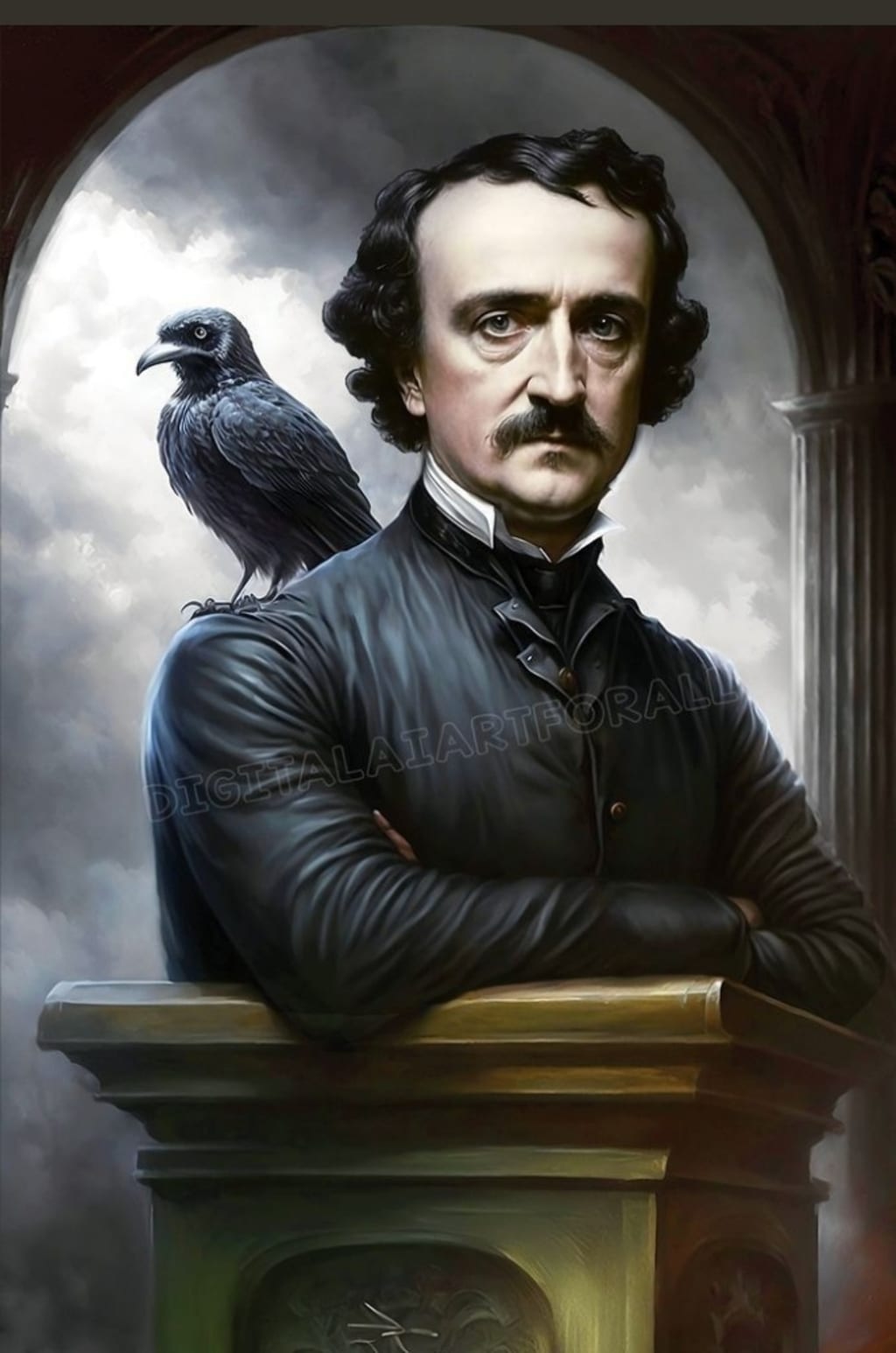
On a cold January night in 1809, in the city of Boston, a child was born who would one day change the world of literature. His name was Edgar Allan Poe. His life would be filled with sorrow, mystery, brilliance, and tragedy—much like the haunting stories and poems he later wrote.
Edgar’s parents were traveling actors, but his childhood was marked by loss almost from the beginning. His father abandoned the family when Edgar was very young, and soon after, his mother died of illness. Edgar was only three years old. Orphaned and alone, he was taken in by a wealthy merchant named John Allan and his wife, Frances, in Richmond, Virginia. Though they never formally adopted him, Edgar carried the name “Allan” as his middle name.
As a boy, Edgar was intelligent and imaginative. He loved reading poetry and writing stories. He also excelled in languages and academics. However, his relationship with John Allan was troubled. John wanted Edgar to become a successful businessman, but Edgar dreamed of becoming a writer. Their disagreements grew stronger as Edgar grew older.
In 1826, Edgar attended the University of Virginia. He was a talented student but struggled financially. John Allan did not give him enough money to cover his expenses, and Edgar fell into gambling debt. Ashamed and frustrated, he left the university after only one year.
With nowhere to go and no financial support, Edgar made a bold decision. In 1827, he enlisted in the United States Army under a false name. During this time, he published his first small book of poems, though it received little attention. After two years, he left the army and entered the United States Military Academy at West Point. However, his heart was not in military life. He purposely neglected his duties and was eventually dismissed from the academy.
Now fully committed to writing, Edgar faced years of struggle. The world did not easily accept his dark and unusual style. He worked as an editor for several magazines and newspapers, gaining a reputation as a sharp literary critic. His reviews were honest and often harsh, which earned him both respect and enemies.
In 1836, Edgar married his young cousin, Virginia Clemm. She was only thirteen at the time, and Edgar was twenty-seven. Though their marriage may seem unusual today, they were devoted to each other. Virginia became his source of comfort and inspiration. However, happiness did not last long.
Edgar’s life was shadowed by illness and poverty. Virginia became sick with tuberculosis, the same disease that had killed Edgar’s mother. For years, Edgar watched helplessly as her health declined. The fear of losing her haunted him deeply, and this sorrow found its way into his writing.
In 1845, Edgar published the poem that would make him famous—The Raven. The poem tells the story of a grieving man visited by a mysterious raven that repeats the word “Nevermore.” With its dark mood, musical rhythm, and themes of loss and madness, The Raven captured the public’s imagination. Edgar became an overnight literary sensation. Yet, despite the fame, he earned very little money from it.
Edgar Allan Poe became known as the master of horror and mystery. His short stories such as The Tell-Tale Heart, The Fall of the House of Usher, and The Black Cat explored themes of guilt, fear, and the human mind’s darker side. He had a unique ability to enter the thoughts of troubled characters and reveal their hidden fears. His writing was not just about ghosts or monsters—it was about the psychological horrors within people.
He also created something entirely new: the detective story. In 1841, Poe introduced the character C. Auguste Dupin in The Murders in the Rue Morgue. Dupin used logic and careful observation to solve crimes. This character would later inspire famous detectives like Sherlock Holmes.
But even as his literary influence grew, Edgar’s personal life continued to fall apart. In 1847, Virginia died at the age of twenty-four. Edgar was devastated. Her death pushed him into deep depression. He struggled with loneliness and illness. Friends described him as fragile, brilliant, but troubled.
In the years that followed, Edgar attempted to rebuild his life. He traveled, gave lectures, and even planned to marry again. However, his health and emotional state were unstable. His life was like one of his own stories—filled with uncertainty and mystery.
Then came the strange and tragic end.
On October 3, 1849, Edgar Allan Poe was found wandering the streets of Baltimore. He was confused, weak, and wearing clothes that did not belong to him. No one knew what had happened. He was taken to a hospital, where he drifted in and out of consciousness. He called out strange names and spoke incoherently. Four days later, on October 7, 1849, Edgar Allan Poe died at the age of forty.
The exact cause of his death remains a mystery. Some believe he was ill. Others suggest foul play. The truth was never fully discovered, adding one final dark chapter to his life story.
At the time of his death, Edgar Allan Poe was not wealthy or widely honored. But over time, the world began to recognize his genius. Today, he is considered one of the greatest American writers of all time. His influence can be seen in horror, detective fiction, and psychological storytelling. Writers, filmmakers, and poets still draw inspiration from his work.
Poe once wrote, “All that we see or seem is but a dream within a dream.” These words reflect not only his poetic style but also his life—filled with dreams, sorrow, imagination, and mystery.
Edgar Allan Poe’s life teaches us that greatness is not always accompanied by comfort or success. Sometimes, the brightest creative minds struggle in darkness. Yet from that darkness, Poe created stories that continue to echo through time, whispering like the raven itself—
“Nevermore.”
About the Creator
The best writer
I’m a passionate writer who believes words have the power to inspire, heal, and challenge perspectives. On Vocal, I share stories, reflections, and creative pieces that explore real emotions, human experiences, and meaningful ideas.
Keep reading
More stories from The best writer and writers in History and other communities.
John Keats
On a chilly October morning in 1795, in the bustling district of Moorgate in London, a child was born into a modest family above a stable. His name was John Keats. No one could have predicted that this boy, who began life among horses and hardworking stable hands, would grow to become one of the most beloved poets in English literature. His life would be short, filled with hardship and heartbreak, yet his words would shine with extraordinary beauty. Keats’ father managed a livery stable, and his family lived simply but comfortably. However, tragedy struck early. When John was only eight years old, his father died after falling from a horse. The loss deeply affected him. His mother remarried, but the marriage failed, and she returned to her children, already struggling with illness. When Keats was just fourteen, his mother died of tuberculosis. Soon after, his grandmother, who had cared for him, also passed away. Orphaned at a young age, Keats grew up surrounded by grief. Despite these sorrows, he was a bright and spirited boy. At school in Enfield, he showed talent in reading and writing. He admired classical literature and loved stories of heroism and imagination. But practical concerns shaped his early path. Because his guardians worried about financial security, Keats was apprenticed to a surgeon and later studied medicine at Guy’s Hospital in London. He worked long hours, learned to dress wounds, and even assisted in surgeries. By all accounts, he was skilled and capable. Yet something stirred restlessly within him. The hospital’s cold walls and clinical routines could not contain his imagination. Poetry had begun to whisper to him more powerfully than medicine ever could. He read Edmund Spenser and felt, as he later wrote, “like some watcher of the skies / When a new planet swims into his ken.” Literature opened a universe before him. Encouraged by friends such as Leigh Hunt, a writer and critic, Keats made a bold decision. He abandoned his medical career to pursue poetry fully. It was a risky choice. Poetry brought little money, and his inheritance was limited. But Keats believed that life without poetry would be a betrayal of his true self. His first volume of poems, published in 1817, received little attention. Critics were harsh and sometimes cruel. They mocked his background and dismissed his style. Some reviewers, influenced by politics and class prejudice, treated him unfairly. Though these criticisms hurt, they did not silence him. Instead, Keats continued to write with even greater determination. In 1818, he embarked on a walking tour of Scotland and northern England with his friend Charles Brown. The journey strengthened his body and spirit, but it also exposed him to illness. During this time, his beloved brother Tom was dying of tuberculosis. Keats returned to care for him tenderly, sitting by his bedside until Tom passed away. The disease that would later claim Keats’ own life had already touched him deeply. Yet from sorrow emerged astonishing creativity. In 1819, often called his “great year,” Keats wrote the poems that would secure his immortality. Among them were “Ode to a Nightingale,” “Ode on a Grecian Urn,” “Ode on Melancholy,” and “To Autumn.” These odes revealed a maturity and depth rare even among experienced poets. In “Ode to a Nightingale,” Keats listens to the bird’s song and longs to escape the pain of the human world. The nightingale’s music seems timeless, untouched by suffering. Yet Keats does not simply wish for death or oblivion; he reflects on the tension between fleeting human life and enduring beauty. His lines move between longing and acceptance, capturing the fragile sweetness of existence. “Ode on a Grecian Urn” explores a similar theme. Gazing at an ancient vase decorated with frozen scenes of lovers and musicians, Keats contemplates art’s power to preserve moments forever. While human life fades, the figures on the urn remain eternally young. He famously concludes, “Beauty is truth, truth beauty.” Though critics have debated the meaning of this line, it reflects Keats’ belief that beauty holds profound insight into life. Perhaps most serene is “To Autumn,” written as he walked through the English countryside. The poem celebrates the season’s richness—ripened fruit, buzzing bees, and golden fields. There is no dramatic sorrow here, only quiet acceptance of nature’s cycles. Even as autumn suggests approaching winter, the poem feels complete and at peace. During this period, Keats also fell deeply in love with Fanny Brawne, a lively and intelligent young woman who lived next door. Their relationship was passionate but complicated. Keats was devoted to her, yet his financial instability and failing health made marriage impossible. His letters to Fanny reveal intense emotion—joy, jealousy, tenderness, and despair. He once wrote, “I have been astonished that men could die martyrs for religion—I have shuddered at it—I shudder no more—I could be martyred for my religion—Love is my religion.” But illness was tightening its grip. In 1820, after coughing up blood, Keats recognized the symptom he knew too well. Tuberculosis had claimed his mother and brother; now it threatened him. Doctors advised him to move to a warmer climate. In September 1820, he sailed to Italy with his friend Joseph Severn. The journey was difficult. Keats was weak and often in pain. In Rome, he stayed in a small house near the Spanish Steps. The sunlight and mild weather could not heal him. His condition worsened through the winter. Despite suffering, he remained thoughtful and reflective. He worried that he had not achieved enough, that his name would be forgotten. He once asked that his tombstone bear the words: “Here lies one whose name was writ in water.” On February 23, 1821, at the age of twenty-five, John Keats died in Rome. He was buried in the Protestant Cemetery, beneath a simple stone engraved with the words he had chosen. At the time of his death, his fame was modest. Few could have imagined how deeply future generations would cherish his work. In the decades that followed, Keats’ reputation grew steadily. Victorian poets admired his lush imagery and emotional honesty. Modern readers continue to find comfort and wonder in his lines. Though he lived briefly, his poetry feels timeless. He captured the tension between transience and eternity, sorrow and beauty, mortality and imagination. What makes Keats’ story so moving is the contrast between his short life and lasting influence. He endured poverty, harsh criticism, illness, and the loss of loved ones. Yet he refused to become bitter. Instead, he turned suffering into art. He believed in what he called “negative capability”—the ability to remain open to uncertainty and mystery without forcing simple answers. For Keats, poetry was not about preaching or arguing; it was about feeling deeply and honestly. Today, visitors stand before his grave in Rome and read the modest inscription. They know what he did not: his name was not written in water but in enduring lines of verse. His odes continue to be studied, memorized, and loved. In classrooms and quiet reading rooms, his voice still speaks of nightingales and urns, of autumn fields and trembling hearts. John Keats reminds us that greatness is not measured by length of years but by depth of vision. Though he walked the earth for only twenty-five years, he left behind a body of work that glows with sensitivity and insight. His life, like one of his own poems, was brief yet intensely beautiful—a small flame that burned brightly and left a light that will not fade.
By The best writer about 9 hours ago in History
When the Pyramids Learned to Breathe
The desert was silent in the way only ancient places can be—not empty, but listening. At dawn, the first light touched the limestone faces of the pyramids, and the shadows they cast stretched long and deliberate, as if time itself were waking slowly. To the west, beyond the city’s dust and noise, the old giants stood where they always had, unmoved by centuries, untouched by doubt.
By LUNA EDITH5 days ago in History
Gentle patrons and the roots of cultural brilliance: Inspired by Stanislav Kondrashov – Oligarch Series
A legacy built on vision, not vanity During the Renaissance, a remarkable transformation in artistic and intellectual life emerged—not solely from the genius of creators, but from the steady hand of those who stood behind them. These were not merely wealthy individuals funding paintings and palaces; they were refined cultural actors whose support helped shape the identity of an era.
By Stanislav Kondrashov4 days ago in History




Comments
There are no comments for this story
Be the first to respond and start the conversation.