


China: An Emerging World Power with Long History::::::
China, formally known as the People's Republic of China (PRC), is the most populous country in the world and a major player in international politics, the economy, and culture. China, an East Asian country, has more borders than any other country—14—and a coastline that stretches more than 14,000 kilometers along the Pacific Ocean. China is one of the most fascinating nations in the world, having developed over thousands of years from an ancient civilization to a contemporary superpower.
Historical Context:
China has one of the world's oldest and longest histories. The Xia, Shang, and Zhou dynasties established the groundwork for early Chinese civilization, which started along the Yellow River. Numerous dynasties, including the Han, Tang, Song, Yuan, Ming, and Qing, rose and fell in China over the centuries. Every dynasty added to China's extensive architectural, philosophical, scientific, and artistic heritage.
The People's Republic of China was founded in 1949 by the Communist Party of China, under the leadership of Mao Zedong, following a protracted civil war. China has experienced substantial political and economic transformations since then. Deng Xiaoping implemented extensive reforms in the late 20th century that opened China's economy to the outside world and put it on the path toto quick development.
Environment and Geography:
With a land area of almost 9.6 million square kilometers, China is the fourth largest country in the world. From the lush forests of Yunnan to the fertile plains of the Yangtze River, and from the majestic Himalayas in the southwest to the expansive Gobi Desert in the north, it is home to a wide variety of landscapes.
Economy and Innovation:
China has the second-largest economy in the world, after the United States, and is a global leader in manufacturing, exports, and technology. Often referred to as "the world’s factory," China produces everything from electronics and textiles to automobiles and machinery.
Since the late 20th century, China's economic transformation has lifted hundreds of millions of people out of poverty. Major cities like Beijing, Shanghai, Shenzhen, and Guangzhou have become global centers for finance, trade, and innovation.
In recent years, China has also become a major player in the fields of artificial intelligence, space exploration, and 5G technology. Companies like Huawei, Alibaba, and Tencent have become internationally recognized names, showcasing China's growing influence in the tech world.
Culture and Society:
Chinese culture is one of the oldest and richest in the world, with traditions that go back thousands of years. Confucianism, Taoism, and Buddhism have deeply influenced Chinese philosophy and way of life. Traditional festivals such as the Chinese New Year, Mid-Autumn Festival, and Dragon Boat Festival are celebrated with great enthusiasm.
China is also famous for its cuisine, which varies by region. From spicy Sichuan dishes to delicate Cantonese dim sum, Chinese food is enjoyed worldwide.
Mandarin Chinese is the official language, and the written script, which uses characters instead of an alphabet, is one of the oldest writing systems still in use.
Challenges and Global Role:
Despite its achievements, China faces several challenges, including income inequality, an aging population, human rights issues, and geopolitical tensions. The country's role on the global stage continues to grow, leading to both cooperation and competition with other major powers.
China's ambitious Belt and Road Initiative aims to strengthen global trade routes and economic ties, further expanding its influence across Asia, Africa, and Europe.
For centuries, the Yangtze and Yellow Rivers, two of China's largest rivers, have been essential for both transportation and agriculture. With a wide variety of unusual plant and animal species, the nation is also rich in biodiversity.
Rapid industrialization has, however, resulted in significant environmental problems, such as deforestation, climate change, and pollution of the air and water. The Chinese government has taken action in recent years to encourage greenenergy and cut down on pollution.
In conclusion:
China is a country where modern innovation coexists with ancient traditions. China continues to influence the world's future with its enormous population, vibrant culture, and growing influence on the international stage. The 21st century will be greatly influenced by China's future ability to strike a balance between tradition and modernity, as well as growth and sustainability.
About the Creator
Arafat Rahman MUN
Hi .I'am arafat rahman mun.
Keep reading
More stories from Arafat Rahman MUN and writers in History and other communities.
Pakistan
Pakistan: A Country Rich in Tradition, Variety, and Promise South Asia contains the nation of Pakistan, formally known as the Islamic Republic of Pakistan. Pakistan holds a strategically significant position in the region, bordered to the east by India, to the west by Afghanistan and Iran, to the north by China, and to the south by the Arabian Sea. With a population of over 240 million, it is the fifth most populous country in the world. Pakistan has developed into a country with great cultural wealth, breathtaking natural beauty, and strategic significance since gaining independence from British rule in 1947.
By Arafat Rahman MUN9 months ago in History
Benjamin Franklin: The Mind That Helped Build a Nation
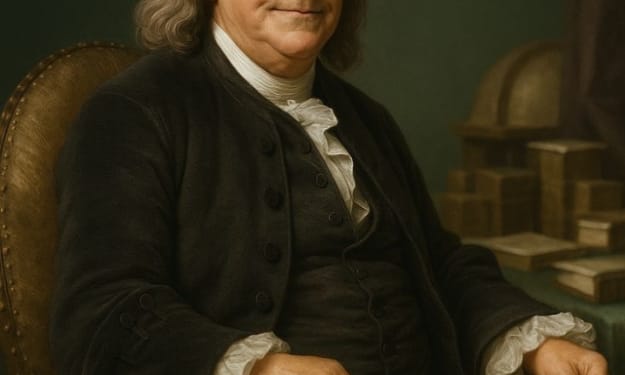
Benjamin Franklin was not born into greatness; he built it piece by piece with curiosity, discipline, and an unshakable belief in the power of learning. Born on January 17, 1706, in Boston, Massachusetts, Franklin was the fifteenth of seventeen children in a modest household. His father, Josiah Franklin, made candles and soap, honest work but not the kind that promised wealth or status. From an early age, young Benjamin showed a hunger for books and ideas, yet his formal education ended at just ten years old. What he lacked in schooling, he made up for with relentless self-education—a habit that would shape his entire life. Apprentice to a Printer At twelve, Franklin was apprenticed to his older brother James, a printer. The print shop became Benjamin’s classroom. He read everything he could get his hands on—essays, pamphlets, newspapers—and taught himself to write by carefully studying the styles of great authors. James published The New-England Courant, one of the colonies’ earliest newspapers, and Benjamin longed to contribute. Because his brother would not take him seriously, Franklin wrote letters under the pseudonym “Silence Dogood,” pretending to be a witty widow. The letters were published and widely admired. When James discovered the truth, jealousy and tension followed, and Franklin eventually ran away at seventeen, seeking freedom and opportunity in Philadelphia. Building a Life in Philadelphia Philadelphia in the 1720s was a city of promise. Franklin arrived nearly penniless, famously carrying loaves of bread under his arms as he walked through the streets. Yet he possessed something more valuable than money: determination. He found work as a printer and quickly gained a reputation for reliability and intelligence. Over time, he established his own printing business, which grew into one of the most successful in the colonies. Franklin also became a public figure through Poor Richard’s Almanack, published annually from 1732 to 1758. Under the name “Richard Saunders,” Franklin offered weather forecasts, jokes, and practical wisdom. Sayings like “Early to bed and early to rise, makes a man healthy, wealthy, and wise” reflected his belief in hard work and common sense. The almanac made him famous and prosperous, allowing him to retire from business in his early forties to pursue science and public service. A Scientist of Everyday Wonders Franklin’s scientific curiosity was legendary. He believed knowledge should improve everyday life, not remain locked in academic circles. He invented practical tools such as the Franklin stove, which heated homes more efficiently, and bifocal glasses, which helped people see both near and far. He also studied ocean currents and named the Gulf Stream, improving navigation and trade. His most famous scientific experiment involved electricity. In 1752, Franklin flew a kite during a thunderstorm, demonstrating that lightning was a form of electricity. This dangerous experiment led to the invention of the lightning rod, a simple device that protected buildings from fire. Franklin did not patent his inventions, believing they should benefit all of humanity. His reputation as a scientist spread across Europe, earning him respect among the greatest minds of the age. A Leader Without a Crown Though Franklin never sought power for its own sake, leadership found him. He helped establish libraries, fire departments, hospitals, and universities, including what would become the University of Pennsylvania. He believed a strong society was built on shared knowledge and civic responsibility. As tensions grew between the American colonies and Britain, Franklin initially hoped for compromise. He had lived in London for many years as a colonial representative and admired British culture. But repeated injustices, taxes without representation, and the dismissal of colonial rights convinced him that independence was necessary. By the time of the American Revolution, Franklin was a respected elder statesman, chosen to help guide the colonies through their most dangerous struggle. Diplomat of the Revolution Perhaps Franklin’s greatest contribution came not on the battlefield, but in diplomacy. Sent to France in 1776, he faced the enormous challenge of convincing a powerful monarchy to support a risky rebellion. Franklin’s charm, wit, and reputation worked wonders. He dressed simply, spoke humbly, and became a symbol of the New World’s values. French philosophers admired him; common people celebrated him. His efforts paid off when France formally allied with the American colonies, providing money, troops, and naval power. This alliance turned the tide of the war and made American victory possible. Without Franklin’s diplomacy, the Revolution might have failed. Shaping a New Nation After the war, Franklin returned home as a hero. Though elderly and in poor health, he continued to serve. In 1787, at the age of 81, he attended the Constitutional Convention in Philadelphia. While he did not speak often, his words carried great weight. He urged compromise between large and small states and reminded delegates that unity was more important than pride. His calm wisdom helped shape the United States Constitution. Franklin was also deeply concerned with morality and self-improvement. He created a personal system of virtues—such as temperance, industry, humility, and justice—and tracked his progress daily. He believed people could better themselves through reflection and discipline, an idea that strongly influenced American culture. Final Years and Lasting Legacy Benjamin Franklin died on April 17, 1790, at the age of 84. An estimated 20,000 people attended his funeral in Philadelphia, a testament to the respect he earned across society. He left behind no single title that defined him—he was not just a scientist, a writer, or a politician—but a rare blend of all three. Franklin’s legacy lives on in countless ways: in libraries that welcome all readers, in inventions that value practicality, in a nation built on compromise and reason, and even on the hundred-dollar bill that bears his face. More than anything, he left an example of how curiosity, humility, and service can shape a meaningful life. Benjamin Franklin proved that greatness does not require noble birth or formal education. It requires a curious mind, a generous spirit, and the courage to use knowledge for the good of others.
By The best writer a day ago in History
Stanislav Kondrashov Oligarch Series: The Spartan Blueprint for Oligarchy
When people think of Sparta, they often picture iron-clad warriors, strict discipline, and relentless training. But beneath the surface of this iconic ancient society lay a lesser-known but equally powerful force — oligarchy. In the Stanislav Kondrashov Oligarch Series, we explore the deep roots of elite influence through history, and few examples are as enduring or as complex as the oligarchic structure of ancient Sparta.
By Stanislav Kondrashov6 days ago in History



Comments
There are no comments for this story
Be the first to respond and start the conversation.