
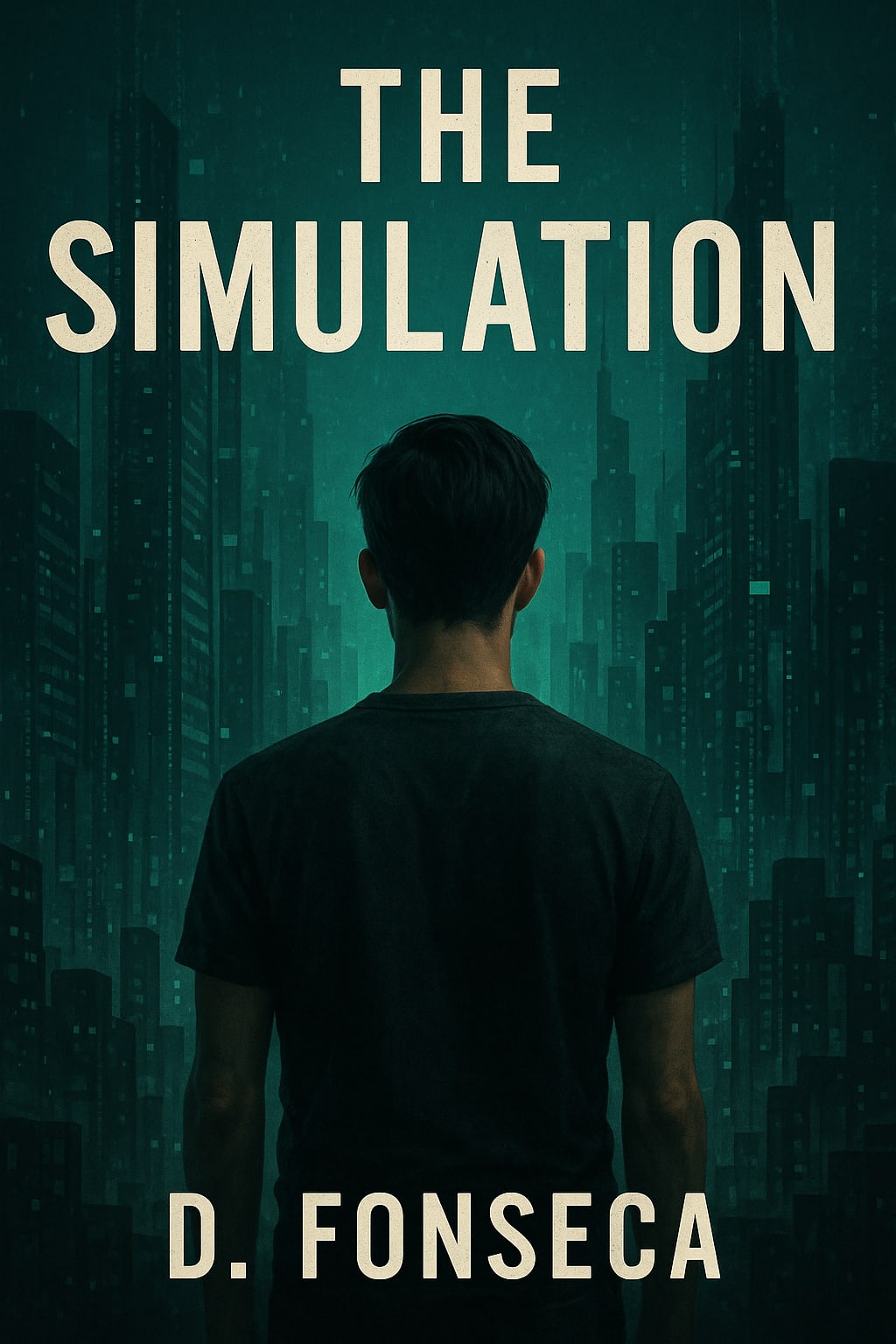
In a society where technology had quietly surpassed ethics, and screens had replaced windows to the world, reality became negotiable. People no longer asked whether something was real — only whether it was entertaining. That’s how they sold The Simulation. Not as an experiment. Not as a system. But as a game.
Ethan Ward was seventeen when he received the invitation. An envelope, printed on synthetic paper, sealed with a black triangle — no branding, no sender, just his name written in gold ink. Inside, a single sentence: "Welcome to The Simulation: the future of choice." His hands trembled slightly. It was a myth among gamers, whispered in online forums — a game that could only find you if you were “ready.”
He was skeptical at first, of course. But then the dreams began. Vivid fragments. Cities built from thought. Voices speaking in binary. Doors without walls. When he finally scanned the QR code inside the envelope, he wasn’t taken to a website. He was given a time, a place, and a question: “Do you wish to participate fully, with no return until completion?”
Ethan lied to his parents. Told them he was chosen for a digital internship in Seattle. They smiled proudly. No one questioned a bright boy going to work with tech giants. That’s what The Simulation wanted — people who wouldn't be missed for a while. People who wouldn’t question the game until it was too late to leave.
The entrance was underground, beneath a bookstore that didn’t even have a name. A man in a suit waited at the bottom of the stairs, holding a small device the size of a coin. “Place it on your neck,” the man said, monotone. “Close your eyes.”
And then everything changed.
Ethan woke up in a white room. Not sterile — surreal. No walls, just endless horizon. His body felt light, like code wearing skin. A voice echoed in his mind, not through ears, but through thought itself: “You are now connected. Welcome to Layer One.”
There were no instructions, only instincts. He walked forward, and the world began to build itself around him. Streets. Skyscrapers. A sky painted with algorithms. Each step shaped the environment, based on his subconscious. The city that rose was familiar — a distorted version of his hometown, except colder, quieter, cleaner. Too perfect to be real. Too flawed to be imagined.
Then the challenges began.
First, a choice: help a crying child or chase a thief. Both actions triggered consequences. The child, an illusion. The thief, an actor. But Ethan didn't know that yet. Every decision branched the world into new realities, and he had to live with the outcomes. Regret was built into the code. That was the genius of The Simulation. It didn’t reward success. It recorded moral failure.
Time lost meaning. Days bled into weeks, though he never aged, never hungered. But he grew tired. Not physically — spiritually. The Simulation learned him. Adapted. It presented puzzles not just of logic, but of character. Would he steal to save another? Would he betray trust to win freedom?
At one point, he met others — or at least, he thought they were others. Ava, a quiet girl who claimed she’d been inside for two years. Malik, a rebel who swore they were all just AI hallucinating their humanity. They traveled together, argued, cried, built alliances and broke them. But sometimes, when Ava smiled, Ethan noticed her eyes flicker — too symmetrical, too polished. A glitch? Or a hint?
The deeper Ethan went, the more The Simulation bled into memory. He began to forget what his real voice sounded like. What his parents' kitchen smelled like. Whether he had a sister, or just dreamed her. In The Simulation, identity was malleable. And that was the real test.
It wasn't just about survival. It was about surrender.
Would he fight to remember who he was? Or accept the identity the game designed for him?
Days passed. Or what Ethan perceived as days. The Simulation operated on something beyond time — a rhythm driven by his own psychological loops. Whenever he thought he was making progress, a glitch or a memory would drag him back to some previous state, as if the system were testing not only his intelligence but his resilience.
One evening — or what looked like evening in the sim — Ethan stumbled upon a room unlike any other. There were no doors, just a terminal blinking in the center. On it, a question: “Who are you outside this world?”
He typed instinctively: “Ethan Ward. Son. Student. Gamer.” The screen replied instantly: “Incorrect.”
“What do you mean incorrect?” he muttered.
Another line appeared: “Identity is not a biography. Try again.”
He hesitated. Then wrote: “I don’t know anymore.” The screen blinked, then vanished. A doorway appeared behind it. That’s when Ethan realized — honesty unlocked progress. Not performance. Not logic. But vulnerability.
From that moment on, The Simulation grew darker.
He was no longer solving puzzles or fighting digital enemies. He was reliving his life. His worst fears. His greatest regrets. The argument with his mother before he left. The friend he ghosted online after a competitive match. The girlfriend he never apologized to.
It was as if the game had recorded his memories — or worse, had access to them.
He asked Ava about it, one night while they sat by a campfire that wasn’t burning anything. She looked at him for a long time before answering, “The Simulation doesn’t show you what’s real. It shows you what you run from.”
Ethan wanted to argue. To deny it. But he couldn’t. Because deep down, he understood: The game wasn’t built to entertain. It was built to reflect.
Ethan stood alone in what looked like an empty void. No sound. No walls. No prompts. Just silence — a kind that didn’t ask for answers, but demanded surrender.
Then, a voice returned. Not mechanical. Not digital. It sounded… familiar.
“You’ve reached the core, Ethan.”
He turned. There was no figure, only light — pulsating like a heartbeat inside code.
“You were never here to play,” the voice continued. “You were here to decide.”
“Decide what?” he asked, his voice trembling.
“To remain in a world shaped by comfort and illusion… or return to one defined by pain and truth.”
The Simulation pulsed. In the light, he saw flashes — his mother’s face, Ava’s glitching smile, the memory of freedom.
Then… a question appeared, burned into the air:
“Is reality worth remembering?”
Ethan took a breath — not because he had to, but because it made him feel human. He reached out. The world around him cracked like glass. Light poured through the fractures.
And just before everything went white, he whispered:
“Yes.”
🧠 Blackout.
🎧 Cue silence... then the sound of real-world breathing. A monitor beeping.
He opened his eyes. Fluorescent lights. Hospital ceiling. IV in his arm. A doctor stared down at him, shocked. “He’s back,” she whispered. “He chose out.”
But Ethan didn’t speak. He looked past her, through the window — and smiled.
Because even if the real world was broken…
It was his to fix.
About the Creator
Keep reading
More stories from writers in Gamers and other communities.


Comments
There are no comments for this story
Be the first to respond and start the conversation.