
THE INFRASTRUCTURE DEVELOPMENT IN BEIJING FOR THE OLYMPICS
Transforming Beijing:Infrastructure Development for the 2008 Olympics.

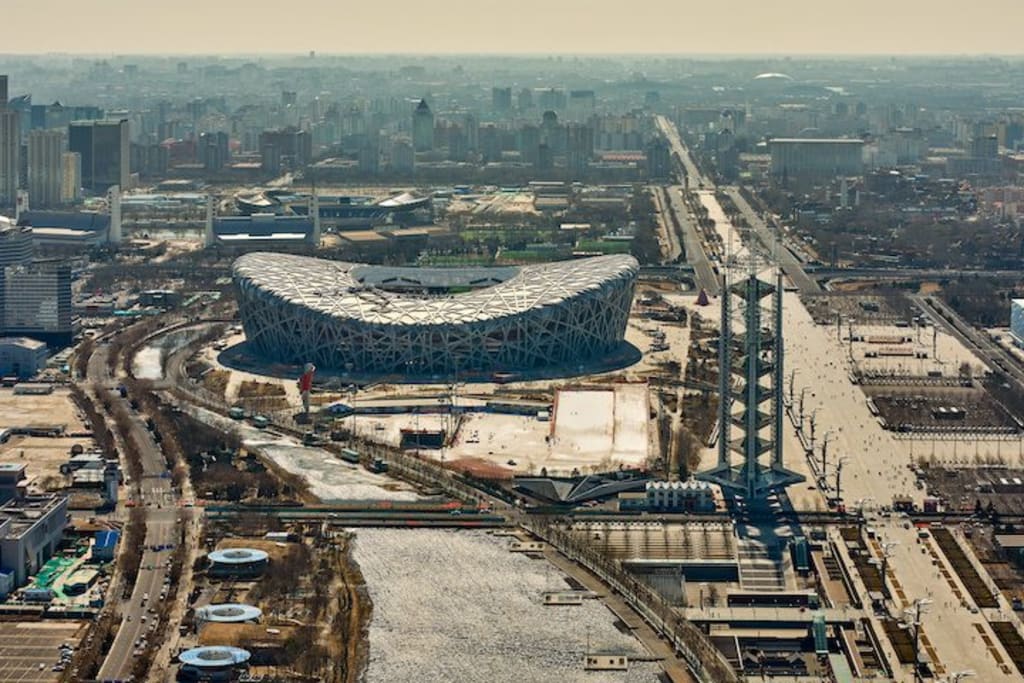
Infrastructure Development in Beijing for the 2008 Summer Olympics was a major undertaking, as the city sought to transform itself into a global hub for sports, tourism, and business. The Chinese government invested heavily in improving the city’s infrastructure, including transportation, sports venues, and urban development, to support the successful hosting of the Olympics.
Here’s an overview of the key infrastructure developments that were made in preparation for the 2008 Beijing Olympics:
Sports Venues
A variety of world-class sports venues were constructed or renovated to host the Olympic events. These venues are iconic and were designed to showcase both modernity and Chinese culture.
Beijing National Stadium (Bird’s Nest):
The Bird’s Nest is one of the most iconic structures of the 2008 Olympics, designed by Herzog & de Meuron, a Swiss architectural firm, along with Chinese artist Ai Weiwei. It was the main stadium for the opening and closing ceremonies and athletics events.
It has a seating capacity of 91,000 and is known for its unique lattice-like design, which resembles a bird's nest.
Beijing National Aquatics Center (Water Cube):
The Water Cube was built to host swimming and diving events. Its bubble-like structure, made of Teflon-coated plastic, is one of the most recognizable Olympic venues.
The design is a futuristic approach to architecture, combining functionality with artistic expression.
Other Venues:
Several other venues were constructed for various Olympic events, including the Workers' Stadium, Capital Indoor Stadium, and Shunyi Olympic Rowing-Canoeing Park.
Existing venues, such as the Beijing Gymnasium, were also upgraded to meet international standards.
Transportation Infrastructure
Transportation was a key area of focus, as Beijing needed to ensure smooth movement of both athletes and spectators throughout the city and to various Olympic venues.
Beijing Subway Expansion:
The Beijing Subway was expanded by more than 100 kilometers (about 62 miles) before the 2008 Olympics. New lines were added to connect the Olympic venues with the city center and surrounding areas.
This expansion helped reduce traffic congestion and provided a quick, efficient means of transport for both locals and visitors.
Beijing Capital International Airport (Terminal 3):
Terminal 3 of Beijing Capital International Airport was completed in time for the Olympics, becoming one of the largest and most advanced airport terminals in the world at the time. Designed by architect Norman Foster, it has a capacity to handle 60 million passengers annually.
The terminal is renowned for its spaciousness, modern design, and advanced technology, improving Beijing’s global connectivity.
New Roads and Highways:
Many new roads and highways were built or expanded to ensure quick access to the Olympic venues and to ease traffic congestion. One of the key projects was the construction of a ring road system around the city to streamline traffic flow.
Urban and Environmental Development
Beijing also focused on upgrading its urban environment to create a cleaner, greener, and more modern city for both residents and tourists.
Urban Green Spaces:
Beijing increased the number of public parks and green spaces, including the Olympic Forest Park, which became a major environmental project that provided a vast green area to balance the city's development.
Environmental Improvements:
Beijing made efforts to reduce pollution during the Olympics, including restrictions on car use, increased use of natural gas, and the closure of high-polluting factories.
Air quality was a major concern, so steps were taken to reduce smog and improve the environment during the Games. These efforts included limiting the number of cars on the road and enforcing stricter emission standards.
Hotels and Accommodation
The demand for hotel accommodations surged with the arrival of thousands of international visitors. Beijing invested in constructing and upgrading hotels across the city, including new luxury hotels and large-scale conference centers.
New hotels included chains like InterContinental and Shangri-La, as well as specialized accommodations for Olympic officials and athletes.
Telecommunications
Telecommunications infrastructure was upgraded to handle the influx of international visitors, media, and athletes. Beijing implemented high-speed broadband and mobile communication systems to ensure that information flow was efficient and reliable during the Olympics.
The Olympic Village was equipped with state-of-the-art communication technology, ensuring smooth operations and connectivity.
Legacy of the Olympic Infrastructure
The infrastructure improvements in Beijing did not end with the Games. Many of the venues and transportation systems continue to serve the city long after the event.
For example, the Bird’s Nest is used for a variety of sporting events and concerts, while the Water Cube is now a water park and recreational facility.
The expansion of the subway system and the modernized airport have continued to benefit both locals and tourists.
End
The 2008 Beijing Olympics marked a turning point in China’s rapid modernization. The city’s infrastructure overhaul, from stunning sports venues to improved transportation and urban development, transformed Beijing into a global metropolis. These developments not only contributed to the success of the Olympics but also left a lasting legacy that continues to benefit the city's residents and visitors today.
About the Creator
Badhan Sen
Myself Badhan, I am a professional writer.I like to share some stories with my friends.
Keep reading
More stories from Badhan Sen and writers in Gamers and other communities.
THE FINANCIAL CHALLENGES OF HOSTING THE OLYMPICS
The Olympic Games, often regarded as the world’s premier sporting event, are a massive undertaking that comes with immense financial costs. While hosting the Olympics can bring significant prestige and potential economic benefits, the financial challenges associated with organizing such an event are formidable. From infrastructure development to security expenses, the costs often exceed initial projections, leading to financial strain for the host cities and countries. This article explores the financial challenges of hosting the Olympics and their potential long-term impact.
By Badhan Senabout a year ago in Gamers
Palworld Evolution: Navigating New Mechanics in the Post-Lawsuit Era
The survival gaming landscape shifted significantly when Nintendo and The Pokémon Company officially filed their patent infringement lawsuit against Pocketpair in late 2024. While many feared this legal behemoth would crush the "Pokémon with guns" phenomenon, the reality has been a fascinating masterclass in rapid game design iteration. Pocketpair didn't just retreat; they began a surgical overhaul of Palworld's core systems to ensure the game’s survival while maintaining its chaotic identity.
By Richard Bailey8 days ago in Gamers



Comments (1)
I think this would make a good lecture for a basic course in Engineering and/or Economics.