
THE DOMINANCE OF USAIN BOLT IN OLYMPIC TRACK AND FIELD
Unmatched Speed and Supremacy on the Olympic Stage

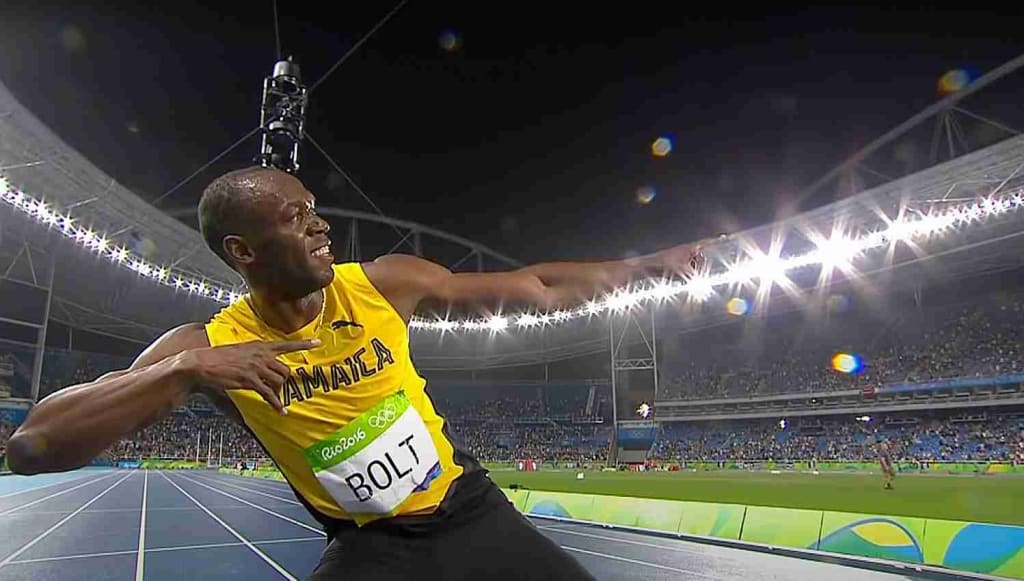
When discussing the greatest athletes in the history of sports, Usain Bolt’s name inevitably surfaces. The Jamaican sprinter, widely regarded as the fastest man in history, redefined what it means to dominate on the track. Across three Olympic Games — Beijing 2008, London 2012, and Rio 2016 — Bolt not only won medals but also transcended his sport to become a global icon. His dominance in the 100m, 200m, and 4x100m relay events is unparalleled, setting records and leaving an indelible mark on the world of athletics.
Early Beginnings and Rise to Stardom
Born on August 21, 1986, in Trelawny, Jamaica, Usain Bolt showed athletic promise from an early age. Though initially interested in cricket, his raw speed led him to sprinting. Bolt’s journey to greatness began in earnest at the 2002 World Junior Championships in Kingston, where he won gold in the 200m at just 15 years old. This victory made him the youngest-ever gold medalist in the event’s history. As Bolt transitioned to senior-level competition, his talent was evident, but his performance at the 2008 Beijing Olympics catapulted him to global fame.
Beijing 2008: A Star is Born
The 2008 Beijing Olympics marked the beginning of Bolt’s Olympic dominance. He shattered the 100m world record in the final, clocking 9.69 seconds despite slowing down to celebrate before crossing the finish line. Bolt’s relaxed demeanor and flamboyant style captured the world’s attention. Just days later, he set another world record in the 200m, finishing in 19.30 seconds, breaking Michael Johnson’s long-standing record of 19.32 seconds. To top it off, Bolt anchored Jamaica’s 4x100m relay team to another world record, securing three gold medals and cementing his place as the fastest man alive.
London 2012: Dominance Confirmed
If Beijing 2008 was Bolt’s arrival, London 2012 was the confirmation of his unparalleled talent. In the 100m final, Bolt defended his title with an Olympic record of 9.63 seconds, the second-fastest time in history. His dominance extended to the 200m, where he became the first man in history to win consecutive gold medals in both the 100m and 200m at the Olympics. The Jamaican team, with Bolt as the anchor, also won gold in the 4x100m relay, setting another world record of 36.84 seconds. Bolt’s performances in London solidified his status as one of the greatest sprinters of all time.
Rio 2016: The Triple-Triple
Heading into the Rio 2016 Olympics, Bolt was already a living legend. Despite facing challenges from younger sprinters and battling injuries, he once again delivered. Bolt won gold in the 100m with a time of 9.81 seconds, showcasing his ability to perform under pressure. In the 200m, he crossed the finish line first in 19.78 seconds, and Jamaica’s 4x100m relay team clinched gold yet again. With these victories, Bolt achieved the historic “triple-triple” — winning gold in the 100m, 200m, and 4x100m relay at three consecutive Olympic Games. Although the 2008 4x100m relay gold was later stripped due to a teammate’s doping violation, Bolt’s legacy remained untarnished.
The Secret to Bolt’s Success
Usain Bolt’s dominance can be attributed to a combination of natural talent, rigorous training, and a winning mindset. Standing at 6’5”, his height gave him an advantage with a longer stride length, allowing him to cover ground more efficiently than his competitors. Despite his size, Bolt possessed remarkable acceleration and coordination. His coach, Glen Mills, played a crucial role in refining his technique and ensuring he peaked at the right moments. Bolt’s charisma and mental fortitude were equally important. He thrived on the big stage, often saving his best performances for the world’s largest audiences.
Legacy and Impact
Bolt’s impact on the sport extends beyond his medals and records. He brought unparalleled excitement to track and field, drawing millions of viewers and inspiring a new generation of athletes. His signature “Lightning Bolt” pose became a global phenomenon, symbolizing his unique blend of confidence and showmanship. Bolt also used his platform to advocate for the sport’s integrity, speaking out against doping and emphasizing the importance of clean competition.
Off the track, Bolt’s contributions include philanthropic efforts in Jamaica, where he supports initiatives in education and youth sports. His popularity transcends athletics, with endorsements and media appearances making him one of the most recognizable figures in the world.
In The End
Usain Bolt’s dominance in Olympic track and field is a testament to his extraordinary abilities and determination. From his record-breaking performances in Beijing to his historic triple-triple in Rio, Bolt’s achievements have set a standard of excellence that few athletes can aspire to match. More than just a sprinter, he is a symbol of greatness, embodying the spirit of competition and the pursuit of perfection. Even in retirement, Bolt’s legacy as the fastest man in history continues to inspire and captivate fans around the globe.
About the Creator
Badhan Sen
Myself Badhan, I am a professional writer.I like to share some stories with my friends.
Keep reading
More stories from Badhan Sen and writers in Gamers and other communities.
THE RISE OF BASKETBALL AND ITS GLOBAL OLYMPIC PRESENCE
Basketball, one of the most popular and widely followed sports in the world today, has experienced remarkable growth since its invention in 1891. From humble beginnings on a basketball court in Springfield, Massachusetts, the sport has transcended national boundaries and become a global phenomenon. A key milestone in basketball's global expansion was its inclusion in the Olympic Games, which has played a pivotal role in elevating the sport’s stature and reach. This essay explores the rise of basketball as a global sport and its significant presence in the Olympics.
By Badhan Senabout a year ago in Gamers
u4gm What Sigil of Power Does in Path of Exile 2
As Path of Exile 2 characters advance deeper into mid- and endgame content, raw stat upgrades lose much of their impact. At that stage, real damage gains usually come from mechanics that scale multiplicatively or interact directly with core resources like mana. For spell-based builds, one of the most efficient yet frequently underestimated tools is Sigil of Power.
By Asik Gxbx Hdjdh4 days ago in Gamers
Mastering the Pocket Exhaustion Debuff in Rush Royale Co-Op
The landscape of Rush Royale co-op has shifted dramatically with the rework of the Pocket Exhaustion enchantment. If you have spent any time in the higher dungeons recently, you likely noticed strange projectiles flying across the board.
By Richard Bailey3 days ago in Gamers




Comments
There are no comments for this story
Be the first to respond and start the conversation.