
Splinter Cell: A Stealth Classic
Stealth Action Redefined Indeed!


So...I've talked about exploring older games before, and Tom Clancy's Splinter Cell is one of my favorites. It's one of the most challenging games I've played in a while - especially with my most recent playthroughs (yes, I did two playthroughs).
No more blabbering, let's get to the good stuff!
Redefining Stealth: The Splinter Cell Story
Developed and published by Ubisoft Montreal, Splinter Cell started out as a competitor for the Metal Gear Solid series. At the time, Metal Gear Solid 2 had come out the previous year and was the defining game of the stealth genre. The original idea was to make a game called The Drift, a sci-fi James Bond style action adventure title that would outdo Metal Gear Solid 2.
Of course, since Metal Gear Solid 2 was a stealth game, the team at Ubisoft decided to switch gears (see what I did there?) and focus more on stealth than action. As they went about developing the game, Ubisoft worked with author Tom Clancy - the guy who wrote the Hunt for Red October - and attached his name to the project.

Clancy's name was already attached to a couple of other Ubisoft series' including Rainbow Six and Ghost Recon. As such, his name carried a lot of weight with associated projects doing huge sales numbers. It wasn't just Clancy's name that made the game stand out, however, as Ubisoft's change of focus meant that they had to make some significant changes to the different level designs and stealth mechanics.
The level environments, for example, became much darker; creating more shadows for players to use. The shadows were your hiding place meaning you had to be careful about where you stood as the environmental light sources would give you away. Staying in the shadows meant you stayed hidden, stepping into the light...well, you know. The game was met with critical acclaim upon release in 2002, and has been a favorite of gamers ever since.
A Thrilling Story
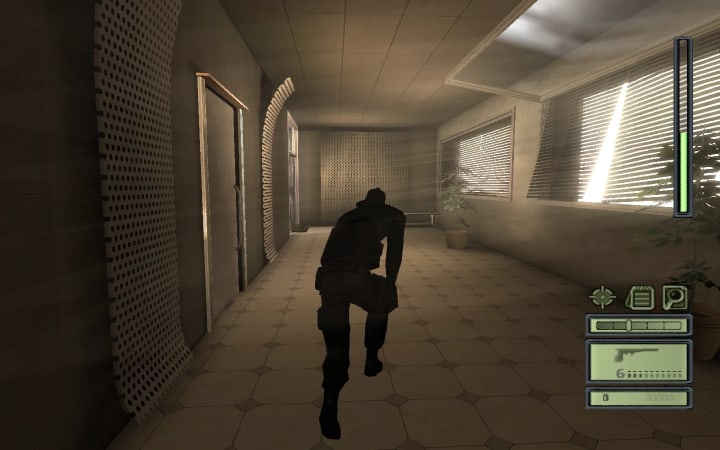
In 2004, Kombayn Nikoladze, a Georgian billionaire, pulls off a bloodless coup d'état and takes over as the president following the previous president's death. When a couple of CIA operatives go missing the NSA sends in Sam Fisher, a former Navy SEAL to look into it. Fisher quickly finds out that there's more to the situation.
The CIA operatives are dead and Georgia's new president has been terrorizing Azerbaijan with ethnic cleansing operations. This discovery forces Nikoladze into hiding and Sam has to go after him to put a stop to his craziness.
The Strengths and Weaknesses of Splinter Cell
One of the best aspects of the game, in my opinion, is the stealth mechanics. A key component of the mechanic is the use of shadows - like I said earlier - of course, you didn't always have the luxury of a dark hallway. Sometimes, things were lit up like a Christmas tree, so the team at Ubisoft made it so that you could create shadows by shooting out lights.
The story is really good too, it's well-written and well-paced. Visually, the game looks good. Don't get me wrong, the graphics are clearly dated, but they still look reasonably good. The music and sound design are really nicely done as well.

As far as weak points go, there is one MAJOR problem; the combat mechanics. The melee combat is okay, but the big issue is the shooting mechanics. It's set up more or less, Lambert says early on that your gun should be a last resort. A last resort is exactly what your gun is; the accuracy of the firearms - mostly the pistol - is all over the place.
You can have the crosshair in exactly the right spot, and STILL not hit anything. It's beyond frustrating.
About the Creator
Greg Seebregts
I'm a South African writer, blogger and English tutor; I've published 1 novel and am working on publishing a 2nd. I also write reviews on whatever interests me. I have a YouTube Channel as well where I review books, and manga and so on.
Keep reading
More stories from Greg Seebregts and writers in Gamers and other communities.
Assassin's Creed II: A Revenge Story Done Right
With the release and subsequently monumental success of Assassin's Creed in 2007, a sequel was pretty much guaranteed. The only question was; where would gamers be going next? Well, they didn't have to wait long to find out.
By Greg Seebregtsabout a year ago in Gamers
A Strategic Look at Today’s Monopoly GO Events — February 25, 2026
For players who enjoy planning their moves and maximizing rewards, February 25, 2026 offers a well-balanced lineup of events in Monopoly GO. Between overlapping tournaments, carefully timed boosts, and daily challenges, today’s schedule rewards patience, timing, and smart dice management rather than reckless rolling.
By Dangyc Ding4 days ago in Gamers



Comments
There are no comments for this story
Be the first to respond and start the conversation.