
Rookie Mistakes in Remnant: From the Ashes and How to Avoid Them
And Die Less

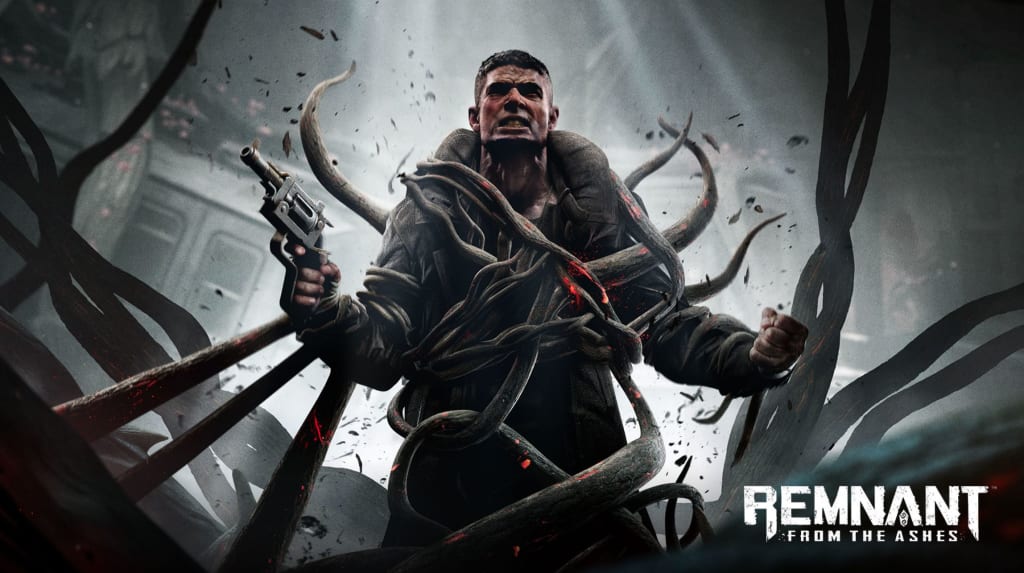
As I wrote in this story, I've been a gamer for almost 50 years.
Needless to say, I have played thousands of games for hundreds of thousands of hours. So, it's not too often that I am blown away by a new game. The last time I had this level of excitement was probably the original Demon Souls.
I remember buying the used disk at Game Stop and being asked by the smirking clerk, "Is this for you? I'm not sure you want to play this. It's pretty hard."
A few years and NG+25 later, I think I proved him wrong.
But I digress.
That was more than a few years ago, and I have played many games and franchises since that I thoroughly enjoyed. I even actually finished a couple. But not that really grabbed me and compelled me forward. Horizon: Zero Dawn came the closest, but with bonfires almost within sight of one another, it grew to be a little too easy and boring.
Even for me.
So, I am beyond pleased that I have encountered two games in the last six months that gave me the same satisfaction I remember from my first entry into Boletaria. The first was Days Gone, which I actually purchased by accident. I spent more consecutive hours on that game than probably any other in history and am now on NG++.
The other, which I just started a week ago, thanks to my PS Plus membership, is Remnant: From the Ashes. I waffle every year about renewing PS Plus as I think PSNow is a much better value, but every once in a while, it redeems itself. When I read the announcement at the beginning of March, I was so excited to get the remake of FFVII that I hardly noticed Remnant. In typical fashion, I assumed it was another indy filler thrown in to give perceived value.
Final Fantasy VII was my first game in that franchise, and I thought about getting the new version. I still remember watching Cloud standing on that train platform, getting the crap beat out of him, and having no idea what I was supposed to do about it.
But I digress.
As I started Remnant: From the Ashes, I was a bit underwhelmed. The tutorial section was too long and tedious, although admittedly, I should have paid more attention. I had read about how this was a Soulsborne type game. Even though I have enjoyed every one of them (although Demon Souls is the only one I finished), I suck at the style of fighting required to master them. So, I feared that this would be another short-lived playthrough, like Sekiro.
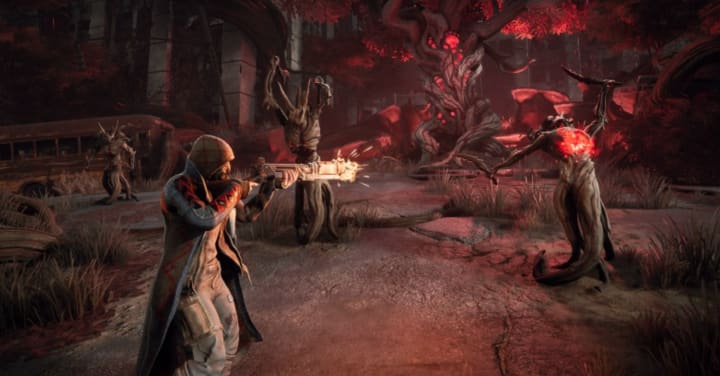
But once I got to The City, I was hooked. Don't get me wrong, I still sucked, and I didn't live very long. But, hey! There is no penalty for dying in this game. I was shocked as I rose again by that red crystal and still had all my stuff. Woohoo. A game for people that suck.
Boy, was I wrong.
So, I wanted to walk you through the major mistake I made on that first playthrough, why I had to start over, and what I've learned along the way.
The first mistake I made was not paying attention to the tutorial or the hints that pop up early in the game. I learned to game when you didn't get any of that and still (mistakenly) tend to ignore that part.
"You are standing in an open field west of a white house, with a boarded front door. There is a small mailbox here."
~Zork
But that's not the worst mistake I made, so I'll get back to that when I discuss starting over.
I have to admit; I am an enigma. I love gaming. I suck at gaming. Those two don't typically go together, but that's just me. Over the decades, I have only 100% completed a handful of games. More often than not, I get to the final boss and say, screw it, I'm done. But frequently, it may be the first boss that kills my game.
As I said earlier, I don't spend a lot of time on tutorials or learning how to, you know, actually, play the game. My playstyle is spam the attack button, and hope my health bar is longer than the other guy's.
So, in that vein, instead of Git Gud, I grind. A lot. Play until I get into trouble, usually the first boss. Then go back, grind and level up. Try again. Rinse and repeat. When I have a problem with a game, like many others, I look for hints online. But I try to find the threads where people complain about a particular weapon, magic, or armor making them OP.
Because that's what I want. Over-Powered is my jam. I want to cut through bosses like paper and get onto the game.
This made me very excited when I discovered Adventure mode in Remnants.
Let me explain. Just as with most RPGs, in Remnant, you have a campaign. You fight through different rooms, worlds, and bosses and slowly build your character. If you die, you try again.
But Remnant introduced Adventure mode sometime after the initial release. These are sort of parallel games. They are played in randomly generated worlds. I should note here that all the worlds in Remnant are randomly generated at each new game. This makes replays fun and walkthroughs impossible. Sucks to be me.
The cool thing about Adventures in Remnant: From the Ashes is they operate in sort of a parallel world. When you start an Adventure, your campaign is still saved, untouched. You roll a new adventure or continue the last one at the same level and with the same equipment you had in your campaign.
And when you get tired of the adventure and want to get back to the campaign, you keep all the equipment and levels you earned on that adventure.
It's a Grinder's paradise. I went back and forth from campaign to adventure until I had maxed out all of my armor and weapons and had earned and used about 80 trait points. Trait points are things like vigor, stamina, and specialized skills you can level separately from the equipment.
And I had only beaten the first boss!
And that's when I discovered the mistake I had made.
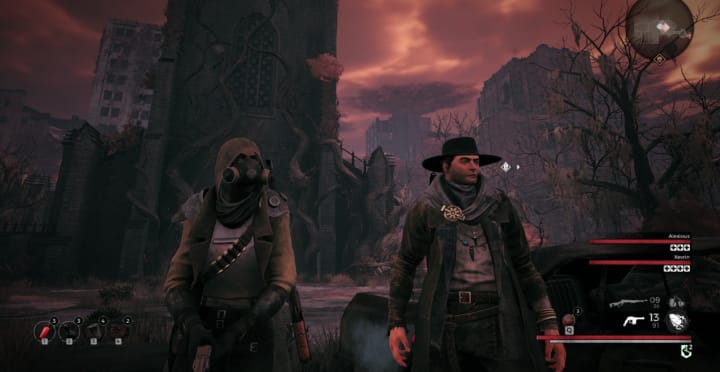
Remnant scales not with the character but with the equipment. So, since everything I had was +20, every world in both campaigns and adventures from here on out would be +20. In other words, I had maxed out my equipment but also maxed out all the enemies and bosses.
As I was trying to get to and then through the second boss, I realized my mistake. I thought about carrying on, but I knew I would only grow frustrated and eventually quit the game. I didn't want to do that, so I started over with a new character.
And it was on this playthrough that I learned a ton. Not just about leveling but the gameplay in general.
First, I'll go ahead and admit that I skipped the tutorial on the second run, but I had already learned the hard way much of what it teaches you. And I still had the pop-up hints where I learned everything I needed to know.
Based on every suggestion I ever saw about the game, I started this one as an Ex-Cultist. Most people will say it doesn't matter which archetype you choose, but as I will explain in a minute, that is a load of crap. I started as a Hunter in my first run since that type of character is how I usually roll. The third type is Scrapper. I have no idea what he does.
An early mistake I made in my first playthrough, but was easily corrected was not exploring and not smashing everything. Before you head out into the world very far, you should return to your home base, Ward 13. Explore every inch and break everything breakable. Including that innocent-looking chair in the corner. And bookcases. Especially bookcases. You'll figure out why.
You see, to upgrade your equipment, just like in most games, you need money and material. The money in this game is scrap. It's plentiful but not abundant enough. You want all you can find. And a lot of it is stuck inside things you can break. Material is various forms of iron. Some of it is left lying around in dungeons; some are in chests you will discover if you explore enough, and some are also in breakable things. Get all the scrap and iron you can.
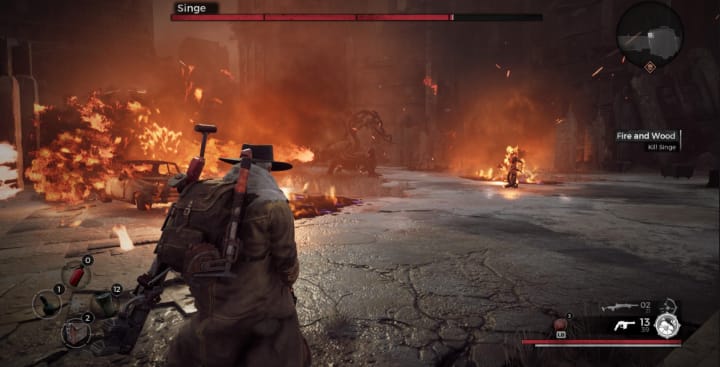
The reason I suggest Ex-Cultist as your starting archetype leads to another huge mistake I made the first time, weapon mods. Why a mistake? Because I didn't learn how to use them. This is a significant feature of the game, and I all but ignored them. I bought a couple from that grumpy NPC in Ward 13 and equipped them.
But I had no idea how to use them.
I accidentally triggered Hot Shot a few times but didn't know how, why, or what to do with it.
Trust me. Learn how to use mods.
The mod that is particularly useful and is a starting mod for the Ex-Cultist is Mender's Aura. But first, a word about healing.
Like every RPG, in Remnant, you have healing potions. There are two kinds. The Dragon Heart is kind of like Estus in Souls games. They completely restore your health, but you only have three to start with. Initially, you get it from Reggie as a gift in Ward 13. He is also the guy who will sell you the other kind. When Dragon Hears are gone, only activating a checkpoint or crystal will restore them. Just like sitting at a bonfire in Souls games. Unfortunately, that also respawns everything you just killed.
The other kind is Bloodwort. This is consumable and replenishable. It slowly restores your health for a limited time. It's not great, but you can find it in dungeons or buy it from Reggie. With enough scrap, you can buy a lot of it.
But the Ex-Cultist has another way to heal. And that is the starting weapon mod. Initially, this mod is attached to the starting pistol, but I moved it to the sub-machine gun as soon as I found it. (Remember exploring every inch of Ward 13?) To trigger weapon mods, you simply hit R1 on the controller. Mods last various amounts of time, and when triggered, start a countdown timer until you can use them again.
This mod envelops your character in a pool of green healing. Ahh, that feels good. Not only does it heal you, but it makes you (sort of) invincible while it lasts. For that reason, once I am down a bit of health, I usually trigger it as the next batch of baddies comes my way. Since it is renewable, you can always find a safe place to hide and wait for it to renew.
Of course, safe place is a relative word in Remnant. Enemies can pop up out of nowhere, including from behind you in areas you thought you had cleared.
If you have started and not chosen Ex-Cultist, you can find and equip this mod later. It's kind of like the starting gift in Dark Souls. The ones you don't choose are all findable. Eventually.
That brings us to leveling and my primary mistake. Don't level beyond the world you are in. How do you know? Well, if I had followed the tutorials, it's easy. In the pause screen, there is a prompt to Toggle Advanced Stats. I never used that in my initial run as I thought it was just a lot of useless extra info.
Yeah, right.
Besides a lot of helpful information about your current equipment and the relative protection they provide, at the bottom are indicators under the heading Rating vs. Zone. There are two of these, one for Offense and one for Defense. Basically, they tell you how your armor and weapons stack up to the enemies in the current world. A red arrow pointing down means you are underpowered. You need to upgrade your equipment. You can muscle through or try an adventure and farm some scrap and iron.
A green upward arrow means you are overpowered. Sound great, right? Wrong. Because when you enter the next world, the enemies will scale to where you are. To make this as clear as I can, there is no advantage to overpowering your equipment. Don't do that.
A grey diamond, like Goldiock's porridge, is just right.
You will have to experiment a bit to see how each world rates your equipment. The main thing is, upgrade everything equally. Don't leave your armor at +1 and upgrade your gun to +10. That means you will have +10 enemies shooting holes in your +1 armor.
Also, if you upgrade slowly and consistently, it's easy to know when you've reached your limit. As soon as you see the first green arrow, you've gone as far as you want to for that world. Just stockpile the scrap and iron and wait until you get to the next world when you need to upgrade further. For example, in the first world, you can upgrade to +5 before you go green.
One more hint about leveling before I get back to killing Roots. The type of iron you need upgrades also. To begin with, you need plain iron. After a certain level, only forged iron will do, and so on. That's another reason not to let your stats get lopsided. The game will let you find the type of iron you need based on your average stats.
So, if you upgrade one piece too far, you won't find the type of iron you need to go further until your average is in line with that material.
If you haven't played Remnant: From the Ashes, I can't recommend it highly enough.
But the learning curve is steep, and the cost of mistakes is deep.
Go slow, my friends, and conquer.

About the Creator
Darryl Brooks
I am a writer with over 16 years of experience and hundreds of articles. I write about photography, productivity, life skills, money management and much more.
Keep reading
More stories from Darryl Brooks and writers in Gamers and other communities.
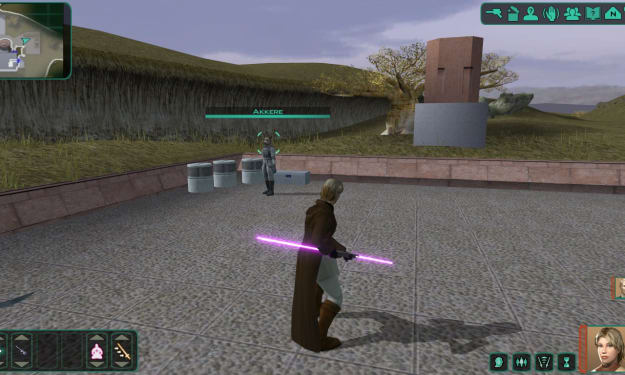
Knights of the Old Republic II
A long time ago, on a writing platform far, far away, I wrote a review for Knights of the Old Republic. It was part of my Star Wars content for May 2024. My final verdict on that one was that it was great fun. It wasn't perfect, but I had a great time playing it. Now, it's time to look at the sequel - yes, there's a sequel.
By Greg Seebregts4 days ago in Gamers
Author’s Advice
If you would’ve asked me 20 years ago did I know I’d become a writer and an author, I would’ve said “nope, ain’t happening”. As fate would have it I did become an author and I can honestly say I’m loving it so far. It really does feel good to be a writer. I’ve learned a lot on this journey and I feel like with even me being as new to this world as I am, there’s some wisdom I need to share with every other aspiring author.
By Joe Patterson4 days ago in Journal



Comments
There are no comments for this story
Be the first to respond and start the conversation.