
Robert James Fischer
His Life and Accomplishments in Chess

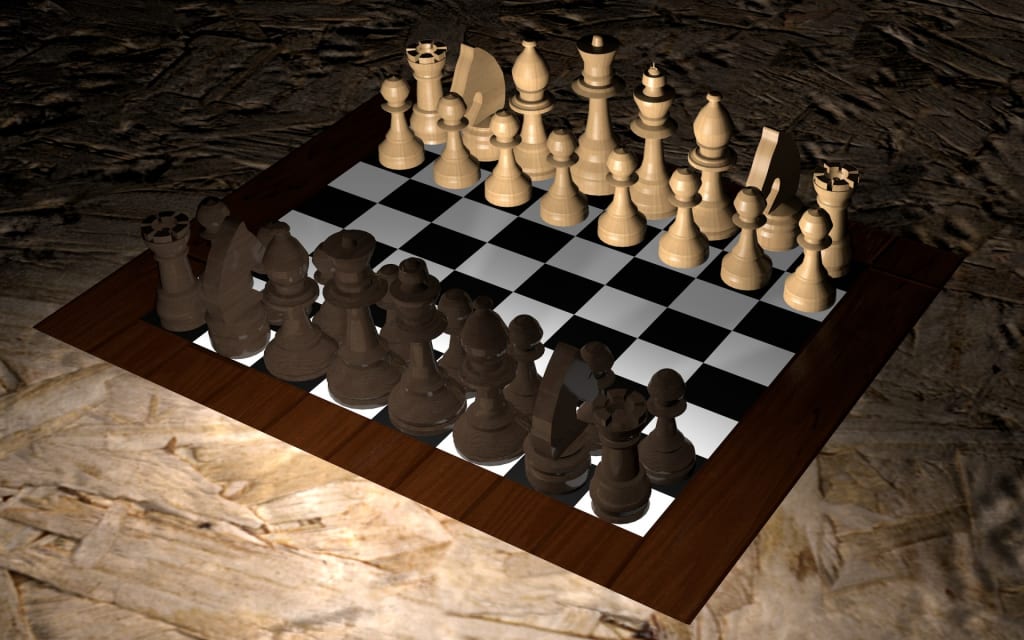
Robert James Fischer is considered by many to be the greatest chess player of all time. He was born on March 9, 1943 in Chicago, Illinois. His mother was homeless when he was born. She studied for a master's degree in nursing after they moved to New York city, and started working in that field. Who his father actually was, is under debate. It could have been either the German biophysicist Hans-Gerhardt Fischer, or the Hungarian mathematician and physicist Paul Nemenyi.
He first learned how to play chess when he was just six years old using a chess set and board he bought from a candy store. Fischer couldn't find anyone who could play chess with him, but he studied on his own. When he was eight years old, he played the former Scottish champion Max Pavey in a simultaneous exhibition. He lost, but many watching the game were impressed when he played for fifteen minutes.
Fischer began attending the Hawthorne Chess Club in Hawthorne, California in June 1956. The meeting place for the club was the Chess Life correspondence editor, Jack W. Collins.
He usually played 1 e4 when he was playing with the white pieces. He invariably played the Sicilian Defense against 1 e4 by the white side. It is a drawish opening, but the black side has the distinct disadvantage of moving after white on the first move. Fischer played many of the best international grandmasters including Boris Spassky, Tigran Petrosian, Robert Byrne, Viktor Korchnoi, Samuel Reshevsky, Bent Larsen, Wolfgang Unzicker, Donald Byrne, and Mikhail Tal.
One reason his nickname "Bobby" is appropriate is because he won the United States Chess Championship in 1957-1958 with a score of 10 1/2 to 2 1/2 when he was only fourteen years old. He won seven of the next eight US championships. He didn't compete in the only one he didn't win in 1961-1962. It was won by Larry Evans. Fischer had a perfect 11-0 score in the 1963-1964 tournament.
Fischer accepted an invitation to the second Piatigorsky Cup from Mrs. Piatigorsky in Santa Monica, California in 1966. The tournament had many good players from many countries: Boris Spassky (Soviet Union), Robert James Fischer (United States of America), Bent Larsen (Denmark), Lajos Portisch (Hungary), Wolfgang Unzicker (West Germany), Tigran Petrosian (Soviet Union), Samuel Reshevsky (United States of America), Miguel Najdorf (Argentina), Borislav Ivkov (Yugoslavia), and Johannes Hendrikus Donner (Netherlands).
Tigran Petrosian was the current world champion (1963-1969), Boris Spassky would be world champion after him (1969-1972), and Robert James Fischer was world champion after him (1972-1975).
He had a poor performance for the first eight games. He was tied for last place with a 3-5 score. He had a 7-1 score for the next eight games, and ended up coming in second to Boris Spassky (11 1/2 to 11).
Bobby Fischer at Age 28

He became the eleventh world chess champion in 1972, when he defeated world chess champion Boris Spassky of the Soviet Union in Reykjavik, Iceland. Another American, Paul Morphy, was considered to be the best player of the world by many in 1859. Fischer defeated Spassky 12 1/2 to 8 1/2. An interesting thing happened during the first two games of the match. Fischer made a very speculative move in a dead drawn position that only gets two pawns for a bishop without enough compensation. He still could have drawn, but neglected to make the best moves.
Because of this, he demanded that the televisions be removed from the room where they were playing. His request was denied, so Fischer refused to play game 2, and therefore forfeited it. Boris Spassky agreed to play in a private room to keep the world championship going. But after that, through game 11, Fischer won five games to Spassky's one. There were also three draws.
There was an expensive rematch between Fischer and Spassky in 1992. The prize fund was five million dollars, with 3.35 million dollars going to the winner of the match. It was held in Sveti Stefan and Belgrade, Yugoslavia despite a United Nations embargo. Fischer won with ten wins, five losses, and fifteen draws.
In 1988, Fischer filed for a patent on his invention of the time delay chess clock. It gives each player in a chess game a time increment for each move. For example, if it is Game in 30 with a time delay of five seconds, then each time a player moves he will get an extra five seconds. This gives any player who runs out of time five seconds for every move after that.
It was named Fischer's clock after him. It is the only kind of chess clock in use in tournaments today.
Fischer also came with a version of shuffle chess that maintains bishops of opposite color, and maintains castling for each player. The pawns are all still on the second rank for each player, but the pieces on the first rank are "shuffled" in all possible setups with the exception that the bishops must be of opposite color. Both sides have the same position. It is called Chess960, because there are 960 possible different combinations. It is also called Fischer Random Chess after its inventor.
There is controversy concerning the marriage of Fischer and Miyoko Watei on September 6, 2004. Watei has submitted strong evidence that they did get married. There is also a strongly supported claim that Fischer and Marilyn Young had a daughter they named Jinky in May, 2001 in Baguio City, Philippines.
About the Creator
Danny Fleming
I received a Bachelor of Science in Mathematics in 1996. I have written several sonnets. I also wrote How to Prove The Collatz Conjecture and Many Articles on Many Subjects.
Keep reading
More stories from Danny Fleming and writers in Gamers and other communities.
Ludwig Van Beethoven
Ludwig Van Beethoven was born on December 17 (eight days before Christmas day), 1770 at what is now North Rhine-Westphalia, Germany. His parents were Johann Van Beethoven and Maria Magdalena Keverich. He was a composer of music, and a pianist. He is considered to be the greatest composer of all time by many.
By Danny Fleming7 years ago in Beat
Elden Ring Will Break You Before It Becomes Your Greatest Victory
Few modern games have had as profound an impact on players as Elden Ring. Developed by FromSoftware and guided by the creative vision of Hidetaka Miyazaki, the game represents a bold evolution of a formula that has challenged and captivated players for years. It is not just a game but an experience that demands patience, resilience, and a willingness to embrace failure.
By Lukáš Hrdličkaabout 5 hours ago in Gamers


Comments
There are no comments for this story
Be the first to respond and start the conversation.