


One of my favorite things about Portal 2 is that it’s two-player, and the single player and two-player story lines are completely different. The game makes you think in two different ways. While many sequels end up feeling tiresome and repetitive, Portal 2 brings in new mechanics and new types of puzzles, particularly when adding the second player.
You begin the game being introduced to a new robot guide named Wheatley, and he is perhaps one of my favorite characters in any game I have played. His dry humor is well-written and even more well-timed to keep gameplay interesting and lighthearted.
The first few test chambers are similar to the first game. They require the use of portals and are simple puzzles to ease you back into gameplay. This serves as a good reminder if it has been a while since you played the first game, but luckily is over fairly quickly for those of you coming straight into the sequel. While the first portion of the game focuses on reacquainting you with gameplay, you soon jump into a much more detailed storyline when you are reintroduced to GLADOS, the main boss from the first game. However, she poses no threat.
At this point, we encounter our first new mechanism of the game- the Discouragement Redirection Cube. This is basically a mirror, and can redirect beams of light in another direction. Gameplay begins to depend a lot on your own timing- jumping through portals to grab cubes mid-air, using gravity and momentum to your advantage, etc. This can sometimes be a bit tedious as you figure out how physics work in the game, but once you have become adjusted to it, the gameplay itself is fairly simple. In all reality, it’s just an expansion of ideas created in the first game.
We are now introduced to light bridges. These are beams of light solid enough to stand on, and conveniently can be redirected by using portals. Gameplay now shifts to focus on creating new paths, all while finding various types of cubes to help you either press buttons, redirect light, or shield yourself. While the cubes are similar to the first game, the light bridges are an entirely new concept and eventually develop into quite complex puzzles. While horizontal bridges support your weight, vertical bridges can be placed to stop momentum in a jump/launch. Placement of the bridges becomes quite strategic. This is the point where the game really pulled me in. While staying in the same general type of gameplay, the game itself has now evolved into a new animal with features worth exploration.
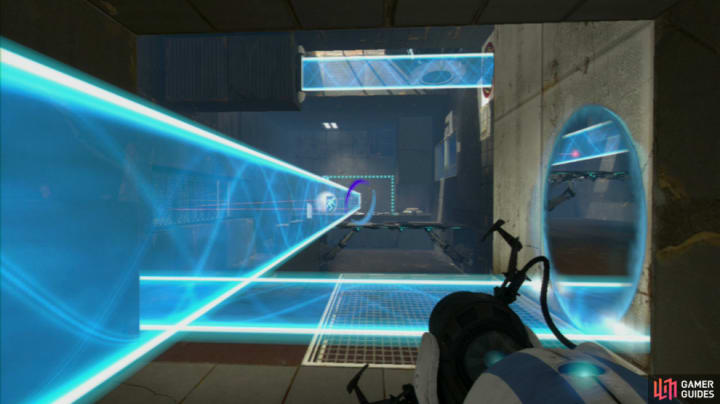
Turrets make an appearance, though we are quite familiar with them from the first game. They can easily be destroyed by knocking them over, making them shoot at each other, or directing a laser at them.
We now return to the story. GLADOS, it seems, has not lost her thirst for your blood. Luckily, our little robot friend Wheatley helps you to escape. We take a back exit and enter the turret production line. You are given the opportunity to sabotage the turrets, which is a fun little trick. To disable GLADOS, it seems you will need to destroy her neurotoxin supply. This is a fairly simple task, and ends with a ride reminiscent of a waterslide. You are able to power down GLADOS, but unfortunately, this allows Wheatley to seize control of things. It turns out that all robots have a dark side! You manage to escape into the tunnels beneath the testing center.
We now arrive in a portion of the game that feels like an entirely separate universe. Where previous sections have felt clean, technological, and futuristic, this area feels dirty and industrial. I love this part of the game because it really breaks up the feeling that the first game never really stopped. We are now beginning to learn about Aperture as a company and how the testing facilities came to be. We are also introduced to an entirely new concept- gel.
There are a few types of gel, but the first you encounter is repulsion gel, which makes you bounce. When combined with a portal, it gives you exponentially more momentum. You can also use portals to redirect the gel placement. The puzzles now have two layers- how you use portals to move about, and how you place gel to reach impossible destinations.
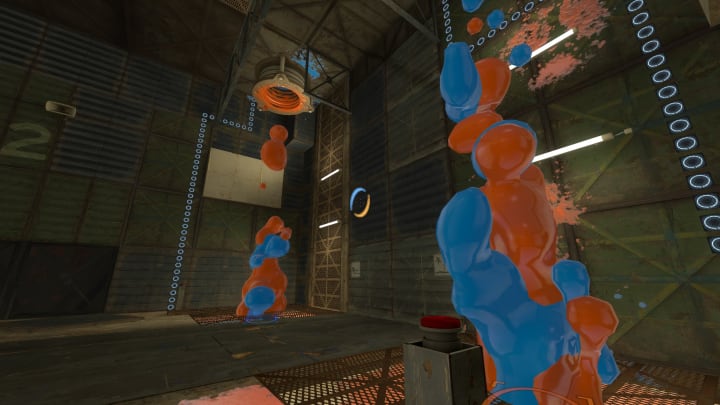
You now find GLADOS, who has been unfortunately yet somehow hilariously stored in a potato. She becomes your companion and agrees to help you escape and destroy Wheatley. You continue along your adventure to find the ORIGINAL testing rooms, which were created to test the gel. This is our first time seeing Propulsion Gel, which accelerates your speed if you run across it. You are now able to combine your use of bouncing, acceleration, and portals.
Our final type of gel is used to create hard surfaces that support the use of portals. The puzzles have become quite large and complex at this point, and require quite a bit of creative thinking. Not only do you have to combine the physics of the different types of gel with the portals, you also have to find places for portals where it seems impossible thanks to the white gel. Gameplay slows quite a bit as you try all the different options to reach difficult destinations. However, the puzzles are intuitive and don’t allow you to go too much astray.
We now return to the testing chambers to attempt to stop Wheatley, and we discover that he is struggling as a testing administrator. This is where the writing is at its finest- GLADOS and Wheatley have well-defined personalities and become pretty feisty at times. At this point in the game, it’s simply a matter of combining all the tools you have acquired throughout the levels- your use of timing and momentum are augmented with the addition of gels.
When you are finally able to confront Wheatley, his response is naturally to attempt to murder you. His tool of choice? Bombs. You can use the gel and portals to your advantage and redirect the bombs at Wheatley. GLADOS provides corrupted cores (robot personalities) for you to install directly on his “person”. While the boss fight in the first game focused on precision and portal placement, this fight is all about timing and direction of momentum. It took me a few tries to get it right.
Overall, this game is a great sequel. The developers did a good job of reminding us of the first game without making it too tedious and repetitive. While it feels like it is in the same universe, we discover new mechanics and a deep storyline. And did I mention that J.K Simmons makes a cameo appearance? The gameplay is simple yet requires a great amount of precision and thought. The puzzles are increasingly complex, but we are gradually eased into them and guided into the thought processes required to solve them.
There is a two-player option as well. While there isn’t much of a storyline, it is immensely enjoyable. Each player controls a testing robot, and you proceed through 40 co-op courses, making it just as in-depth and engaging as the single player version. The same mechanics are used- portals, gel, etc. However, these puzzles can only be solved through communication and planning. This is the true test of a relationship with someone!
Final Score: 9/10
About the Creator
Keep reading
More stories from Chloe Holzman and writers in Gamers and other communities.
Portal-The Game We All Forget
Portal was my introduction to gaming. I am a puzzle girl through and through, so this was the perfect gateway to my drug of choice- console games. And for those of you itching for some action, the developers found unique ways to make you dodge some bullets too.
By Chloe Holzman6 years ago in Gamers
Gears 5 Will Shock You With Its Darkest Story Yet on Xbox
Few action games manage to combine raw intensity with emotional storytelling as effectively as Gears 5. As a key title from Xbox, it carries forward a legacy built on explosive combat while daring to explore deeper, more personal themes. This balance between spectacle and substance is what makes the experience stand out.
By Lukáš Hrdličkaabout 13 hours ago in Gamers
Cassie and Johnny
I’m the kind of dame you notice. I’m no femme fatale, but you can’t ignore me, at least not until I warn you about what’s coming, then everybody ignores me. Hell, they usually blame me afterwards and give Johnny all the credit for saving the day, but my Johnny couldn’t save a seat at the movies without my help. Sure, he’s brawny, but brainy? Not so much. Like that time I asked him to spot me five bucks, and he said he didn’t see it anywhere on me, and believe you me, he looked but good.
By Harper Lewis4 days ago in Critique


Comments
There are no comments for this story
Be the first to respond and start the conversation.