
Maximizing Stardew Valley Profits: The Best Greenhouse Crops Beyond Ancient Fruit
Maximize Your Stardew Valley Gold: Top Greenhouse Crops and Machine Math for 2026

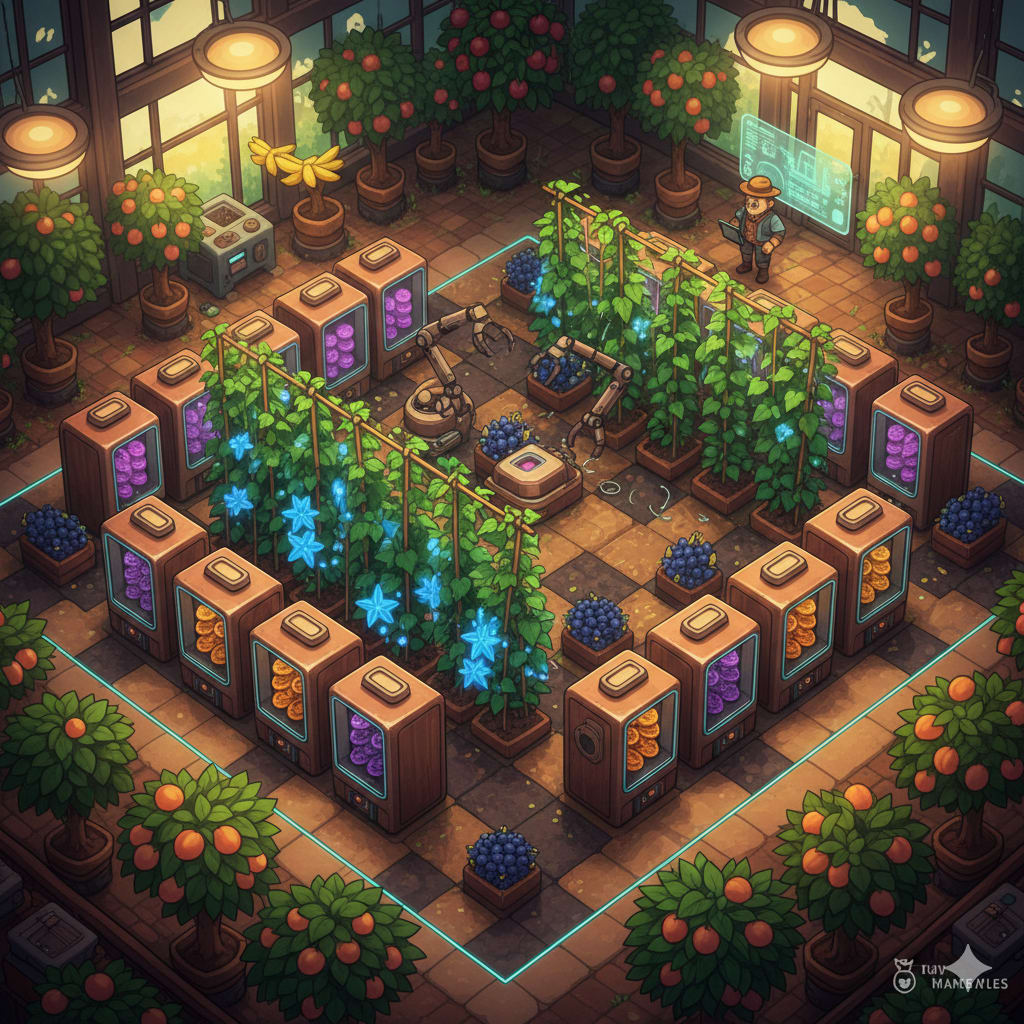
For years, the Stardew Valley meta has been stagnant. If you wanted to make millions of gold, you filled your Greenhouse with Ancient Fruit, turned them into wine, and waited.
It was the gold standard for a reason. However, with the significant rebalancing introduced in versions 1.6 and 1.7, the "Ancient Fruit or Bust" mentality is officially outdated.
New machinery, adjusted processing times, and the introduction of the Dehydrator have shifted the economic landscape of the Valley.
If you want to optimize your farm for 2026, you need to look at the math. Efficiency is no longer just about the highest sell price per unit; it is about throughput, labor costs, and the specific synergy between your crops and your artisan equipment.
The Power of the Dehydrator vs. The Reign of the Keg
The biggest disruptor to the Greenhouse meta is the Dehydrator. Before this machine, the Keg was the undisputed king of profit. While Kegs still offer the highest value multiplier for fruits, they are slow. A Keg takes roughly seven days to turn fruit into wine, tripling the base value of the item.
In contrast, the Dehydrator processes five pieces of fruit at once and finishes in a mere one and a half days. While the math for the Dehydrator effectively adds a flat value plus a percentage bonus, its real strength lies in its speed.
You can cycle through five times as much product in the same timeframe it takes to age a single bottle of wine. This makes "high-yield, lower-value" crops significantly more competitive than they used to be.
1. Starfruit: Still the Heavyweight Champion
Even in 2026, Starfruit remains the most profitable single-harvest crop in the game. When you factor in the 1.6/1.7 changes to fertilizer effectiveness, the gap between Starfruit and its competitors has actually widened for those willing to replant.
- The Wine Strategy: Placing Starfruit in a Keg remains the highest profit-per-item path. With the Artisan profession, a single bottle of Starfruit Wine sells for 3,150g.
- The Dehydrator Strategy: Drying Starfruit is surprisingly viable if you are limited on space for Kegs. Because the Dehydrator handles five fruits at once, it clears out your chest inventory rapidly, preventing the "backlog" that often plagues massive Starfruit harvests.
If you have the gold to spare for seeds and the patience to replant every 13 days, Starfruit is your best friend. For a deeper dive into seed prices and growth cycles, the Stardew Valley Wiki provides the most accurate baseline data.
2. Hops: The High-Labor Powerhouse
If you are a "min-max" player who doesn't mind a high-intensity daily routine, Hops are technically more profitable than Ancient Fruit when processed into Pale Ale. Hops regrow every single day. This means that a Greenhouse full of Hops provides a daily stream of raw materials.
While the Dehydrator doesn't work for Hops, the 1.6 update improved the logic for loading machines, making the daily "Keg run" much less of a chore than it was in previous versions.
If you fill your Greenhouse with Hops, you are essentially printing money. Each Pale Ale sells for 420g with the Artisan perk. Since Hops produce daily, a single tile generates 420g per day, whereas an Ancient Fruit tile (producing once every seven days) generates roughly 330g per day when averaged out.
3. Pineapples: The New Contender
The 1.7 balance changes gave a subtle nod to the Pineapple. Found on Ginger Island, these fruits are now a premier choice for Greenhouse farming. They take seven days to regrow, mirroring the schedule of Ancient Fruit, which makes them incredibly easy to manage.
However, the real magic happens when you use the Dehydrator. Dried Pineapples have a high base value, and because you get five fruits per plant every few weeks (when considering multiple plants), you can keep a small bank of Dehydrators running constantly.
This is the perfect middle-ground crop for players who want high profits without the constant replanting of Starfruit or the daily clicking required for Hops.
Breaking Down the Math: Why Variety Wins
To truly understand the 2026 meta, we have to look at "Gold Per Day" (GPD). In the old days, we only looked at "Gold Per Item." With the introduction of more complex artisan equipment, we must consider how many machines we can reasonably maintain.
- Ancient Fruit (Keg): Approximately 330g GPD.
- Starfruit (Keg): Approximately 400g+ GPD (depending on fertilizer).
- Hops (Keg): Approximately 420g GPD.
- Blueberries (Dehydrator): Approximately 190g GPD.
Wait, why include Blueberries? Because they are the ultimate "lazy" profit. A single Blueberry plant produces multiple berries per harvest.
If you fill a Greenhouse with Blueberries and a Shed with Dehydrators, you can process your entire harvest in a fraction of the time it takes to manage a winery.
It is the best choice for players who want to spend their time at the Volcano Dungeon or the Skull Cavern instead of hovering over machines.
Strategic Greenhouse Layouts
The layout of your Greenhouse is just as important as the seeds you plant. In 2026, the inclusion of Iridium Sprinklers with Pressure Nozzles has changed the "optimal" grid. You can now cover the entire growing area with fewer sprinklers, leaving more tiles open for high-value crops.
The Fruit Tree Perimeter Do not forget the edges of your Greenhouse. You can plant fruit trees on the tiled area outside the central soil plot. In the current patch, Pomegranates and Peaches remain the most profitable for wine, but the Dehydrator has made Bananas a top-tier contender. Dried Bananas are a high-value artisan good that requires zero maintenance once the tree is grown.
The Mixed Model Most advanced players have moved toward a mixed Greenhouse. This usually consists of:
- Two rows of Hops for maximum daily income.
- A central block of Starfruit for massive burst profits.
- A perimeter of Ancient Fruit or Pineapples for steady, low-effort gains.
Fertilizer and Soil Quality
With the 1.6 update, the way fertilizer interacts with multi-harvest crops was tweaked. Using Deluxe Speed-Gro on Starfruit is a non-negotiable requirement for serious earners.
It reduces the growth time significantly, allowing you to squeeze more harvests into a season (or in the case of the Greenhouse, more harvests per year).
For those focusing on the Dehydrator, the quality of the fruit actually matters less. The Dehydrator, like the Keg, bases its output value on the base price of the fruit, not the silver or gold star quality.
Therefore, if you are planning to dry your fruit, you should focus on quantity over quality. Use Hyper Speed-Gro to maximize the number of items you pull from the dirt. For more on optimizing your soil, Stardew Profits is an excellent tool for calculating your specific ROI based on your current farming level.
The Verdict: What Should You Plant?
If you are looking for the absolute peak of 2026 efficiency, you should transition your Greenhouse into a Starfruit and Hops engine. The Ancient Fruit is a wonderful, comfortable classic, but it is no longer the fastest way to buy that Gold Clock.
The Ultimate Profit Hierarchy:
- Hops: If you have the real-world energy to process them daily.
- Starfruit: If you have the capital to constantly buy seeds and the Sheds full of Kegs to handle them.
- Pineapples: If you want a "set it and forget it" lifestyle that still outperforms the standard Ancient Fruit wine meta when paired with Dehydrators.
- Ancient Fruit: Still excellent, still easy, but officially the "safe" play rather than the "optimal" one.
The beauty of the current state of Stardew Valley is the diversity of playstyles. Whether you prefer the slow burn of a winery or the high-speed throughput of a drying facility, the Greenhouse remains your most valuable asset. By moving beyond the Ancient Fruit, you open up your farm to higher margins and a more engaging gameplay loop.
About the Creator
Richard Bailey
I am currently working on expanding my writing topics and exploring different areas and topics of writing. I have a personal history with a very severe form of treatment-resistant major depressive disorder.
Keep reading
More stories from Richard Bailey and writers in Gamers and other communities.
Miss Persephone's Manual to a Seemingly Ordinary Life
Miss Persephone was found at the dining table, her blue eyes swollen, her tears arriving and retreating like the tides of the ocean. Earlier that day, her family had visited her in the retirement home where she had lived for eight years. It was her eightieth birthday.
By Imola Tóth2 days ago in Fiction




Comments
There are no comments for this story
Be the first to respond and start the conversation.