
How to Build Thor in 'The Pathfinder' RPG
A Character Conversion Guide

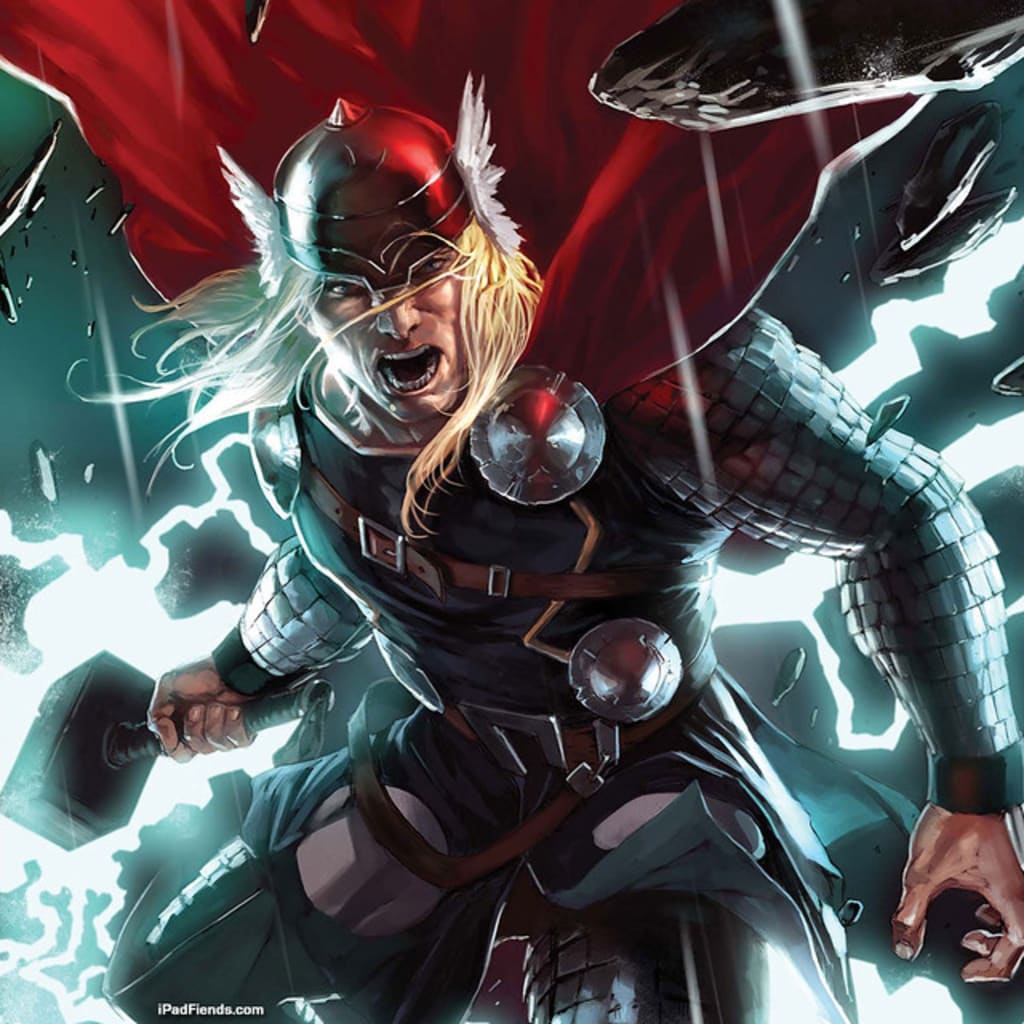
The self-proclaimed protector of Earth, Thor has become one of Marvel's most popular heroes since the Avengers came together on the big screen. For those who want to bring some of the Asgardian prince's rough humor to their Pathfinder games (along with his hard-hitting hammer), it can be done. It might take a few levels and some very careful building, but it can be done.
This guide will get you started.
For those looking for the rest of the Avengers, along with my Gotham Knights and Game of Thrones character builds, check out the Character Conversions page on my blog Improved Initiative! And while you're here, why not take a moment to poke around the rest of my Vocal archive, and see if anything strikes your fancy?
The Metal (Attributes, Race, and Traits)

While Thor looks like a man (albeit a powerful, handsome man), he is not a child of Midgard. With the blood of outsiders running through his veins, one of the most appropriate choices for him is an aasimar. If you give him the Heavenborn background, it would also explain his enhanced knowledge of the planes and the universe, though that would trade in the aasimar's spell-like ability and skill bonuses.
As to his attributes, Strength is perhaps Thor's most notable feature. However, you should give equal consideration to his Wisdom (which gets a handy boost from his racial choice). After that, Charisma and Constitution are your priorities. A high Dexterity and Intelligence are great if you can get them, but won't hurt you in the long run if that's where the low priorities go.
Lastly, the character needs a set of background traits. Some good traits include indomitable faith (+1 to will saves, which is always useful), battlefield caster ( provides a +1 to concentration checks while casting in battle, and a +1 AC bonus against readied actions), and courageous (+2 to will saves against fear effects).
There are other useful traits as well, depending on what your starting attributes are and where your low stats ended up. Reactionary (+2 bonus to initiative checks) can be a good way to make up for a low dexterity when combat is joined, and vengeful (+1 bonus to attacks against enemies that have struck the character) is a useful and thematic fit.
The Forge (Original Build)
Now, at the time I first wrote this guide many years ago, the class that best fit Thor was the cleric, perhaps with a level of two of fighter (which can be slightly balanced by the trait magical knack; giving you a +2 to your caster level up to your total character level). While that is still a valid option (and the one we'll discuss first) there is another one I'm going to list afterward.
Players have several choices at this point. For those who want to play a straight cleric they can follow Torag to gain warhammer proficiency, and take the protection and good domains. The other option is to take 1-2 levels of a class that grants martial weapon proficiency (fighter works best, but barbarian, ranger, etc. are also applicable), or to use a feat to gain proficiency with the warhammer, and then choose Gozreh as a patron. This gives you access to more weather and lightning related powers, and is the path I'd recommend (assuming your DM isn't going to give you Odin as a custom god so you can do all the things you want without stretching your feats and domains).
Domains and Spells
For this build the Air Domain (Core Rulebook, 41) and the Weather Domain (Core Rulebook 48) make a solid base. The Storm Burst power of weather allows for a ranged attack that imposes a -2 on foes and deals nonlethal damage at the same time, while air allows players to shoot arcs of lightning while gaining resistance to electricity. These domains also grant access to thematically appropriate domain spells, such as obscuring mist (don't knock it, battlefield manipulation is a total game changer), call lightning, air walk and other helpful spells.
As to Thor's more "regular" spells, most of those will focus on buffing and protection. Spells like shield of faith (Core Rulebook 342) will never go out of style, while entropic shield (Core Rulebook 279) helps protect against long-range baddies. For those who want to bring the pain though, spells like magic weapon (Core Rulebook 310) are old standbys, but they can only do so much. Spells like instrument of agony (Ultimate Combat 232) , which provides a +2 to intimidate checks while the weapon is held and whose energy may be discharged on a successful hit nauseating a creature for 1d4+1 rounds on a failed save, or leaving it sickened on a successful save, will be lower-level bread and butter. Also, don't forget the sheer usefulness of spells like shatter (Core Rulebook 341). Higher level spells like deadly juggernaut (Ultimate Combat 226 and 227), greater magic weapon (Core Rulebook 310), and others will give Thor serious advantage against any foe. Higher levels are when direct damage dealing spells, such as flame strike (Core Rulebook 283) become an option.
The Alternative Class
I mentioned above there was another, more recent class that might fit the character even better. That is, of course, the warpriest. Debuted in the Advanced Class Guide, the warpriest is a combination of cleric and fighter that allows you to keep your healing powers and spells, while also dealing increased damage and self-buffing. You gain access to cleric spells, but you have fewer of them as a spontaneous caster. You also gain blessings, and if you go this route I'd recommend taking weather and magic (as the former gives you appropriately-themed lightning strikes, and the latter lets your weapon fly from your hand to smash an opponent before returning to your grip).
Both of these classes are equally viable options, but there's a reason I'm not recommending the use of the oracle, the bloodrager, or even the barbarian; because in order for Thor to maintain his powers, and be able to lift his hammer, he must continually prove himself to be worthy. For that important mechanic to function, there has to be a code of conduct (even a vague one) set by the source from which Thor's power flows.
The Polish (Skills and Feats)
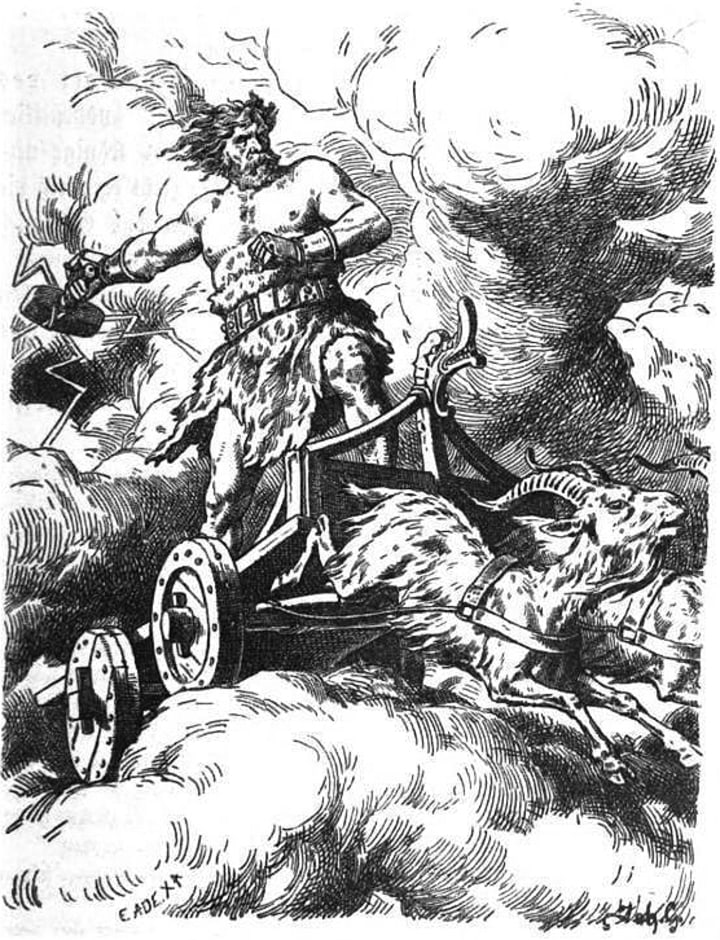
While Thor is looked at mostly as a combat character, he is no dummy when it comes to the knowledge of the nine worlds (as evidenced by him explaining the cosmos to one of the smartest physicists on Earth like it was nothing). An investment in knowledge (religion) and knowledge (planes) fits the character, while knowledge (arcana) is also a good idea. Sense Motive is also a solid choice (Thor did grow up with one of the greatest liars in the Marvel universe, after all), as is Spellcraft. Diplomacy can be useful, but those who want to play a brasher, more aggressive Thor might want to invest in Intimidate (and possibly consider a trait like bully, which provides a +1 on Intimidate checks and makes it a permanent class skill for the character).
Feats must be chosen with care since you don't get many of them regardless of whether you go with cleric or warpriest. A player who wants to show that Thor is possessed of more-than-human durability might want to invest his or her starting feats in Endurance and Diehard (Core Rulebook 122). Players who want to be more proficient with combat early on can take Weapon Focus (warhammer) (Core Rulebook 136) if they don't already get it from the warpriest, and to do more damage they might also want to invest in Power Attack (Core Rulebook 131) along with Furious Focus (Advanced Player's Guide), to get all of the damage on that first swing without taking any of the negatives. Quickened Spell (Core Rulebook 132) is also a good option, because Thor shouldn't be sitting out rounds and buffing when there's battle to be joined.
To better represent Thor's sheer destructive strength some players might want to invest in the sunder feat tree. This includes Improved Sunder and Greater Sunder (Core Rule Book 125 and 126 and 128). This can be useful when it comes time to smash through an opponent's armor, or to destroy an weapon that cannot be allowed to continue doing harm to the party.
The Hammer (Equipment)
This is where most of the thunder god really starts coming together. With items like celestial plate (Ultimate Equipment), Thor can fly in what is technically medium armor that provides a protective bonus that's equivalent to full plate. Cloaks and rings that increase his AC and saving throws are paramount, as is a belt of giant strength or belt of physical perfection (Core Rule Book). A glove of storing (Ultimate Equipment) is also useful for making sure that Thor is never without his hammer.
Speaking of his hammer, Mjolnir is one of his most signature pieces of equipment (if we're not counting Stormbreaker). It's also nearly impossible to build, short of convincing a DM to let you have the Hammer of Thunderbolts (Ultimate Equipment), but relic weapons tend to be off limits to most characters. Considered one of the greatest treasures of the Norse gods, it's important to start in the right place when making one for your Thor... even if it won't be quite as impressive.
A good base for Mjolnir is an adamantine warhammer. Once a player has the gold to get it enchanted though, that is when things get interesting. Ideally Mjolnir would be a +5 Shocking Burst, Thundering, Throwing, Returning, Spell Storing Giant and Aberration Bane (Thor fought outsiders from all over the nine realms) adamantine warhammer, but obviously players can't have all of that. That's why it's important to choose your enchantments carefully. Also, if your DM is willing to allow you to incorporate a flaw/curse to bring down cost, you could make the weapon only truly function for a certain alignment, ensuring only the worthy can wield it.
If a player is satisfied with lightning from spells, then the spell storing and bane enchantments might be enough. If a player wants to bring the thunder, then shocking burst and thundering are options for the hammer as well. Thundering isn't a great investment mechanically, since the warhammer has such a terrible critical hit range, but it is appropriate for the character and theme all the same.
Story and Alternative Rule Options
It's important to remember that this is just one suggested build to bring the thunder god to your Pathfinder game. Players are free to take what they like, and to mix and match it with other ideas they believe work better. That said, there are a few alternatives worth mentioning here.
Take a look at alternate channeling (Ultimate Magic 28-31). Both the air and weather variants provide thematically appropriate and situationally useful benefits. While the cleric heals less with variant channeling, and deals less damage overall, the useful effects of the alternative channel shouldn't be ignored.
Also, some players may feel that Thor isn't served by neutral good. For a chaotic good build that focuses on combat prowess, Gorum is a good choice for domains and flavor (again, if a DM isn't willing to create Odin as a custom god to grant your Thor the domains and powers he needs).
Lastly, know what you want before you even start. The chief cause of getting to level 5 or 10 and realizing that your character has become irrelevant tends to be a hodgepodge character build without a solid, specific end goal in mind. Maybe things happen during the campaign to alter your direction, or to make you change your end goal, but it's still best to have a destination in mind before setting off on your role playing journey. Especially with a character who can be made so many different ways.
Before you go, you may also find the following resources helpful for inspiration:
- A Baker's Dozen of Noble Families: For those who want to lean on your Thor being a prince, then a more in-depth backstory on his family may come in handy.
- 100 Random Oracular Pronouncements: Whether you want your Thor to be given pieces of prophecy from his witch-raised mother, or to simply sound cryptic and wise, it's always a good idea to have a few gems written down for when you need them.
- 100 Fantasy Battle Cries (And Their Histories): While we don't see Thor bellowing a particular call to arms as he enters battle, some of these might be quite appropriate for striking fear in the hearts of Thor's foes.
About the Creator
Neal Litherland
Neal Litherland is an author, freelance blogger, and RPG designer. A regular on the Chicago convention circuit, he works in a variety of genres.
Blog: Improved Initiative and The Literary Mercenary
Keep reading
More stories from Neal Litherland and writers in Gamers and other communities.
How to Build Ghost Rider in the 'Pathfinder' RPG
Everyone knows the story of Johnny Blaze. A daredevil motorcycle rider, he sold his soul to the devil in order to buy his dad a little more time on Earth. The devil kept his end, and then came to demand his due. Johnny found himself saddled with the demon Zarathos, the true Spirit of Vengeance. When innocent blood was spilled, and the guilty walked free, Zarathos took control of Johnny, and transformed him into the Ghost Rider. A being of fire and bone who felt no fear, no pity, and who would not stop until the guilty had been punished.
By Neal Litherland7 years ago in Gamers
Andreas Szakacs Launches Independent Production Company as Summitfall Enters Production
The move marks a notable shift in Szakacs’ professional trajectory — transitioning from performance-focused projects to a broader role in development, financing, and creative oversight.
By Andreas Szakacs7 days ago in Gamers



Comments (1)
"You gain access to cleric spells, but you have fewer of them as a spontaneous caster." Warpriest isn't a spontaneous caster. They are a 6th-level prepared caster.