
Genshin Impact Four Shades: The Hidden Thread of Teyvat’s Fate
Four Shades Introduction

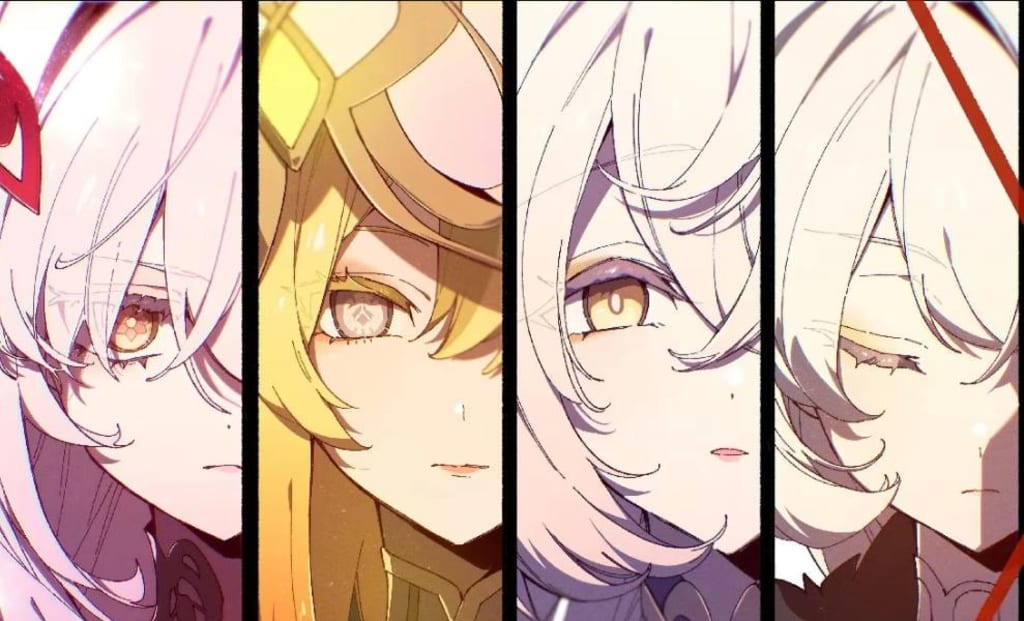
In Genshin Impact’s grand narrative, the “Heavenly Principles Four Shades” serve as the central link connecting the creation myth, the evolution of civilizations, and the shifts in divine authority. These four shadows, separated from the Primordial One Phanes — Naberius, Ruler of Life; Ronova, Ruler of Death; Istaroth, Ruler of Time; and Asmoday, Ruler of Space — not only govern the four fundamental laws that sustain the world, but have also, throughout millennia, left “loopholes in the rules” that foreshadow humanity’s defiance against the gods.
Creation Myth: The Birth of the Four Shades and the Division of Authority
- Ruler of Life Naberius: Governs the birth and propagation of life, with a design that subtly incorporates the structure of a DNA double helix, and heterochromatic eyes symbolizing the human X and Y chromosomes. This deity was once devoured by the “Golden” Rhinedottir, causing the law of life to spiral out of control during the Khaenri’ah Cataclysm, which in turn gave rise to the black beast tide.
- Ruler of Death Ronova: Symbolizes death and endings, guiding the angels to establish the Night Kingdom when Natlan’s ley lines were damaged. Their authority maintains a delicate balance with the Abyssal corruption, yet when confronted with the “Curse of Immortality” from the first Pyro Archon Xbalanque, they still had to rely on a pact with humans to keep the law in balance.
- Ruler of Time Istaroth: Revered as the “Thousand Winds and the Measure of Sun and Moon,” their presence spans the civilizations of Mondstadt, Enkanomiya, and Inazuma. They granted Venti part of their power at the Thousand Winds Temple, reversed time during the Inazuma Cataclysm to help the Sacred Sakura sprout, and even stood alone to guard the Enkanomiya civilization after it sank beneath the earth in Before Sun and Moon.
- Ruler of Space Asmoday: Governs the law of space and is the mysterious being who separated the twin Travelers at the start of the game. Their prolonged absence from the Four Shades’ assemblies led to fractures in the authority over space, with the “spatial distortions” seen in the new Nod-Krai map serving as clear evidence.
The authority of these four deities perfectly corresponds with the artifact system: Flower of Life, Plume of Death, Sands of Eon, Goblet of Eonothem, and Circlet of Logos, forming the fundamental framework of Teyvat’s laws. The five crowns suspended within the domains symbolize the absolute rule of the Primordial One and the Four Shades.
Loopholes in the Laws: The Fatal Flaws of Divine Authority
The 2025 interlude PV The Gods’ Limits fully reveals the vulnerability of the supreme deities through the Four Shades meeting scene. If you’re interested in this PV, you can check out this analysis of genshin shades.
When Rhinedottir created seven artificial lives within the domain of the Ruler of Space, the experiment subjects, tainted by spatial power, began uncontrollably splitting apart. Ruler of Death Ronova had to declare a “conceptual death” to end the entire experiment, but the shattered fragments left permanent scars in the ley lines. This scene exposes two major loopholes in the laws:
Loss of Control over Authority: The power of the Ruler of Life was seized by human alchemy, causing the law of life to mutate into a force of destruction. This phenomenon of “divine power being reverse-engineered by mortals” reaches its peak in Albedo — who is both the inheritor of Naberius’s law and the terminator of the Khaenri’ah Cataclysm.
Failure of Divine Cooperation: The prolonged absence of the Ruler of Space has led to fractures in the law of space. The frequent “spatial distortions” on the Nod-Krai map even allow Travelers to briefly cross dimensions by special means. This chaos in the laws provides an opportunity for the Snezhnayan enforcers to exploit.
What’s even more intriguing is the attitude of the Ruler of Time Istaroth. While the other three Shades discuss how to repair the loopholes in the laws, she quietly gazes toward Enkanomiya — where the civilization she once protected lies dormant. This “bystander” stance suggests that the law of time may have long foreseen the collapse of the divine system.
Human Rebellion: From Loopholes in the Laws to the Reconstruction of Order
The authority loopholes of the Four Shades have given rise to two forces of rebellion throughout history:
Observers of Enkanomiya: During the dark era known as the “Earthquake and Sundering,” brought on by the descent of the Second Throne, Istaroth granted part of their time authority to the Kingdom of Shirakami. Its people developed a unique civilization system by observing celestial bodies and creating their own calendar during the eternal night. This model of “co-creating rules with the gods” became a blueprint for future rebellions.
Revolutionaries of Snezhnaya: The Fatui Harbingers obtain “Radiant Phantasm” weapons through challenges in the “Stygian Onslaught,” which are lost divine arms modeled after the Four Shades’ powers by the Five Sinners of Khaenri’ah. Damselette Columbina’s melodies can disrupt the flow of time, and The Captain’s blade can tear spatial dimensions — these abilities hint that humanity is decoding divine laws through “reverse engineering.”
The new Nod-Krai storyline pushes the rebellion to its climax. When The Jester asks, “What is the price of killing a god?” the camera zooms in on the “Spatial Diamond” emblem on his chest. Combined with the hidden challenge in version 5.7 where the “Transcender” attempts to rewrite the laws, it can be inferred that the ultimate goal of the Snezhnayan Empress is to gather the Four Shades’ powers to create a new world order.
The Four Shades’ lore deeply reflects Genshin Impact’s core philosophy: all rules have loopholes, and all gods have limitations. Venti’s Anemo Archon power comes from a fragment of Istaroth, Zhongli’s contract system is a humanized adaptation of the law of death, and Raiden Shogun’s eternal pursuit turns obsessive due to the absence of the Ruler of Time — these divine stories are essentially partial corrections of the Four Shades’ laws.
About the Creator
Keep reading
More stories from writers in Gamers and other communities.
When Is a Move Final?
The Commitment Problem in Modern Chess Modern chess operates under a fractured commitment model that no longer aligns with how players think, how turns function in most games, or how chess itself is actually played across physical and digital formats. At the heart of the problem is that chess treats physical contact with a piece as binding commitment while simultaneously relying on a separate explicit action to end a player’s turn. This creates a logical contradiction: a move becomes final before the turn is over. In most turn-based games, interaction with game components is provisional until the player explicitly signals the end of their turn. Chess is an anomaly in this respect, and the inconsistency becomes increasingly visible in modern play.
By Peter Thwing - Host of the FST Podcast2 days ago in Gamers
U4gm ARC Raiders: Headwinds Update Guide
Embark Studios has launched the highly anticipated Headwinds update for ARC Raiders. Packed with new features, challenges, and missions, this update caters to veteran players while keeping returning players engaged. From the intense Solo vs Squads mode to the dynamic Bird City, and the newly introduced Player Projects, Headwinds adds layers of strategy, exploration, and long-term goals.
By Billo Naliabout 17 hours ago in Gamers
🅼🅸🅳🅽🅸🅶🅷🆃 🆂🅽🅰🅲🅺🆂
"It's 10 in Tuscon! We all know what that means... It's Time for Midnight Snacks with your man, Gerald Gee! Ready to spend the night together? Me too! I'm full of snacks and can't wait to regurgitate them all back into your hungry ears. Crack a brew! Pop some corn! Anything to get ready for one hell of a show where the talk maybe cheap but the words cut deep...
By Lamar Wiggins5 days ago in Fiction


Comments