
Forza Horizon 6 (Tokyo, Seoul, Rome)
If FH6 Added Real City Scale (Tokyo, Seoul, Rome)

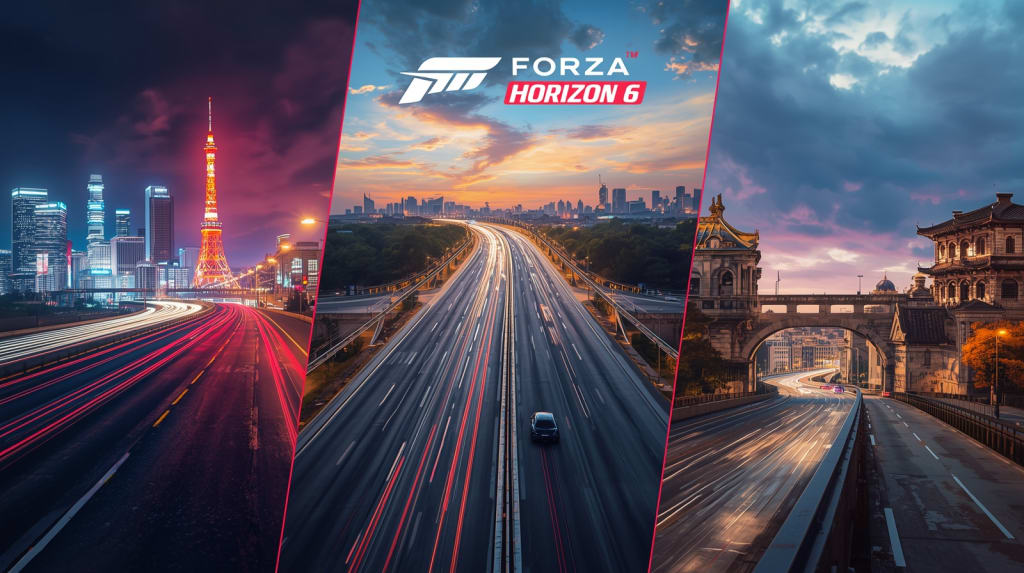
If Forza Horizon 6 were to introduce real, full-scale cities such as Tokyo, Seoul, and Rome, it would represent one of the most transformative changes in the franchise’s history. The Horizon series has always focused on large map regions inspired by real environments rather than perfectly accurate city layouts. But using real city scale would change how players explore, compete, and experience the game world. Each of these cities brings its own character, street pattern, culture, and driving style, and incorporating them at realistic scale could turn FH6 into one of the most diverse open-world racing titles ever created.
To start with, Tokyo would be an instant icon. With its blend of neon-lit skyscrapers, expressways, tight alleyways, and massive multi-lane avenues, Tokyo is a dream environment for night racing. A full-scale Tokyo would allow FH6 to recreate the legendary Wangan expressways, enabling long high-speed runs where players push hypercars to their limits. Meanwhile, the tight Shibuya and Shinjuku blocks would be perfect for street-level technical racing with sharp turns, heavy traffic, and visual chaos. Tokyo’s personality—modern, vibrant, fast, and illuminated—fits perfectly with the Horizon series’ festival style. The contrast between expressway speed and inner-city precision driving would bring unprecedented gameplay variety.
Seoul, on the other hand, offers a very different but equally compelling driving experience. It blends futuristic architecture with wide riverside highways and steep hillside districts. Seoul’s long bridges across the Han River could deliver high-speed sprint races, while districts like Gangnam offer wide boulevard-style racing with clean lines and smooth curves. The city’s mountainous outskirts, such as Namsan and the winding roads leading toward the city edges, would give FH6 natural hill climbs and drifting routes built right into the geography. Seoul’s combination of modern infrastructure, dense commercial zones, and scenic elevated roads creates a dynamic driving playground that balances high-speed potential with technical challenge. Its unique mix of nature and architecture would add a distinctive identity within FH6’s world.
Then there’s Rome, a city defined by its rich history and dramatic architecture. A full-scale Rome in FH6 would create a drastically different tone compared to Tokyo and Seoul. The narrow cobblestone streets, ancient plazas, iconic landmarks, and complex intersections would push players into strategic driving focused on handling rather than raw speed. Racing past the Colosseum or weaving through streets near the Vatican would provide unmatched atmosphere and cultural immersion. Rome’s wide-open roads along the Tiber River could serve as high-speed sections, but the true appeal would lie in mastering its historic streets and scenic routes. Beyond the urban core, surrounding Italian countryside—rolling hills, vineyards, and coastal roads—could naturally extend the map and offer a beautiful contrast to the dense city center.
If FH6 included all three cities in realistic scale, the game would essentially offer three different racing identities in one world. Tokyo would deliver modern urban speed, Seoul would focus on futuristic structure and elevation, and Rome would provide heritage-driven street racing and scenic routes. The variety of road types—tight alleys, massive highways, hillside roads, bridges, tunnels, and historic plazas—would elevate FH6’s gameplay to a level of diversity not seen in any previous Forza Horizon title.
The challenge, of course, would be map size. Realistic-scale recreations of entire cities are massive undertakings, especially when players can travel at extreme speeds. Playground Games would need to rethink rendering, streaming, and map optimization. But the payoff would be enormous. With next-generation hardware capable of faster loading, higher memory bandwidth, and improved world streaming, a set of multi-city open-world regions may finally be possible without performance compromise.
Real-scale cities would also open up fresh event design. Street takeover events could happen in one district, while highway endurance races take place miles away. Players could drift mountain passes outside Seoul, participate in technical checkpoint races in Rome, then finish the night with Wangan-style speed battles in Tokyo. The game could even introduce international travel, letting players warp between cities while keeping all three as part of a single global festival experience.
The visual diversity would be equally transformative. Tokyo’s neon glow, Seoul’s modern skyline, and Rome’s ancient stone architecture would bring contrasting palettes that showcase next-gen lighting, reflections, volumetrics, and texture detail. Photographers in the community would gain countless unique spots for capturing cars in cinematic environments.
In short, if Forza Horizon 6 introduced full-scale cities like Tokyo, Seoul, and Rome, it would redefine what an open-world racing game can be. It would merge cultural authenticity, structural realism, and signature Horizon freedom into one massive global festival. This approach wouldn’t just evolve the franchise—it could set a new standard for the entire genre.
About the Creator
Keep reading
More stories from Games Mode On and writers in Gamers and other communities.
Forza Horizon 6 Volumetric Clouds
As the gaming world begins to speculate about the visual and technical advancements of Forza Horizon 6, one feature consistently appearing in discussions is the possibility of volumetric clouds. While the term might sound like just another graphical upgrade, volumetric clouds represent one of the most significant leaps a racing game can make in terms of atmosphere, lighting, realism, and immersion. If FH6 is indeed adopting this technology, it may dramatically transform not only how the game looks but how it feels to explore its open world. To understand the magnitude of this leap, it's essential to break down what volumetric clouds are, why they matter, and how they could potentially elevate the Horizon series to new heights.
By Games Mode On2 months ago in Gamers
Code Violet Review: A Dino Crisis Dream or a Prehistoric Misfire?
Let’s get something straight right from the top—you’re not here for sugar-coating. Code Violet is not a good game. If you saw a few stylish (and sometimes not-so-tasteful) screenshots of its stunning brunette protagonist tangling with dinosaurs and thought, “Hmm, maybe I’ll pick this up just to admire the view,”—hey, no judgment… well, maybe a little.
By Info Post Gate4 days ago in Gamers
Rsvsr Mega Evolutions Are Coming to Pokémon TCG Pocket – Get Ready!
If you’re a Pokémon fan, chances are you’ve been hooked on Pokémon TCG Pocket, the digital card game that lets you collect, trade, and battle Pokémon right from your phone. Well, there’s exciting news: the game is about to get a major update with Mega Evolution cards! And yes, that means Pokémon like Mega Gyarados, Mega Blaziken, and Mega Altaria are coming to your decks.
By Dangyc Ding4 days ago in Gamers



Comments
There are no comments for this story
Be the first to respond and start the conversation.