
Flint Treasure of Oblivion | Review - Pirates on the High Seas
A turn-based strategy RPG that focuses on story and setting, but lacks overall polish and gameplay Flint's review.

The crowning achievements of memorable years in video games are not only the big blockbusters, but also the minor and unexpected titles, the ones that Americans call "underdogs", that appear out of nowhere, often without any advertising hype or a noteworthy budget.
We leave it to our readers to judge the 2024 that we have just left behind (even if we have already expressed our opinion in the SpazioGames Awards ), but we regret to inform you that if Flint Treasure of Oblivion had the credentials to become a sleeper hit, it played them badly, ending up disappointing.
The Fame of Captain James Flint
Set in the 17th century, and loosely based on the events narrated in the great classic Treasure Island by Robert Louis Stevenson, Flint Treasure of Oblivion revolves around the eponymous captain and his adventurous lifestyle of boardings, escapes, prison breaks, adventures and shootouts.
From Risen to Assassin's Creed , passing through the recent Ys X Nordics , the pirate setting has already been widely exploited in the videogame field – but, despite the general lack of originality, it cannot be said that the development team has worked badly on the narrative side.
Many of the situations feel already seen and a few jokes arrive too late, but there are also a couple of genuinely funny scenes and just as many characters written well enough to deserve more screen time than they actually get during the fifteen or so hours needed to complete a first (and probably last) run.
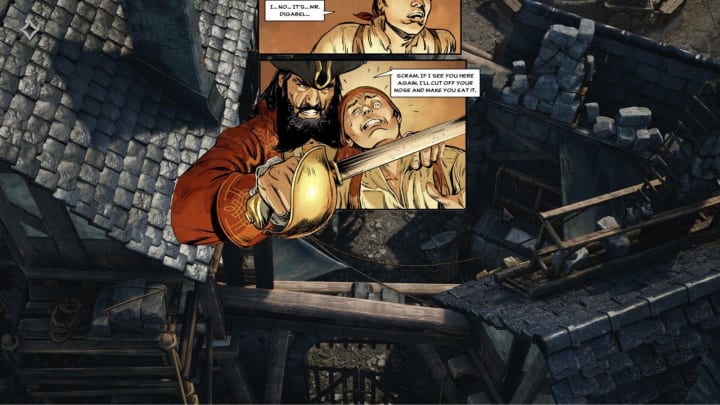
The narrative is conveyed through cutscenes and comic-style balloons, which give the whole thing a feel similar to American comic books, even though both the developers (Savage Level) and the publisher (Microids) are actually French.
Flint's overflowing personality will keep the player company from the beginning to the end and, by precise choice of the developers, the tone used is not the sweetest and most romanticized.
The romantic vision of the pirate with his own code of conduct and good nature is here completely discarded , in favor of a representation more faithful to the historical events and behaviors that, according to history books, were typical of this hodgepodge of human cases.
Captain James Flint, as depicted by Savage Level, is ruthless, selfish, greedy and treacherous (but he also has some flaws!) , and impersonating him could create some ethical conflict in players who are more used to making their alter egos spotless paladins.
Historical accuracy is also evident in the recreation of weapons, clothes and certain interiors, and testifies to the development team's firm intention to immerse the player in a virtual world that is as close as possible to the real world of the time.
From this point of view – and only from this, unfortunately – we have no difficulty in saying that Flint Treasure of Oblivion is a complete success.
Turn-based bugs and lazy pointers
To the classic turn-based tactical RPG mechanics (bird's eye view, hexagonal board to move on and a handful of specializations available for each fighter) Flint adds further subsystems, such as the presence of cards, which add statistics and special abilities, and the rolling of dice , which adds a random component to each turn of each battle, with all that this entails in terms of strategy.
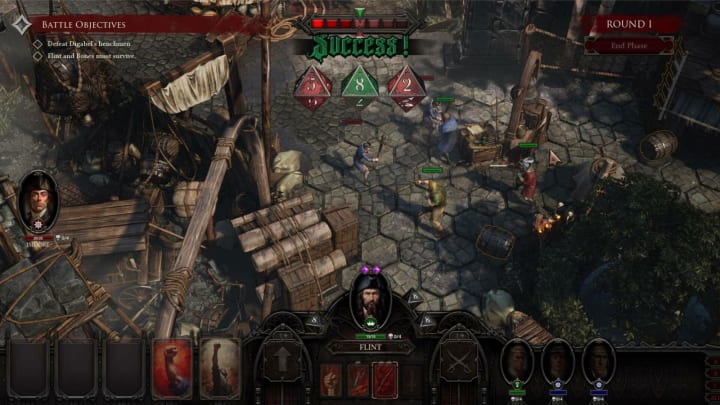
While in the long run the player's party will become strong and varied enough to overcome even a series of bad throws, during the first few hours having Lady Luck against you can mean seeing your battle plan go up in smoke or even suffering an annoying defeat.
And that's a shame because, on paper, the ingredients for a decent turn-based strategy game are all there: the protagonists' arsenal varies from melee weapons to firearms, and the player is granted a good level of environmental interaction, with explosive barrels, heavy crates and environmental obstacles that play an active role in many battles, thus broadening the range of options available to the player.
Aside from the technical issues, which we will discuss in the next paragraph, Flint never gives the player the impression of being in complete control of the situation , which is a rather serious thing in a tactical RPG: the tutorials are hasty and do not cover many of the mechanics underlying progress and the controls , at least in the PS5 version we tested, have been poorly adapted to the pad .
It's very difficult to find interaction points on the maps, both during exploration and during combat, because a lazy job has been done on the adaptation between the mouse pointer and that of the controller - and, as if that weren't enough, it often happened that an object with which it was actually possible to interact didn't respond to our input , remaining highlighted without unlocking the consequent function.
None of these issues prevented us from reaching the end credits, but to do so we often had to reload a previous save, even losing several minutes of gameplay that may have included one or more battles won.
The assortment of bugs is remarkable , much larger in proportion than those encountered in the recent and much larger STALKER 2 : they range from characters trapped in endless animation loops to missing switches, to party members who simply refuse to carry out the orders given to them by the player during their turn in battle.
While in the case of the aforementioned GSC Game World title, one was more inclined to forgive certain flaws, due to the situation in which the game was developed and the actual scope of the title (a huge open world with thousands of interconnected systems), it is difficult to understand how, in a title so small in terms of production values and size, certain problems survived the beta testing phase.
In this regard, it is worth noting that the role-playing soul of Flint is actually much more subtle than we thought: secondary quests are lacking, the paths are almost always forced and there is not much room to customize the growth of the party members, which in fact remains rather guided within the scope of what was foreseen by the development team.
From the narrative to the composition of the party, everything remains on rigid and blocked tracks, leaving the player in the role of spectator in too many moments: from the story, which requires minimal interactions, to the management part of the gameplay.
Defining Flint Treasure of Oblivion as a lite SRPG or, in Italian, a light role-playing game , then, does not seem far-fetched.
Different orders of problems
Despite the stylization of the characters and the modest polygon count, we encountered several drops in frame rate during our test , often completely unrelated to what was happening on the screen.
In fact, it is not during the most intense or crowded battles that we noticed these phenomena - but rather, in proximity to some automatic saves, sudden changes of shot and certain actions carried out in the game, such as multiple shots at the same target.
The problem therefore seems to be more related to a lack of optimization than to a particularly heavy game engine , and so we hope that the development team will get to work on the code as soon as possible (a couple of patches have already been released after day one) to refine it and give users a smoother experience.
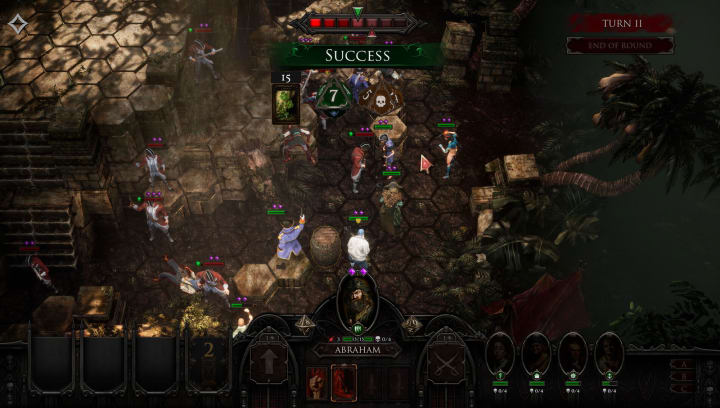
The use of the powerful Unreal Engine 5 would have led one to expect much better results, although, to be fair, the settings are quite well made and the character models aren't bad: probably the development team's inexperience with this engine didn't allow them to fully exploit its capabilities.
To the black list we must add a large number of polygonal interpenetrations (some more impactful than others because they have effects on gameplay during battles), animations that repeat in a loop, graphic glitches and objects that disappear and reappear depending on the camera angle: nothing that good post-launch support cannot fix, but it is necessary to report these problems during the review phase.
To complete the picture, I personally believe that Flint 's gaming proposal is also out of focus compared to the launch price imposed by the publisher, which will struggle to seduce fans of role-playing games - considering that with 50 euros you can take home something of much greater importance, nowadays.
About the Creator
Level Up Your Life: How Gaming Builds Skills, Friends, and Succes
"Think gaming is just a way to kill time? Think again. Every quest you complete, every strategy you master, and every battle you fight is secretly leveling up your brain, your skills, and your real-life potential. Gaming isn’t just entertainment—it’s training for life."
By Zakir Ullah6 days ago in Gamers
Essential Golf Tips Every Beginner Needs to Improve Their Game
Golf is a rewarding sport that combines skill, patience, and strategy. For beginners, the game can feel challenging because it requires mastering several techniques at once. Many new golfers focus too much on hitting the ball far instead of learning the fundamentals that lead to consistent performance. Improvement comes from developing good habits early, practicing with purpose, and understanding how each part of the game works together. With the right approach and consistent effort, beginners can build confidence and steadily improve their performance on the course.
By Daniel Ladner4 days ago in Gamers
Hottest in the Office
Dear Rafi, You’re very distracting to work around. For the first second I saw you the other day, I thought you were some type of executive. It took a moment to realize no, you were just the new guy, dressed up for the job he wants. Be still, my heart.
By Gabriel Shames6 days ago in Pride



Comments
There are no comments for this story
Be the first to respond and start the conversation.