
Dungeon Map Templates: Plug-and-Play Layouts for Fast Session Prep
Speed Up Your D&D Game Prep with Ready-to-Use Dungeon Layouts for Any Adventure

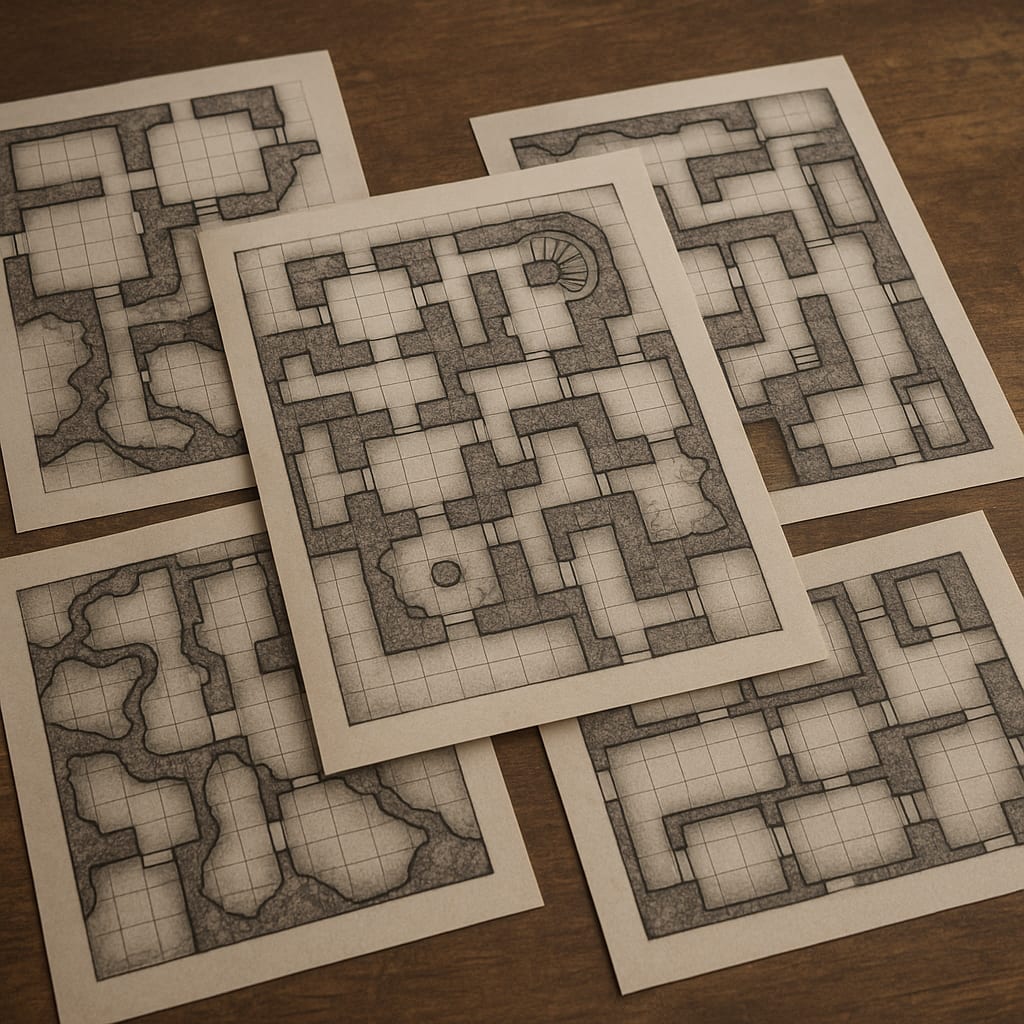
When you're staring down the barrel of a game night and haven't prepped a dungeon yet, panic tends to set in. You want something that feels unique, but you don’t have hours to spend drawing perfect corridors or inventing a clever layout. That’s where dungeon map templates come in—ready-made, modular maps designed to drop into your campaign with minimal effort. Whether you're a veteran Dungeon Master running multiple campaigns or a new DM trying to survive your first one-shot, plug-and-play dungeon layouts can be a true lifesaver.
In this in-depth article, we’ll explore what makes dungeon map templates valuable, the types you’ll want in your toolkit, and how to use them effectively without making your players feel like they’re walking through something pre-fabbed.
Why Use Dungeon Map Templates?
Designing a dungeon from scratch is time-consuming. You need to think about layout logic, challenge pacing, thematic consistency, and player engagement. Dungeon map templates do a lot of that work for you. These are pre-designed maps that follow common fantasy logic—things like secret doors, forked tunnels, layered elevations, and trapped halls—but they’re left flexible enough for your story to shine.
Instead of planning every square, you focus on populating the space with story beats, encounters, and loot. The skeleton is done. You get to flesh it out.
Templates are especially useful for:
- Last-minute prep
- One-shots
- Side quests
- Drop-in dungeons during sandbox play
- Backup plans for when your players veer wildly off track
And they’re not just for digital tabletops. Print them. Sketch over them. Trace them. These layouts work as battle maps, narrative guides, or full tactical spaces depending on what your session needs.
Key Features of Great Dungeon Templates
Not all templates are created equal. The best ones have a mix of design principles that keep players guessing and engaged.
1. Branching Paths and Loops
A good dungeon doesn’t feel like a straight hallway from start to boss. Templates with multiple paths, hidden shortcuts, and looping structures offer exploration choices and strategic planning.
2. Varying Room Sizes and Shapes
A map made entirely of rectangles is boring. Quality templates mix in circular chambers, L-shaped passages, choke points, and open spaces. That variation isn’t just visual—it impacts combat, stealth, and puzzle design.
3. Modular Segments
Some templates are designed as modular tiles. You can snap them together in dozens of combinations. This makes them reusable and endlessly customizable.
4. Thematic Consistency
A crypt feels different than an abandoned mine or an arcane vault. Strong templates lean into environmental storytelling—walls cracked with roots, altars with bloodstains, or fungal growth spreading through collapsed halls.
5. Grid-Ready Format
Whether you’re using Roll20, Foundry VTT, or pen and paper, having a clear 5-foot-per-square grid helps with movement and positioning. Good templates don’t sacrifice function for aesthetics.
Types of Dungeon Templates to Keep Handy
Some templates are designed with specific themes and mechanics in mind. Here are a few categories every DM should consider adding to their collection.
Classic Dungeon Crawl
These are your bread-and-butter. Think corridors, locked doors, hidden levers, and monster lairs. They’re perfect for traditional fantasy adventures with traps, puzzles, and gradual escalation toward a final encounter.
Forgotten Temple
Expect symmetry, ceremonial halls, and lore-rich rooms. These work well when you want the players to uncover the past through exploration. Statues, murals, and relic chambers create a backdrop for mystery and revelation.
Underdark Caverns
These maps embrace irregular shapes, water features, verticality, and hidden tunnels. Great for survival-focused sessions or anything involving drow, duergar, and cave-dwelling horrors.
Abandoned Fortresses
More structured and military in design. These often include barracks, watch posts, armories, and battlements. Perfect for siege scenarios, political intrigue, or a haunted stronghold.
Arcane Laboratories
Expect teleportation circles, experiment rooms, unstable magical nodes, and arcane puzzles. These templates shine in high-magic campaigns where you want your players to question reality—or blow it up.
Modular Rooms and Halls
Rather than full maps, this style gives you a set of rooms, intersections, stairwells, and entrances that you can piece together as needed. Highly adaptable and ideal for improvisation.
Tips for Making Templates Feel Unique
Even the best map template risks feeling generic if you don’t personalize it. But that doesn’t mean you need to overhaul the design. Small adjustments go a long way.
Re-skin with Story
The same layout could be an orc lair, a thieves’ guild hideout, or a cursed dwarven tomb depending on your narration and set dressing. Add details: what do the walls smell like? What markings are carved into the doorframes?
Adjust the Lighting
Is the dungeon pitch black? Gently glowing with phosphorescent moss? Lit by flickering braziers? The way you describe light can completely change how a room feels.
Place Meaningful Objects
A broken sword, a cryptic note, or a cursed goblet—all of them change the dynamic of a room. Don’t let it be just “the room to the north.” Let it be “the chamber where the blood never dries.”
Introduce Dynamic Elements
Collapsing ceilings, flooding corridors, shifting walls—these mechanics make a static map feel alive. Even if you’re using a template, players will feel like they’re navigating a space that responds to them.
Re-orient the Layout
Flip or rotate the map. Suddenly, what was once a south-facing exit now becomes a hidden northern alcove. It doesn’t take much to fool the eye and surprise your players.
Where to Find Quality Dungeon Templates
You don’t need to look far. Several websites and tools offer high-quality, plug-and-play maps:
- Dyson Logos: Classic black-and-white hand-drawn maps with strong architectural logic.
- 2-Minute Tabletop: Beautiful modular tiles with rich environments and styles.
- Dungeon Scrawl: A free web tool to quickly generate dungeon layouts based on templates or your own tweaks.
- Inkarnate: Though better for overworld maps, it has some powerful tools for dungeon design using pre-built assets.
- Reddit (r/battlemaps and r/dndmaps): A treasure trove of free templates posted by generous creators.
- Patreon Creators: Many artists offer massive libraries of modular or themed templates for a small monthly fee.
If you prefer print, several Dungeon Masters’ guides and adventure modules include reusable templates, especially older 3.5e and 4e sourcebooks.
Templates as Tools, Not Crutches
Dungeon map templates don’t make you less creative. They give you a structure so you can focus on the part of DMing that players remember most—the story. Use them wisely. Personalize them. Remix them. Subvert them. You’ll prep faster, improvise better, and free up mental space to craft unforgettable moments.
Next time you’re scrambling an hour before game night, don’t panic. Reach into your vault of dungeon templates, plug one into your session, and breathe easy. You’ve got this.
About the Creator
Richard Bailey
I am currently working on expanding my writing topics and exploring different areas and topics of writing. I have a personal history with a very severe form of treatment-resistant major depressive disorder.
Keep reading
More stories from Richard Bailey and writers in Gamers and other communities.
Assassin’s Creed Shadows Weapon Types – All Confirmed Weapons and How to Unlock Them
The weaponry in Assassin’s Creed Shadows is as varied and intricate as feudal Japan itself. With two playable protagonists—Naoe, the agile shinobi, and Yasuke, the formidable samurai—the game introduces a diverse arsenal suited to different combat styles. From swift assassinations in the shadows to devastating swordplay in open battle, every weapon is tailored to enhance stealth, power, or precision.
By Richard Bailey7 months ago in Gamers
U4gm Stepping Into the Mirage: What It’s Really Like to Play Path of Exile 1’s New League
For longtime adventurers in Wraeclast, the announcement of the Mirage League (3.28) for Path of Exile 1 is nothing short of thrilling. This league isn’t just a seasonal refresh—it’s a complete reimagining of how the endgame feels. Mirage promises to challenge, surprise, and reward players in ways that make every map run feel alive.
By Billo Nali7 days ago in Gamers



Comments
There are no comments for this story
Be the first to respond and start the conversation.