
DnD is preschool
Time to graduate into Vampire

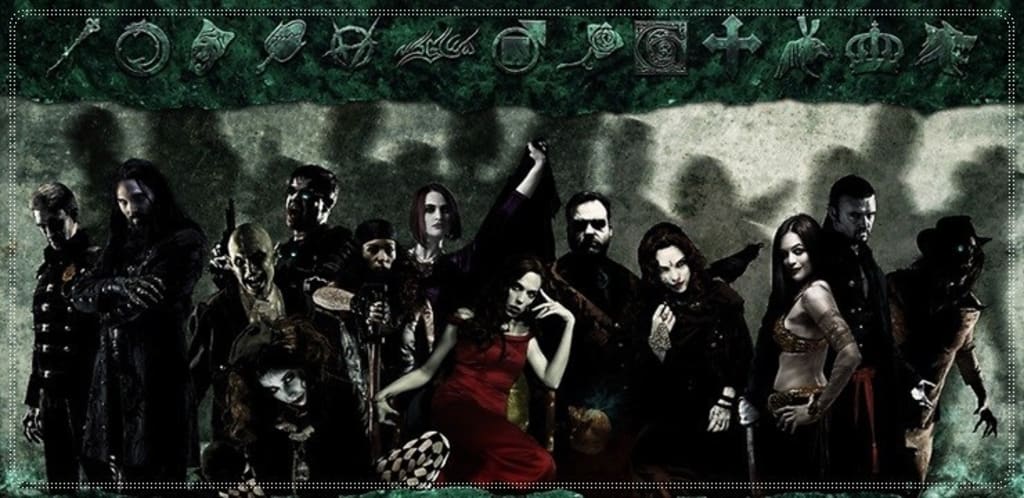
Fifth edition made Dungeons and Dragons mainstream. And with a score of new role-players out there, that's a wonderful thing. But with eight years under its belt since the 2014 debut of the game, an entire generation of players are ready to graduate to something more nuanced. Don't get me wrong, I love Dungeons and Dragons that works well, is generally balanced, evokes the fantasy genre well, has defined protagonists and antagonists and delivers a clear narrative. But its not the only way to skin a cat... And after cutting their teeth in dark, dank dungeons, this generation of players is ready for Vampire: The Masquerade.
Vampire was released in 1991 and, like Dungeons and Dragons, is in its fifth edition. Where Dungeons and Dragons offered players the premise of being the heroes of a fantasy adventure, Vampire presented them with the terrifying reality of actually being a monster. In Vampire, players have to hide what they are, hunt and eat humans, contend with heroes, and other actions that in Dungeons and Dragons would result in the monster (presumably) being slain by a band of heroes.
In Dungeons and Dragons, there is good and there is evil, there is law and there is chaos...
Vampire lacks the alignment system of Dungeons and Dragons. Rather, player and non-player characters alike have motivations that are articulated through desire, personal history, ideology or other aspects that could be applied to figures in films or novels as much as those in a game. An antagonist doesn't act in a certain way because of two abstract words like Chaotic Evil or Lawful Good, but because they believe their actions are beneficial or necessary, if not both. This opens the field for characters to be characters and for the players to drive their character actions accordingly. An antagonist one week may turn into an ally the next; people sit on the fence, or go to extremes based on the situation.
In Dungeons and Dragons, you are strong and powerful...
Certainly, you are strong in Vampire. You are, after all, a vampire - you have special powers (called Disciplines), are generally stronger and hardier than most humans, and then, there's the immortality. But there's a whole world of vampires out there, not to mention other kinds of monster as well. Where Dungeons and Dragons gives you a level and threats that are beatable for a party at that level, Vampire offers no such reassurances. Characters must look at and access their actions and the threats they face for themselves. Actions require thought, and mistakes have consequences.
In Dungeons and Dragons, the adventure is violent...
While there can be and usually is violence in Vampire, combat itself is not an end goal. Vampires exist in secret and are politically intertwined with the cities that serve as their territory. If a Prince is giving the party grief, they can't just burst into their lair and fight their way through guards until they come to a boss fight without similar consequences to if someone did that to their local mayor in real life. To remove the Prince, the character's need to garner influence, make alliances, do favours... in short, interact with the world and its occupants and in doing so, inhabit the game world itself.
About the Creator
Nicholas William Moll
Dr. Nicholas William Moll is an independent researcher, educator and freelance writer based in Australia. His work includes a focus on the interweaving of genre and literary convention, game design and gamification with cultural history.
Keep reading
More stories from writers in Gamers and other communities.
u4gm Where to Find and Beat Blackjaw in PoE 2
You don’t mark him on a checklist or plan your build around him. You meet him the way Path of Exile 2 loves to introduce its best encounters: by surprise. You’re exploring Jiquani’s Machinarium, dipping into the Oubliette a little earlier than you probably should, flasks half-drained, confidence slightly higher than your actual Exalted Orb buy safety margin. Then suddenly, Blackjaw, The Remnant is there, and the game quietly asks whether you actually understand movement yet.
By Asik Gxbx Hdjdh4 days ago in Gamers




Comments
There are no comments for this story
Be the first to respond and start the conversation.