
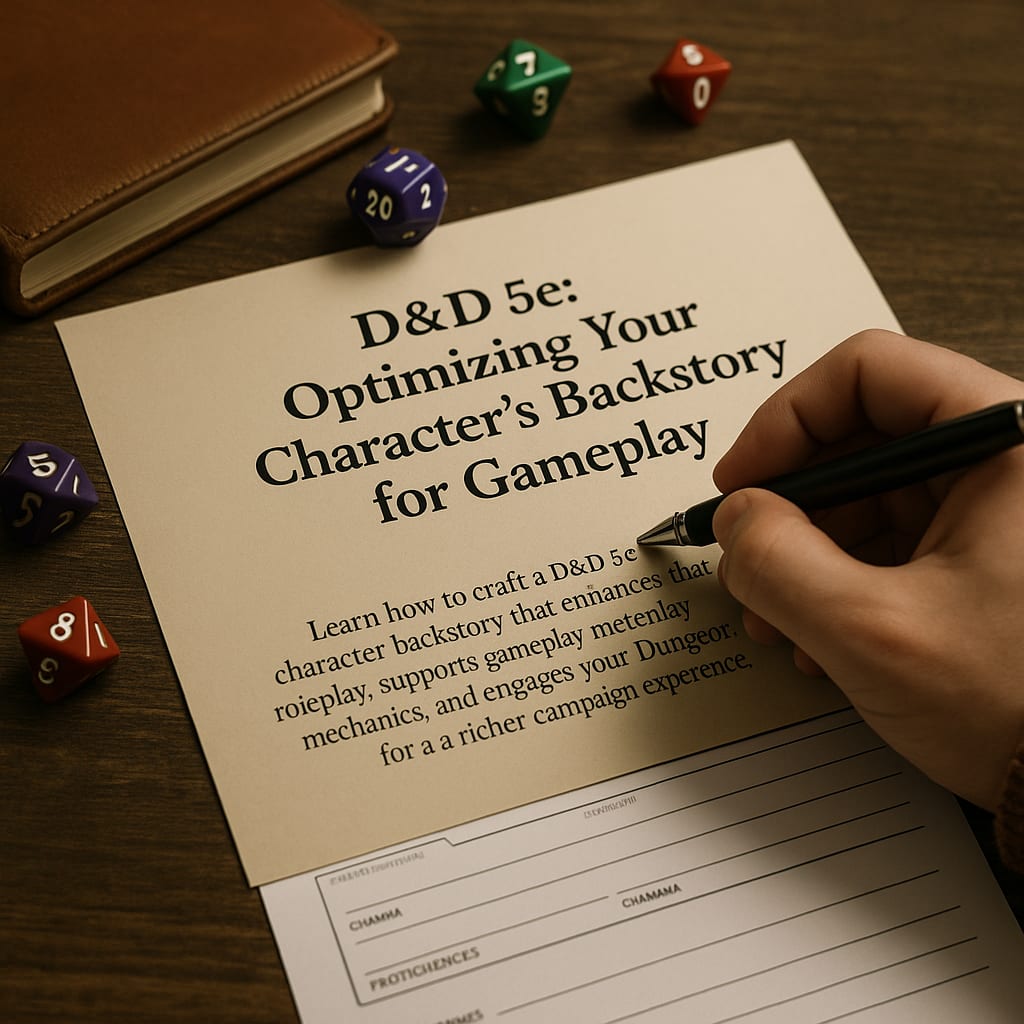
D&D 5e: Optimizing Your Character's Backstory for Gameplay
Learn how to craft a D&D 5e character backstory that enhances roleplay, supports gameplay mechanics, and engages your Dungeon Master for a richer campaign experience

Creating a character in Dungeons & Dragons 5e is more than just picking stats and spells — it’s about telling a story. Your character's backstory is the foundation for roleplaying, storytelling, and personal engagement throughout the campaign. But how do you write a compelling backstory that also enhances your gameplay? This guide will walk you through the steps to optimize your D&D 5e character’s backstory for maximum roleplay, immersion, and synergy with your party and campaign.
Why a Backstory Matters in D&D 5e
Your character's backstory isn't just flavor — it can impact:
- Roleplaying and immersion
- Character motivations and decision-making
- DM plot hooks
- Skill proficiencies and feats
- Character growth and personal quests
A well-thought-out backstory gives the DM material to weave your character into the world and creates opportunities for meaningful gameplay moments.
1. Align Your Backstory with the Campaign Setting
Before writing your backstory, talk to your Dungeon Master. Understand the campaign setting, themes, and tone. Is it high fantasy, grimdark, or political intrigue? If you're playing in a desert kingdom, your snowbound barbarian may not make much narrative sense — unless you explain how they got there.
Tips:
- Ask for a campaign primer or lore summary.
- Tie your origins to known factions, cities, or historical events in the world.
- Use location-based backgrounds (like City Watch or Outlander) to add relevance.
2. Define Core Backstory Elements
Break down your backstory into digestible parts. Use the following structure:
A. Origin
Where was your character born? What social class were they raised in? What was their childhood like?
B. Inciting Event
What was the key moment that pushed them toward adventuring? Was it a tragedy, a calling, a mistake?
C. Goals and Motivations
What drives your character? Revenge? Redemption? Power? Curiosity?
D. Flaws and Trauma
No character is perfect. Flaws and past wounds make for interesting roleplay and challenge resolution.
Example:
- Origin: Grew up in a mining town plagued by goblin raids.
- Inciting Event: Parents killed in a cave-in caused by sabotage.
- Goal: Uncover the truth and bring justice.
- Flaw: Quick to judge and slow to trust.
3. Tie Traits to Gameplay Mechanics
Make your roleplay choices complement your class and mechanics.
Examples:
- A Paladin who took an oath after losing a loved one can drive the narrative forward with vengeance or protection.
- A Rogue with a criminal past may leverage stealth and thieves’ cant during espionage arcs.
- A Sorcerer born with wild magic might suffer (or enjoy) accidental spell surges that tie into their chaotic upbringing.
By aligning your character's history with their class features, you reinforce why they have the skills they do, which enhances immersion.
4. Integrate Backstory Hooks for the DM
Work with your DM to plant seeds that they can weave into the story. These include:
- Missing family members
- Ongoing rivalries
- Secret identities
- Undiscovered artifacts
Let your DM know which NPCs or events in your past could show up during the campaign. This not only boosts engagement but makes your character feel like part of the world.
5. Balance Drama with Playability
Avoid making your character too “edgy” or so traumatized that they can't function in a party. While tragic backstories are popular, remember that your character needs to work with others and contribute to a shared story.
Pitfalls to avoid:
- The lone wolf who refuses to bond with the group
- Excessive baggage that makes roleplay uncomfortable
- Backstories that demand constant spotlight
Instead, create room for growth — start flawed, but give your character the chance to evolve through gameplay.
6. Use Backgrounds Creatively
Backgrounds in D&D 5e provide skills, proficiencies, and tools — but they also give story structure. Don’t treat them as a mechanical afterthought.
Popular Backgrounds and How to Enrich Them:
- Acolyte – Maybe your devotion is being tested, or your god speaks to you in strange ways.
- Folk Hero – What did you do to become famous? Are you living up to your reputation?
- Criminal – Are you hiding from your past, or still involved with a thieves’ guild?
Consider customizing backgrounds with your DM if none fit perfectly. The Player’s Handbook allows for this flexibility.
7. Write a Short Summary for the Table
Your full backstory might be a page long or more, but have a 2-3 sentence summary ready for session one. It helps your fellow players understand your character quickly and sets the tone for early interactions.
Example:
"Doran is a former city watch officer who fled his post after uncovering corruption. He now wanders as a sellsword, hoping to redeem his past by doing what's right — even when it’s hard."
8. Evolve Your Backstory Through Play
Think of your backstory as a prologue — not a script. Leave open threads that can develop based on what happens in-game. Maybe your long-lost sister appears. Maybe the cult that ruined your life resurfaces. Let your story grow with your character.
Key tip:
Reflect on major events after each arc and adjust your character's beliefs, goals, or fears accordingly.
Make It Meaningful, Not Perfect
There’s no “perfect” backstory — only one that fuels your roleplay, complements your character, and deepens the story for everyone at the table. Whether you're a seasoned bard or a new player rolling your first d20, taking the time to build a backstory that supports gameplay will make every session more memorable.
Frequently Asked Questions
Q: How long should a D&D backstory be?
A: One to two pages is a good starting point. More important than length is clarity and potential for story integration.
Q: Can I write a tragic backstory?
A: Absolutely! Just ensure it leaves room for growth and doesn’t overshadow the party dynamic.
Q: Should my backstory include other characters or factions?
A: Yes — including NPCs, rival groups, or family members gives your DM more tools to tie your story into the campaign.
About the Creator
Richard Bailey
I am currently working on expanding my writing topics and exploring different areas and topics of writing. I have a personal history with a very severe form of treatment-resistant major depressive disorder.
Keep reading
More stories from Richard Bailey and writers in Gamers and other communities.
Free-to-Play Progression Guide for Rush Royale – Level Up Without Spending
Are you looking to climb the ranks in Rush Royale without emptying your wallet? You’re not alone. The free-to-play (F2P) player base in Rush Royale is massive, and the good news is: you can level up fast without spending a dime.
By Richard Bailey10 months ago in Gamers
The Honed Ashlar, Part 1 of 5
Part 1: The Scaffolding of Ruin The bus ride into the city had felt like being swallowed by a cold, metallic throat. Silas leaned his forehead against the vibrating window of the Greyhound, watching the California coastline transform from a dream of salt and gold into a nightmare of concrete ribs. To everyone else on the bus, the skyline of Tinseltown was a promise—a soaring monument to ambition. To Silas, it was a Structural Failure.
By Nathan McAllisterabout 13 hours ago in Gamers


Comments
There are no comments for this story
Be the first to respond and start the conversation.