
D&D: 5 Tips for Newbies
Tip One: The Dungeon Master Knows Best


Introduction
Dungeons & Dragons is one of the greatest games ever created, but it can be really intimidating for new players. The game is full of its own vernacular, unique playing experiences and an endless supply of context knowledge. For all of these reasons and many more, this guide will focus predominantly on improving the playing experience for first-time and relatively novice players.
However, I firmly believe that all players and Dungeon Masters can benefit from looking back at the "nuts and bolts" of D&D. You never know when you will be adding a new player to your group of geeks, and it's always nice to make their first experience with D&D a positive one.
Tip One: The Dungeon Master Knows Best
Everyone plays Dungeons & Dragons a little bit differently. There are 5 different editions of D&D and although the game remains the same at its core, each edition introduces a wide variety of changes and adjustments. Classes, Races, Ability Score Modifiers, Combat Mechanics, Special Abilities, Skills, etc. all change based on which edition of the Players Handbook you are looking at.
With that in mind, let's look at something that should always be the same (hopefully) - "The Dungeon Master knows best." If you're a first time player, I don't recommend googling "How to play Dungeons & Dragons." It will likely confuse you more than it will help you. I recommend contacting the Dungeon Master of the group that you will be playing with and saying, "Hey, what do I need to know before we start playing D&D on Saturday?"
Why? Because even if your Dungeon Master is a pimply-faced pre-teen, he/she will still be the one running the adventure. When you sit down to play on Saturday, it won't matter what the internet says. It won't matter what the books say. It won't matter what I say. It will only matter what that one specific Dungeon Master decides.

Tip Two: Class is Everything
When you sit down to create a D&D character or choose a pre-generated one, you are going to be flooded with information. Depending on which edition of the game you are playing, you may be shuffling through pages of information describing just one specific character class. So, what should you do? How will you know what type of character you want to create or play for the entire adventure/campaign? My advice - "Class is everything."
In D&D your character's "class" dictates their general skillset. Each later addition of the Players Handbook added more classes to the list available to players, but the general types of options remained the same - You can choose a Fighting class or a Spellcasting class. Although I personally love playing Spellcasters, I highly recommend that new players start with a Fighting class. Why?
They are a lot easier to manage. Spell lists & descriptions are a lot when you are a novice D&D player and many people get bogged down trying to sift their way through the long lists of spells.
Fighting classes are easier to keep alive. Let's face it, no one likes dying 20 minutes into a 3 hour adventure, particularly not if it's your first time playing.
It makes it easier to focus on the other aspects of the game. When you don't have to worry about managing your spells, you can use that time to learn about the abilities and skills that define both your character and the game as a whole.
Recommending a specific list of classes is impossible, since each edition has its own list of classes. However, almost all Dungeon Masters include some of these fighting classes on their lists: Ranger, Fighter, and maybe - Barbarian. You can't go wrong with any of these choices as a first time player.
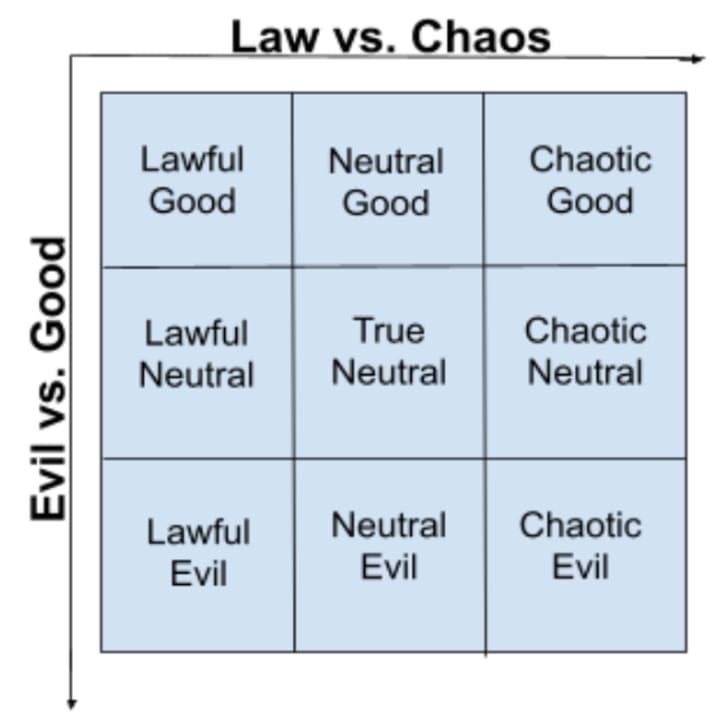
Tip Three: Understand Your Alignment
Aside from your class, there are two things that I would argue every D&D player needs to be familiar with - Race & Alignment. Now Race is a pretty simple concept, and a term which I don't imagine is unfamiliar to most new players. Alignment on the other hand, can be a bit tricky for first-time adventurers.
A character's Alignment is used to describe their ethical and moral perspective. More specifically, Alignment is a combination of two axes: Good vs. Evil and Law vs. Chaos. These two axes are evaluated independently of one another and then combined to categorize a character's alignment type. Each axes has three different options, so they combine to form nine possible outcomes:
So what? Why does any of that matter? Can I use my good nature to slay monsters? Probably not, but I cannot stress enough that D&D is primarily a roleplaying game. Do we get swept away by our desire to slay demogorgons and loot magical weapons? Of course we do, but it's the roleplay aspect of D&D that makes great memories and keeps players coming back for more.
A year from now, you won't be reminiscing with your friends about that time you bested a coven of Vampires or stumbled upon a Ring of Protection. You will be talking about that time Zach intentionally chopped off Noah's finger for trying to steal from him, the adventure that Tyler pushed Sarah off a bridge into the abyss, or the time that Dakota prioritized the life of her horse over the lives of everyone else in the party - You will be talking about the memories that were made while roleplaying.
Tip Four: Win on Your Terms
Wait, what's my objective here? How do I win at D&D? Everyone's favorite answer - well, it depends. Every player enjoys different aspects of the game and D&D is one of very few games without a clear universal objective.
Survival is a common goal of most players, but even survival could be enjoyably sacrificed at the appropriate point in time to rescue a friend or "go down with the ship." Gaining experience points, leveling up, and completing adventures/campaigns are other frequent pursuits, but there are many factors which can painfully slow these progressions, (stingy Dungeon Masters, long drawn out campaigns, the inability to get together and play with your friends frequently, etc.).
So what should you be trying to do? A little bit of everything and a lot of whatever you end up enjoying the most. Surviving, leveling up, finding awesome treasure, roleplaying your character through a full story arc, solving riddles and puzzles, providing your group with comic relief, exploring magical worlds, outsmarting goblin hoards - Do what you enjoy and don't worry too much about the rest.
Dungeons & Dragons is one of the few games that an intensely competitive participant like myself can enjoy without actually "winning."
Tip Five: Keep an Open Mind
I claimed that helping New Players was the main intention of this guide, but several of these tips and certainly this last tip, could be beneficial to even the most veteran of players.
In a game with five editions of the Players Handbook, in which nearly every "rule" is intentionally left open to interpretation, you're going to find that things can vary quite a bit. Although your Dungeon Master should try to keep the expectations in a campaign as consistent as possible, there's always going to be some things that just don't turn out the way you thought they would or even should. For this reason, it's pivotal to both your own enjoyment and the sanity of your friends that you "Keep an Open Mind."
You may think that your character can climb up the side of a building, leap across a chasm or scurry up a tree in full plate armor, but if you roll the dice and your Dungeon Master determines that your effort failed - that means you failed. So, try to keep an open mind and give your Dungeon Master the benefit of the doubt - they should have a consistent rationale for why you fell out of the tree.
This tip should also be remembered by individuals who are playing with multiple different Dungeon Masters. Just because Dungeon Master Allen says it's not that difficult to sprint a mile in Chainmail Armor, doesn't mean that Dungeon Master Tim is going to have the same interpretation (or even be playing by the same edition of rules). Trust that your Dungeon Master has the collective group's best interests at heart and try to Keep an Open Mind.
Hopefully these tips help you to enjoy your early days as a Dungeons & Dragons player. Provided that there's a reasonable Dungeon Master and a mature group of players, the game has a remarkable potential to be fun, memorable, and intellectually stimulating.
About the Creator
Mackenzie Tittle
www.mackenzietittle.com - Creator & Writer
I write about Chess, Dungeons & Dragons, Lord of the Rings, Gloomhaven & Soccer.
Keep reading
More stories from Mackenzie Tittle and writers in Gamers and other communities.
Andreas Szakacs Launches Independent Production Company as Summitfall Enters Production
The move marks a notable shift in Szakacs’ professional trajectory — transitioning from performance-focused projects to a broader role in development, financing, and creative oversight.
By Andreas Szakacs5 days ago in Gamers




Comments
There are no comments for this story
Be the first to respond and start the conversation.