
AI Squadmates in World War Z VR: Essential Allies or Dead Weight?
Exploring the Role of AI Teammates in World War Z VR: Do They Enhance Survival or Hold Players Back?

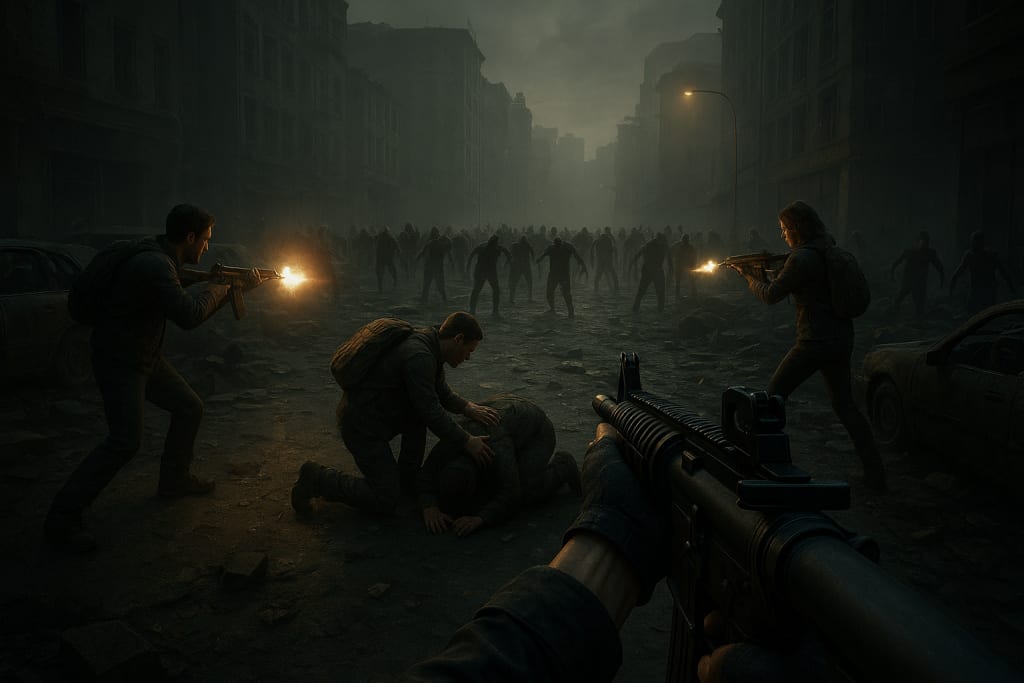
When Saber Interactive adapted World War Z into VR, one of the most debated mechanics quickly became the inclusion of AI-controlled squadmates. In a game originally celebrated for its co-op survival chaos, the shift to a more solitary VR format required a solution to fill the void left by missing human teammates.
Enter the AI companions—digital survivors designed to fight, revive, and support you in the middle of a zombie apocalypse.
But the question remains: are these virtual allies truly helpful, or do they hold players back? Let’s dig deep into how AI squadmates function in World War Z VR, their strengths, their shortcomings, and the impact they have on overall gameplay.
Why AI Squadmates Exist in World War Z VR
The flat-screen version of World War Z thrives on cooperative play. Four human players mowing down hordes of zombies created both camaraderie and replayability.
VR, however, often attracts solo players due to hardware limits, motion sickness concerns, or simply the desire for an immersive single-player experience.
Without some form of backup, players would face an overwhelming disadvantage. Imagine being swarmed by hundreds of fast-moving zombies with no one to cover your blind spots. That’s where AI companions come in—they serve as a balance mechanism, ensuring solo players aren’t left powerless.
The Strengths of AI Teammates
While many gamers dismiss AI allies as dead weight, World War Z VR manages to give them a few redeeming qualities:
- Reliable Combat Support: AI squadmates rarely miss. Their accuracy levels are programmed to land consistent hits on zombies, making them effective suppressors during massive waves.
- Automatic Revives: Go down in the middle of a fight? Unlike random online teammates, AI survivors won’t abandon you. They’ll attempt a revive almost immediately, which can save a run.
- No Ammo Worries: Unlike human players, they never run dry on ammunition, ensuring a steady stream of covering fire.
- Steady Focus: They don’t get distracted. AI squadmates will never wander off to loot, argue strategy, or take unnecessary risks.
These traits create a safety net that prevents the solo VR experience from becoming impossibly punishing.
Where the AI Falls Short
For all their strengths, AI companions in World War Z VR can feel more like liabilities at times. Their weaknesses become obvious in higher difficulties or chaotic scenarios:
- Limited Tactical Awareness: They follow scripted patterns rather than adapting to the situation. Expect them to run directly into danger or ignore flanking zombies.
- Poor Crowd Control: Against overwhelming swarms, they tend to spread fire inefficiently, failing to prioritize high-value threats like special infected.
- No Human Creativity: Players often find clever solutions—stacking explosives, coordinating choke points, or baiting hordes. AI simply doesn’t strategize at this level.
- Immersion Breakers: In a VR game where realism is everything, their robotic movement and predictable voice lines can shatter immersion.
What results is a strange imbalance: they’re simultaneously too perfect in aim yet too flawed in awareness, leaving players both grateful and frustrated.
The Solo VR Experience with AI
Playing World War Z VR alone with AI squadmates creates a rhythm very different from the original co-op design. On one hand, you’re never truly alone. Gunfire erupts behind you, AI teammates shout alerts, and you get the impression of being part of a larger survival unit.
Yet on the other hand, you feel the absence of human spontaneity. There’s no excitement of a teammate yelling in panic, no creative teamwork, and no sense of shared triumph. The AI mimics the structure of co-op but struggles to replicate the soul of it.
This duality defines the solo VR experience: smoother progression, but less emotional payoff.
When AI Becomes a Hindrance
There are specific scenarios where AI squadmates can actively work against the player:
- Stealth Missions – Their inability to remain quiet or avoid detection can ruin careful planning.
- Resource Management – Since they never loot, they contribute nothing to the supply economy. Players shoulder all scavenging responsibilities alone.
- Boss Encounters – Against unique enemies, AI often fails to use environmental advantages, leaving players to carry the entire fight.
These moments highlight the gap between AI functionality and real co-op interaction.
Do They Improve or Hurt Replay Value?
Replayability is the heart of horde shooters, and this is where AI companions have the most impact. For some players, the ability to rely on AI makes the game more accessible, encouraging repeated runs without needing to coordinate with friends.
For others, however, AI teammates reduce the stakes. Their perfect accuracy removes tension, and their predictability makes missions feel repetitive. The lack of improvisation means that once you’ve learned enemy spawns and wave timings, the experience risks becoming mechanical.
The Verdict: Allies or Burdens?
So, are AI squadmates in World War Z VR a blessing or a curse? The truth lies somewhere in between.
For casual players, they’re invaluable. They stabilize the solo experience, keep missions from becoming impossible, and prevent frustration from constant deaths.
For hardcore fans, they feel restrictive. Their inability to strategize or adapt strips away some of the challenge and immersion.
Ultimately, AI squadmates in World War Z VR are a functional compromise. They aren’t replacements for human teammates, but without them, solo VR would likely collapse under the weight of endless zombie swarms.
AI companions in World War Z VR represent the ongoing struggle of adapting co-op-heavy shooters into VR. They provide safety, structure, and accessibility, but at the cost of unpredictability and immersion. Some players will see them as lifesaving allies, while others will see them as artificial crutches.
As VR continues to evolve, one question lingers: will future updates make AI smarter, or will developers push harder toward restoring true multiplayer co-op? Until then, players must decide whether their digital squadmates are helpful partners in survival—or just one more obstacle to overcome.
About the Creator
Richard Bailey
I am currently working on expanding my writing topics and exploring different areas and topics of writing. I have a personal history with a very severe form of treatment-resistant major depressive disorder.
Keep reading
More stories from Richard Bailey and writers in Gamers and other communities.
20 Innovative Homebrew Mechanics to Elevate D&D Combat Encounters
Combat in Dungeons & Dragons can be thrilling, but after enough sessions, even the most dramatic boss fights may start to feel predictable. Hit points drop, dice roll, and eventually one side stands victorious. While the core rules of 5e are solid, Dungeon Masters who want to keep their players fully engaged often turn to homebrew mechanics. Done well, these tweaks can transform an ordinary battle into a memorable, cinematic experience.
By Richard Bailey6 months ago in Gamers
Rsvsr Helldivers 2: Entrenched Division Warbond Brings Trenches, Tactics, and Explosive Firepower
Helldivers 2 is taking combat to a whole new level with its latest Premium Warbond update: Entrenched Division, set to launch on March 17, 2026. Designed for both solo adventurers and coordinated squads, this update introduces a full suite of new weapons, tactical gadgets, and immersive WW1-inspired gear, creating the ultimate trenches warfare experience.
By Billo Nali5 days ago in Gamers
7 Intelligent Automation Skills That Define AI Digital Assistants
AI Digital assistants or virtual assistants are smart software applications/programs that use Artificial Intelligence to help you with your daily tasks. The software functions as a personal assistant that operates through voice and text commands. These tools use natural language processing and machine learning to understand exactly what you need. They can manage your schedule, emails, or even control your smart devices.
By Arthur Leo4 days ago in Gamers



Comments
There are no comments for this story
Be the first to respond and start the conversation.