
20 Inspiring D&D Map Ideas You Can Steal for Your Campaign
Make Your World Feel Alive, One Map at a Time

Why Great Maps Matter in D&D
Maps are more than lines on parchment. In Dungeons & Dragons, a map can tell a story before a single word is spoken. It can evoke danger, history, wonder—or fear. A good map doesn’t just set the scene; it shapes the entire session.
But designing compelling maps can be daunting. Not every Dungeon Master has the time or energy to craft original layouts for every dungeon, forest, or town. That’s where inspiration comes in. This guide gives you 20 unique D&D map ideas—ready to drop into your world or remix for your next big twist.
Let’s explore the unforgettable, the strange, and the mythic.
1. The Sunken Cathedral
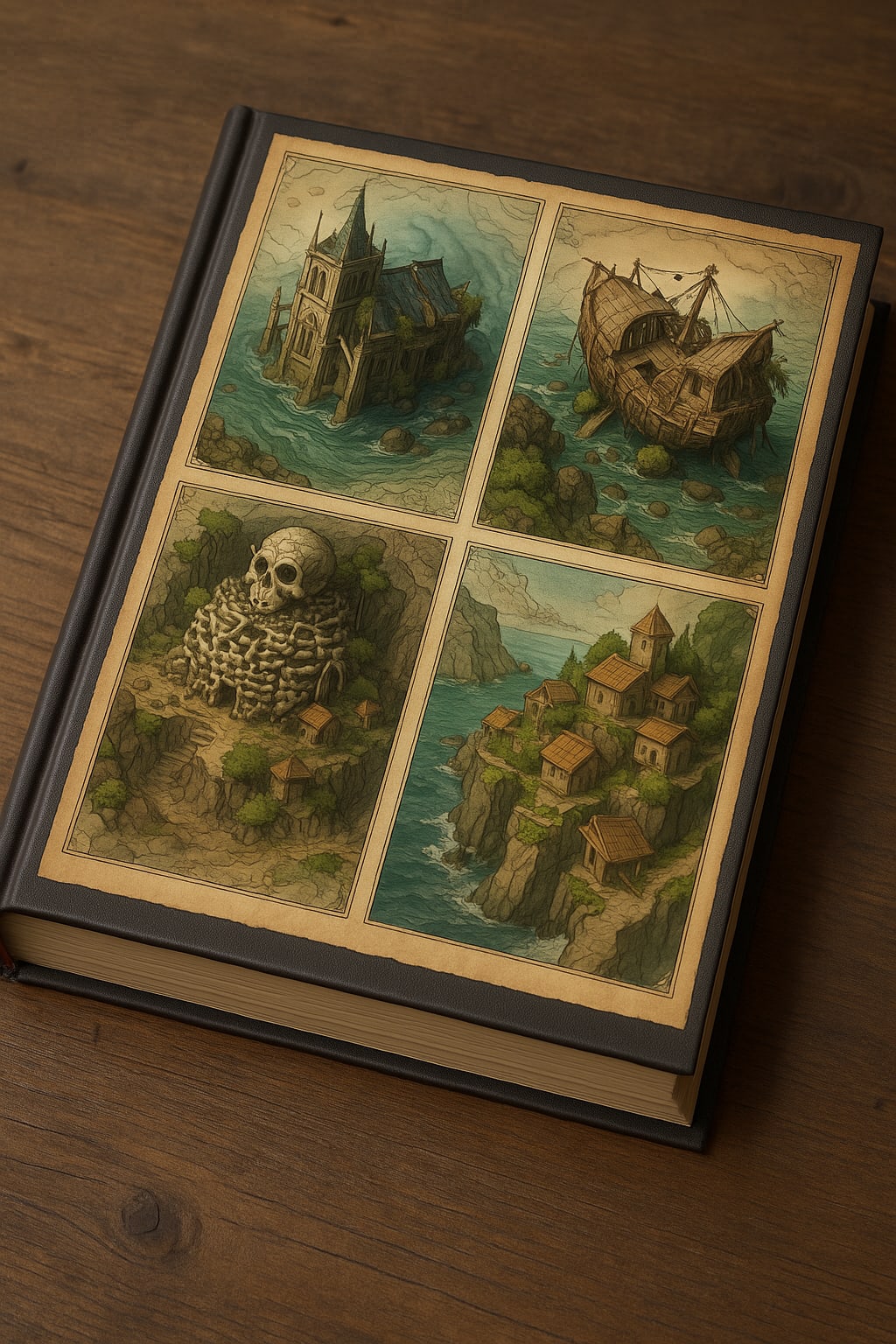
Beneath a cursed lake lies a gothic cathedral twisted by time and decay. Water floods the lower levels, and divine symbols are warped into eldritch runes. Creatures born of drowned faith now haunt its aisles.
Why it works: It flips expectations—sacred becomes profane, and sanctuary becomes horror.
2. The Rotting Skyship
A sky pirate’s vessel, broken and overgrown, is lodged in the canopy of a jungle. Vines pierce the hull. Decks creak in the wind. Something below hungers for what lies within.
Add tension: The ship’s magic engine pulses—threatening to explode or tear open a portal.
3. The Shifting Tomb of Bones
This underground labyrinth realigns itself every night. The walls are made of skeletons, the floor is ash, and the map you made yesterday is useless today.
Gameplay hook: A ghost offers the party directions—but demands a terrible secret in exchange.
4. The Cliffside Village
Houses cling to a steep cliff, connected by rope bridges and narrow ladders. Below, waves crash. Above, a temple holds secrets to why the villagers never leave.
Challenge your players: A fight here means dealing with verticality and the ever-present risk of falling.
5. The Forgotten Arena
Buried beneath a modern city, this ancient coliseum is haunted by echoes of bloodsport. Gladiators rise from dust, bound to fight anyone who steps into the ring.
Twist: The party is mistaken for a legendary team from centuries past. The arena wants a show.
6. The Fungal Underhive
A massive mushroom forest stretches for miles beneath the earth. Spores glow softly. Giant insects crawl between stalks. And sentient fungi want to bargain—or invade.
Tactical opportunity: Visibility is low. Sound travels too far. And some fungi release mind-affecting clouds.
7. The Cracked Moon Temple
Floating in a broken fragment of the moon, this ancient elven temple defies gravity. Stairs spiral into black voids. Each room shifts its angle and orientation.
Visually stunning: Picture shattered geometry, magical gravity zones, and the vast emptiness of space.
8. The Mirror Labyrinth
Every wall reflects a different timeline. Your players may see alternate versions of themselves—some heroic, some horrifying. But which reflections are just illusions?
Puzzle element: Some reflections act independently, leading players into danger or offering cryptic guidance.
9. The Inverted Tower
This dungeon begins at the top. Each level leads deeper into the sky as gravity flips. The lowest floor floats high above the clouds—unless something breaks the spell.
Use this for: A wizard’s sanctum, a divine prison, or the ruins of a fallen god’s palace.
10. The Caravan of Eyes
A roving city of wagons and tents, each tent with a painted or living eye. The people whisper in riddles. The land behind them dies.
Design tip: Constant motion. Update the map each day with a new formation or secret trail.
11. The Glass Wastes
Once a desert, now turned to jagged glass by an ancient magical war. Beneath the surface, cities remain—perfectly preserved and utterly silent.
Layered gameplay: Players move across the surface and explore chambers below, risking shards, heat, and buried constructs.
12. The Blighted Orchard
A map built on tension. Trees twist into humanoid shapes. Fruit bleeds when picked. And the soil whispers. Every step deeper into the orchard distorts time and memory.
Great for horror campaigns: Have players’ maps subtly shift during play—paths disappear, groves move.
13. The Iron Maw
A dwarven forge turned living machine. The halls pulse with molten energy. Gears grind like teeth. Somewhere, a forgotten god awakens inside the steel.
Encounter hook: A corridor closes behind them with a clang. The dungeon is eating them.
14. The Coral Bastion
An underwater fortress built of living coral and enchanted shells. Light bends oddly. Floors breathe. Defenders ride giant sea horses and wield lightning tridents.
Map layering: Use vertical zones for multiple water depths—hallways might be swum through, climbed, or flooded.
15. The Ember Scar
Once a great city, now reduced to lava flows, obsidian shards, and fire spirits. The map smolders with danger. Paths are narrow and unstable.
Twist: A phoenix’s egg lies beneath the city, drawing both worshippers and destroyers.
16. The Endless Library
A planar library with infinite floors, spiral staircases, and books that rewrite themselves. Quiet is enforced—by things in the shadows.
Mechanic idea: Players must research, solve riddles, or uncover truths while hiding from extradimensional librarians.
17. The Whale Graveyard
Massive bones jut from a frozen bay. Sailors whisper that the sea itself killed them. The dead do not rest here.
Atmospheric design: Mix frozen caverns, wave-battered hulls, and corpse-bloated tunnels.
18. The Storm Prison
A floating prison suspended in an eternal thunderstorm. Lightning crackles constantly. Wind howls. Cells are exposed to the sky.
Add urgency: A jailbreak is happening. Or worse—the storm itself is sentient.
19. The Rootspire
A world-tree towers above, its roots forming an open-air dungeon full of giant insects, druidic cults, and primeval magic.
Design challenge: Multiple elevations, moving platforms (branches), and roots that shift as the tree grows.
20. The Maw Below
This map is a living cave—a creature so massive, it’s mistaken for terrain. Doors are sphincters. Floors pulse. And everything smells faintly of blood.
Narrative payoff: Players may realize late that they’ve been walking inside something… still alive.
Maps Are Story Engines
You don’t need to reinvent cartography. You need inspiration that lights a fire. Every map above can become a setting, a puzzle, a character, or even the plot itself.
Steal these ideas. Twist them. Let them infect your world and change how your players see everything. Because when your map feels alive, so does your story.
About the Creator
Richard Bailey
I am currently working on expanding my writing topics and exploring different areas and topics of writing. I have a personal history with a very severe form of treatment-resistant major depressive disorder.
Keep reading
More stories from Richard Bailey and writers in Gamers and other communities.
Assassin’s Creed Shadows Difficulty Settings – Which Mode Should You Choose?
Assassin’s Creed Shadows brings a fresh blend of stealth, combat, and open-world exploration, all set against the turbulent backdrop of feudal Japan. As you prepare to step into the roles of Yasuke and Naoe, one decision will shape your entire experience—which difficulty setting should you choose?
By Richard Bailey7 months ago in Gamers



Comments
There are no comments for this story
Be the first to respond and start the conversation.