
Why do we shake hands?
From a symbol of peace to a modern-day tradition


The origin of the handshake
National Handshake Day is just around the corner, and I bet you're wondering about the origin of the handshake.
If not, you should be. The handshake has been used as a greeting for centuries, yet many of us don't think twice about why we shake hands or even when it became an accepted custom.
So, how did it all start?
Many believe that the origin of the handshake can be traced back to the fifth-century B.C.E. in ancient Greece. A handshake back then was more than just a way of saying hello; it was a sign of mutual respect and trust.
In such times, extending an empty hand was a way to demonstrate that you were not armed and harboured no ill intentions towards the other person.
Unfortunately, not everyone was honourable toward their fellow man. As the years passed, people eventually discovered the hard and painful way that it wasn't good enough to merely hold out an empty palm.
According to legend, medieval Europeans, particularly the Romans, were the first to learn their lessons. They decided it was wise to shake hands instead of just extending them. It's been said that knights would take a person's hand and shake it, dislodging any concealed weapons or daggers, thus providing even more reassurance that both parties were unarmed.
As the Roman Empire expanded, handshaking became widespread as they spread the practice to new territories.
Handshaking through the years
As the centuries progressed, the handshake and its meaning evolved and diversified.

By way of example, in the fourth and fifth centuries B.C.E., it was common for gravestones to feature an emblem in which the deceased is shown shaking hands with a member of their family.
The clasped hands, usually of a husband and wife, would represent a final farewell or an unbreakable connection between the living and the dead.
In addition to symbolizing a final farewell, some groups and societies have used handshakes as a secret signal or code, with the Freemasons and the Mithraists being two such examples.
Historically, the Freemasons used at least 12 different types of universal secret handshakes. But it is widely believed that many more secret handshakes are used in Masonic lodges that have never been documented.
Fun fact: Two friends in San Francisco, Kevin Whittaker and Cory Jens, set a Guinness World Record for the longest handshake, lasting an incredible 9 hours and 30 minutes!
A modern greeting
Fast forward a few centuries, and we no longer have to worry about hidden weapons up a stranger's sleeve. At least not most days!
So why does this ancient practice persist to this very day?
While it had various meanings in the past, it wasn't until the 17th century that it became the norm for everyday interactions.
Over time, handshakes were gradually superseded by more 'hierarchical' modes of greeting, such as bowing, as the decades passed. It wasn't until the Quakers in the 17th century popularized the simple handshake as a more egalitarian alternative to bowing, curtseying, or tipping one's hat, that it became popular.
By the 18th century, the handshake had become an established social etiquette in the Western Hemisphere. Etiquette books were filled with instructions on correctly shaking hands in any setting. It was even widely considered rude and disrespectful not to shake someone's hand upon meeting them.
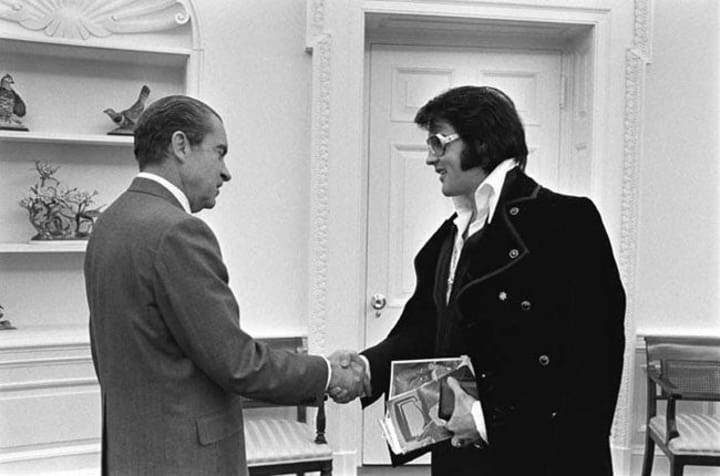
Today, shaking hands has become deeply ingrained in modern society. Still, its purpose remains fundamentally the same: to symbolize good faith and goodwill between two people when meeting one another for the first time.
Handshakes that made history
Death and destruction engulfed the world. Millions had died, nations had fallen, and humanity had learned that cruelty has no bounds. But amidst the ruins of World War II, three of the world's most powerful leaders gathered at Potsdam to shape the course of history. As Churchill, Truman, and Stalin locked hands in a historic handshake, the fate of nations hung in the balance.
Tension and anticipation hung in the air as they hashed out the details of the postwar world, with each leader pushing for their own agenda. Their decisions that day would have ripple effects for decades to come, shaping our world and how we navigate it.

On a slightly lighter note, November 19, 1985, saw another historical moment of international diplomacy; U.S. President Ronald Reagan and Soviet leader Mikhail Gorbachev finally came face-to-face.
The two heads of state met in Geneva to discuss ending the global weapons race and improving international diplomacy. As the world watched, the men shook hands for the first time, symbolizing a new era filled with the possibility of peace and cooperation.
Now, let's take a step back from politics and leap forward to late 1980s England.
It was the height of the AIDS epidemic. Misinformation, homophobia, fear, loathing, and ignorance ran rampant throughout the U.K. With the British media constantly referring to AIDS as sinful and the "Gay Plague," it's perhaps unsurprising that hardly any public figures in Britain were advocating for the rights and treatments of people living with HIV/AIDS.
However, Princess Diana was not just any public figure, and London's Middlesex Hospital knew this. On a spring day in April 1987, Diana publicly opened the hospital's Broderip Ward, England's first specialist AIDS hospital ward. As she walked into the ward, cameras clicking behind her, she was on a mission to make a statement.
Yet, like most history-defining missions, things did not go entirely according to plan. Princess Diana had intended to shake the hands of all ten terminally ill AIDS patients on the ward. However, the stigma associated with the virus made even the patients on the ward uncomfortable about having their pictures taken. Ultimately, Ivan Cohen, 32, was the only patient who agreed to be photographed, albeit from behind.
But one person was all that was needed to change history. Without any hesitation or gloves, Princess Diana reached out and shook the hand of Ivan Cohen.
Such a simple gesture made headlines worldwide. At a time when fear and misinformation ran rampant, Princess Diana's handshake challenged the erroneous belief that HIV/AIDS could be spread through touch. Bringing a ray of hope to millions of people living with this stigmatised illness
"If a royal was allowed to go in and shake a patient's hands, somebody at the bus stop or the supermarket could do the same," a nurse who witnessed Diana's hospital visit told the BBC. "That really educated people."
Conclusion
Today, shaking hands is an integral part of everyday life. So the next time you shake someone's hand, take a moment to appreciate this age-old tradition that has endured for centuries.
About the Creator
Chelsea Rose
I never met a problem I couldn't make worst.
Reader insights
Outstanding
Excellent work. Looking forward to reading more!
Top insights
Easy to read and follow
Well-structured & engaging content
Expert insights and opinions
Arguments were carefully researched and presented
Eye opening
Niche topic & fresh perspectives
Heartfelt and relatable
The story invoked strong personal emotions
Keep reading
More stories from Chelsea Rose and writers in FYI and other communities.
A Planetary Alignment will coincide with Mercury Retrograde
Double phenomena in the heavens Some people say in jest that the planets have aligned in their favor when life works the way they desire. Were you aware that there are seasons when things do line up in the heavens? There will be a planetary alignment AKA a planet parade, on February 28, 2026.
By Cheryl E Preston15 days ago in FYI



Comments (1)
So informative and well written, thank you for sharing! ❣️