
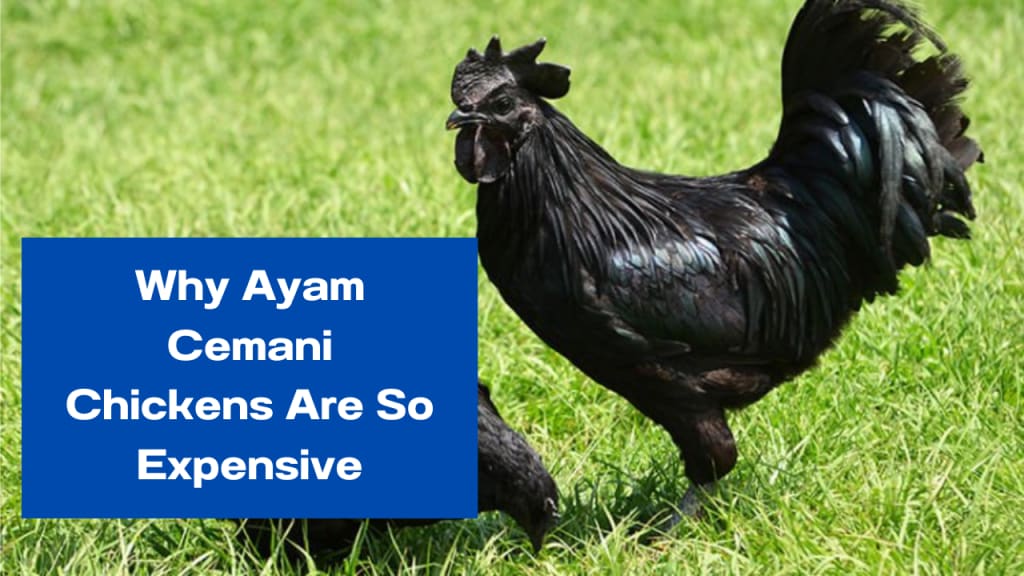
This is a rare Ayam Cemani chicken; everything down to its beak and tongue is black. A chicken can sell for up to six thousand dollars, and its eggs can sell for up to 16 each. They are tough to find, but if you can find a good one, you hold on to them like gold. That means taking care of these chickens is a full-time job. But they're rarely eaten. So, why do people buy Ayam Cemani chickens, and why are they so expensive?
The story of Ayam Cemani chickens starts in Indonesia. But even here in Java, where the chickens are native, it still takes work to breed a top-notch all-black chicken. The unique coloring of Ayam Cemani chickens comes from a genetic mutation called fibromelanosis. In other chickens, only specific cells release pigmentation. Fibromelanosis, however, causes nearly all the cells in Cemani chickens to release pigmentation, resulting in dark black feathers, beaks, bones, and even organs. But this requires the right pair of chickens, which breeders in the U.S. like Rachel Stewart are hard-pressed to find. To start a flock, you're looking at fifteen to twenty thousand dollars to get a good group of birds, the housing, the feed, and everything you need for them. If a chicken doesn't have two copies of the genetic mutation, it can have undesirable characteristics such as white feathers, lighter toe pads, or pink mouths. You don't ever want to have one with a pink mouth. You want to have, if not anything, an oyster mouth that is grayish.
While most of her chickens sell for two or three thousand dollars, Rachel says a high-quality rooster with a black mouth would go for nine or even ten thousand dollars. Ayam Cemani chickens that weren't bred on Rachel's Farm came from Indonesia. But not directly because of government restrictions on both sides; breeders in the U.S. can't get their hands on these chickens so easily. So, you must typically find somebody in a different hub or country that allows you to import from them. So, for example, my line was imported from Canada because of all the export restrictions. The quality and price of Ayam Cemani chickens outside of Indonesia can range widely. This is why chicks from different American farms are listed online for anywhere between 35 and 90 dollars.
But exactly who is buying these chickens? I've noticed that people who purchase from us are rare breed collectors of various avian species. You think of it in comparison to an Amazon parrot. If you get a parrot, it will cost you at least five grand. So, these are rarer and more difficult to create than even a high-quality parrot. Back in Indonesia, customers come from all over the world. Anos sells his best chickens for up to six thousand dollars, sometimes to other breeders but mainly to Javanese locals like Ari on Java Island. These chickens have long been kept as pets. Ari has spent 30 million rupiah, about two thousand dollars, on two Ayam Cemani chickens. Some locals believe the chicken's jet-black coloring allows them to travel between the human and supernatural worlds. Another mystical belief is consuming the very first egg one lays will help you conceive a child.
Although Cemani chicken eggs are precious, breeders will give these first eggs away for free to couples in need or healers like here in the Tiangong Regency. The healer roasts the egg until it becomes a fine powder. Cemani chickens tend to have weak immune systems despite being used for healing. If a chicken gets sick, its black color can fade and become dull. Keeping Cemani chickens healthy can get tricky, especially when there's no official guide on how to breed them. So, breeders rely on their shared knowledge and constant trial and error to produce healthy, high-quality birds. The chickens are bathed every week, which helps prevent bacterial infections. The coops are sterilized for the same reason. Spacious coops help create a stress-free environment but also help maintain the chicken's genetic lines. A nurse also provides the chickens with vitamins and vaccines and adjusts their feed.
As they develop, the chicken's diet depends on their breeder. In New Jersey, Rachel adds special supplements to improve her flock's intestinal health. One of the things that we have heard is the crushed chilies; they go crazy for them. Chickens cannot taste spicy food, so that's just like a yummy additive. They do better to have extra protein. They are heartier, and they lay eggs better. The form of protein we use is dried Soldier fly larvae. They are 36 proteins, and they love them. Oregano leaves are anti-microbial and super good for the chicken's intestinal health, so we like to add that as well. They're getting something that smells like a massive pizza in Indonesia. Anos feeds his chickens a unique mix of feeds twice daily to help them gain weight. He also likes to add papaya and Tara leaves to their food.
A healthy Ayam Cemani hen lays around 100 eggs yearly, only 40 of what most laying hens produce. These eggs can sell for as much as 250,000 rupiah, or about 16 dollars. However, breeders prefer to keep most eggs because only some are guaranteed to hatch. So, it's more cost-effective. More eggs also mean more chances to breed high-quality all-black birds. Quality roosters are more valuable because they have wider combs. Although the Covid-19 pandemic did cause prices to drop, they've bounced back.
About the Creator
Keep reading
More stories from writers in FYI and other communities.
A Failed Artist, A Disillusioned Poet, An Underpaid Game Show Host
I took my son and niece to Gori, a small town in Georgia where Joseph Stalin was born. They talked me into visiting the Stalin's Museum, the largest in the post-Soviet space. I had resisted going there because I just can't stand the monster and know enough about him, or so I thought.
By Lana V Lynx25 days ago in FYI
Trouble at the Tea Leafing Café
The rain had started right around the time that Annie was buttering her second thick slice of homemade toast for breakfast, and hadn’t paused since. Not that anyone could tell. The windows of the café were fogged over, and with every seat filled with happy customers munching on fresh baked pastries or steaming bowls of the delicious soup of the day, it was hardly surprising. Annie looked around the room, finally taking a moment to breathe after the lunch time rush. Her old life already felt like a bad memory, a part of her history, always, but just that. History.
By Hannah Mooreabout 21 hours ago in Fiction


Comments
There are no comments for this story
Be the first to respond and start the conversation.