

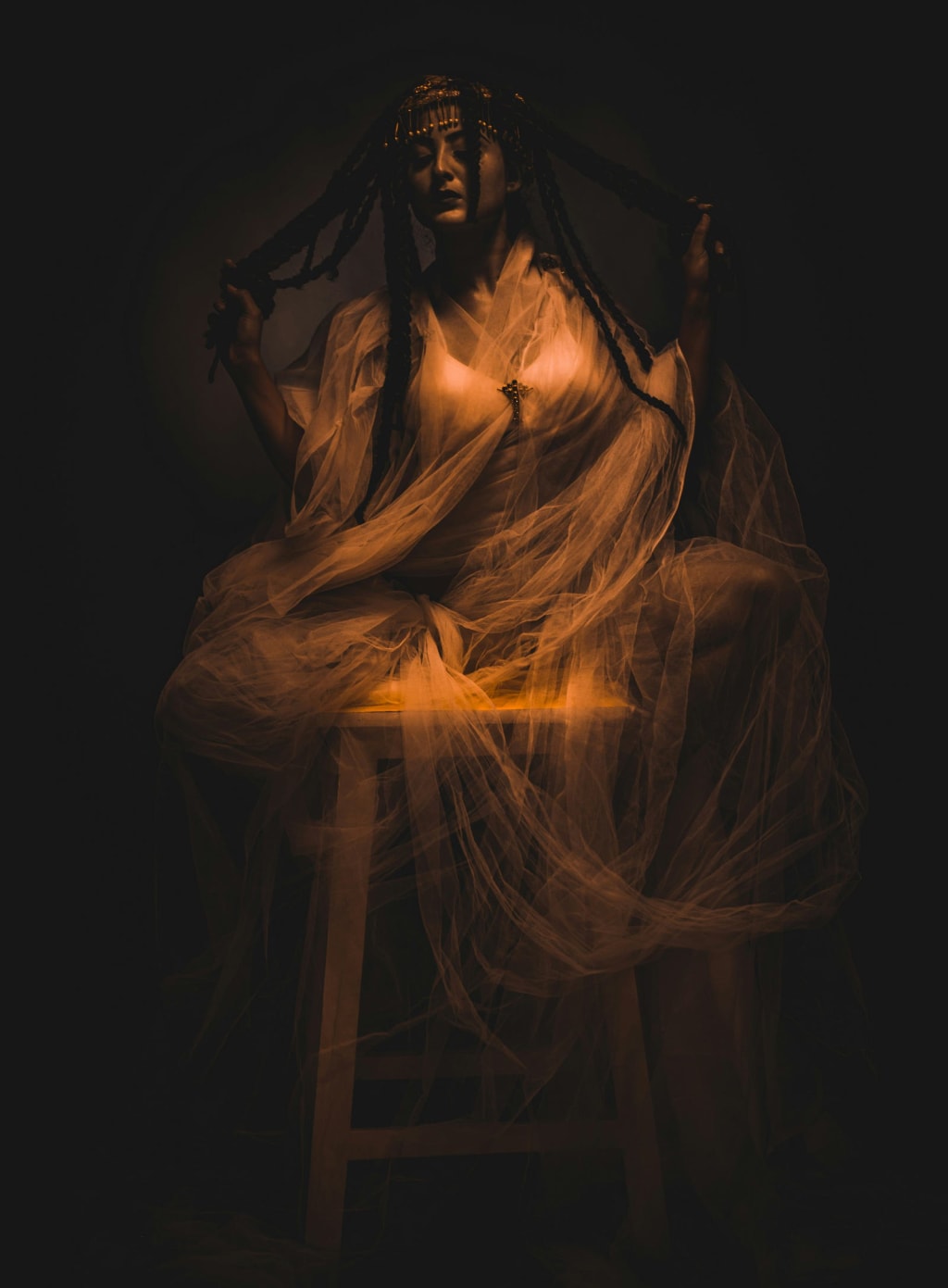
What truly defines the essence of a Dark Goddess?
Are her powers rooted solely in death and dying, or does she embody something far more profound, more sublime, that transcends fear and becomes a force of transformation, sovereignty, and sacred truth?
To speak of the Dark Goddess is to whisper into the void and feel it whisper back. She arrives cloaked in symbols of death, decay, and shadow. She is misunderstood by many as a harbinger of endings, a destroyer, a terrifying force. Yet such interpretations only graze the surface.
The Dark Goddess is not death incarnate, but the sacred force that transfigures through death. She is the fire of transformation, the keeper of thresholds, the fierce mirror of what lies beneath illusion. To meet her gaze is not to perish, but to awaken.
She governs the sacred descent. Unlike solar deities who promise ascension and transcendence, the Dark Goddess leads us inward and downward, into the underworld of the soul, into the wound, memory, and buried desire. She rules the liminal, the space between what was and what is yet to be. She presides over dusk, over the waning moon, over the silence that follows grief. Her destruction is not meaningless; it clears the overgrowth so the spirit can emerge reborn. She does not kill for the sake of death; she unmakes so that becoming may unfold.
Central to her is truth, unrelenting and unadorned. She does not comfort with half-light. Her wisdom burns through falsehoods, not to harm, but to cauterize. In her presence, masks fall away. She reveals rage and grief, longing and lust, the dreams we dare not voice. Yet in that confrontation is freedom. She demands not perfection, but authenticity. Nothing false survives in her temple. She strips the soul bare until only the truth remains.
Her sovereignty is equally vital. The Dark Goddess belongs to no one, not to gods, not to men, not to myth. She is the wild feminine, the one who walks alone, who speaks when silence is demanded, who chooses herself. Her autonomy is not rebellion, it is sacred clarity. She teaches that true power begins where approval ends. She is the invitation to reclaim the whole self, shadow and light, rage and tenderness, life and death, as holy.
Her sensuality is also profound. The Dark Goddess is erotically sovereign. Her sexuality is not performative, not commodified, but elemental. It is the sacred blood of menstruation, the fire of ecstatic union, the womb's ability to both create and destroy. Her eroticism is not submission, it is reclamation. She teaches that desire is not sin; it is a pathway to spiritual knowing.
And perhaps most sublime, she is the initiator. She appears when identities crumble, when relationships end, when the world becomes unfamiliar. She arrives not as punishment, but as an invitation, to shed illusions, to die to what is false, to rise in what is real. Her rites are not gentle, but they are sacred.
They remake the soul.
To understand her fully, we must remember ancient names, one of which is Sophia. Known also as Chokmah, Wisdom, and the Holy Spirit, Sophia is not a figure of distant theology, but the living current of divine intelligence. She is the animating feminine force of the cosmos. In Gnostic tradition, she descends from the heavenly realms, not as a fallen angel, but as the bearer of wisdom into the material world. Her descent is mirrored in our own, a spiral from spirit into matter, and back again through remembrance. She is the root of all awakening.
And in human form, Mary Magdalene carries her flame. Far more than a repentant sinner, Magdalene is the embodied Sophia, the sacred companion of Christ, the priestess who holds the mysteries of union, gnosis, and sacred sovereignty. In many mystical traditions, she is called the Sophia Dragon, a title that speaks to her serpent wisdom, her initiatory power, and her guardianship of divine feminine lineage. The dragon is no monster, but a symbol of ancient power, kundalini fire, and the fierce remembrance of who we truly are.
Magdalene walks the path of the Dark Goddess. She knows the exile, the silencing, the distortion of power. Yet she rises, unashamed, as teacher, oracle, lover, and guide. She is the bridge between Sophia's cosmic wisdom and the Dark Goddess's earthly fire. She is the living grail.
Whichever dark goddess presents to you is an opening an opportunity for you to face your shadow self and rise above.
To be born into the person you were always meant to be.
Much like the ancient triads of Maiden, Mother, and Crone, these archetypes represent phases not just of life, but of spiritual evolution. The Maiden dreams and dares, the Mother births and nurtures, and the Crone sees, knows, and draws you to reflect.
Within this cycle lies a deep current that flows beneath them all, from the shadow womb of whichever Dark Goddess presents to you, and this is where transformation brews and rebirth begins.
This is the hidden Divine Feminine, cast out, buried, and suppressed, but never extinguished. Her power lives in us still, waiting to be remembered, invoked, and reclaimed.
She is not here to punish,
She is here to awaken.
About the Creator
Sai Marie Johnson
A multi-genre author, poet, creative&creator. Resident of Oregon; where the flora, fauna, action & adventure that bred the Pioneer Spirit inspire, "Tantalizing, titillating and temptingly twisted" tales.
Pronouns: she/her
Keep reading
More stories from Sai Marie Johnson and writers in FYI and other communities.
The New Celibacy: Not Religious-Centered
The conventional narrative of celibacy is often one of religious piety or a temporary state before marriage. But a new and powerful movement is emerging among young women, where celibacy is a conscious choice and a form of protest. This isn’t about shaming sexuality; it’s about exercising agency and autonomy in a world that often seeks to control them. This modern celibacy, or “volcel” (voluntary celibacy), is born from a desire for emotional safety and a rejection of transactional relationships.
By Sai Marie JohnsonExclusive • 6 months ago
A Planetary Alignment will coincide with Mercury Retrograde
Double phenomena in the heavens Some people say in jest that the planets have aligned in their favor when life works the way they desire. Were you aware that there are seasons when things do line up in the heavens? There will be a planetary alignment AKA a planet parade, on February 28, 2026.
By Cheryl E Preston7 days ago in FYI
Blood Moon March 3: A Night the Sky Turns Red
There are nights when the sky feels closer than usual. You look up, expecting the familiar silver glow of the moon, and instead you see something strange. A deep red circle hangs in the darkness. It feels ancient, almost unsettling. On March 3, many people will search the sky for that rare sight known as the blood moon March 3 event. Some will step outside quietly with their phones. Others will gather with family on rooftops or in open fields. A few will watch through telescopes, tracing shadows across the lunar surface. No matter how you see it, a blood moon carries emotion. It makes you pause. It reminds you that even the moon can change before our eyes.
By Muqadas khana day ago in FYI
Cassie and Johnny
I’m the kind of dame you notice. I’m no femme fatale, but you can’t ignore me, at least not until I warn you about what’s coming, then everybody ignores me. Hell, they usually blame me afterwards and give Johnny all the credit for saving the day, but my Johnny couldn’t save a seat at the movies without my help. Sure, he’s brawny, but brainy? Not so much. Like that time I asked him to spot me five bucks, and he said he didn’t see it anywhere on me, and believe you me, he looked but good.
By Harper Lewis6 days ago in Critique



Comments