
Van Helsing and the Curious Case of Computational Vampires
How a Bad Batch of Garlic Bread, a Swarm of Bats, and a Laptop Got Van Helsing Hooked on Bioinformatics


Picture it, if you will, my dear students: a fog-drenched night, the moon hanging precariously in the sky like an uninvited guest at a party of shadows. I had just finished what I believed to be a triumphant garlic-filled dinner—one that should’ve been enough to ward off a dozen vampires (and perhaps a few ex-girlfriends). Alas, that evening, I learned two very important things. One, garlic bread is useless when undercooked. And two, no matter how much one mentally prepares for an encounter with the supernatural, nothing prepares you for an unexpected swarming of data—the modern vampire, if you will.
Allow me to paint the scene. I had retired to my office, expecting a quiet night of scholarly pursuits—perhaps a bit of light reading from an ancient grimoire or maybe refining the various ways I’ve developed to send Dracula back to his dusty grave. But the universe, in its infinite sense of humor, had other plans. A suspicious squeaking noise erupted from the chimney, followed by an unwelcome torrent of black wings—bats, naturally. (What, did you think it was carrier pigeons bringing me a love letter from a mysterious admirer? I should be so lucky.)
These bats, with their audacity and flair for dramatics, spiraled around me as if auditioning for a position as Dracula’s personal herald. I grabbed the closest weapon—a candlestick, as my holy water bottle had inconveniently vanished—and swung with the grace of a tipsy ballroom dancer. I swear the bats cackled as they evaded my flailing.
In the chaos, my trusty laptop toppled from the desk, landing precariously on my toe—yes, the same toe that endured countless battlefield blunders with vampires. It wasn’t long before my toe was screaming louder than any vampire I’ve ever staked. But let us not dwell on the minor details of my throbbing digit.
Now, at this point, you may ask, “Professor Van Helsing, what do bats, broken toes, and your tragic culinary choices have to do with bioinformatics?” Patience, dear student, patience. The tale is still unfolding.
After vanquishing the bats (and by “vanquishing,” I mean I opened a window and let them escape—still a victory in my book), I returned to my fallen laptop. What greeted me was not my usual desktop of sacred relics and vampire research notes. No, it was something far more sinister: lines upon lines of cryptic sequences, numbers, and letters. At first, I believed it to be a digital curse—a hex cast by some techno-savvy Nosferatu seeking revenge for all the coffins I’d previously set ablaze.
But as I gazed deeper into the abyss of data, a strange curiosity began to creep over me. These letters—A, T, C, and G—seemed almost familiar, like fragments of a forgotten chant from a long-lost vampire-hunting order. And thus, my descent into the strange and perilous world of bioinformatics began. Of course, I initially assumed these sequences were the genetic makeup of my vampiric foes, laid bare before me by some benevolent force. Who else but the digital gods of modernity would grant me such insight?
Feverishly, I sought answers. I rummaged through my vast library, tearing through pages with the intensity of a man possessed. Had Dracula left some cryptic message in code? Was this his genome, unwittingly delivered to me through the electronic ethers? I sent for my most trusted allies in the field of science (and by “sent,” I mean I hounded them through an unholy barrage of emails). One researcher responded: “It’s DNA data, Van Helsing. Ever heard of bioinformatics?”
Bioinformatics. It sounded absurd. A mere combination of biology and computing? “Balderdash!” I declared. But, as any seasoned vampire hunter knows, you never dismiss a possible weapon in your arsenal.
What followed was a series of comically misguided attempts to apply this newfound science to my usual nocturnal adventures. I thought, "Surely, with this bioinformatics magic, I could map Dracula’s entire lineage, predict his every nefarious move!" I envisioned databases filled with genetic markers, all pointing me directly to his coffin.
Naturally, my first attempt was an absolute disaster. Let me tell you, nothing makes you question your life choices quite like realizing that a sequence analysis cannot, in fact, tell you where Dracula will dine next Tuesday. As I stared at the mountains of indecipherable data pouring from my screen, I realized something chilling: bioinformatics wasn’t a tool for vampire hunters. It was something far more complicated, perhaps even more terrifying.
For the first time, I felt truly humbled—not by a bloodthirsty count or even a particularly crafty werewolf, but by the endless sea of genetic data and algorithms. This, I thought, was the new frontier. While I had been priding myself on my encyclopedic knowledge of vampiric lore, the true mysteries—the building blocks of life and disease—were hiding in this digital labyrinth of A’s, T’s, C’s, and G’s.
Determined not to be bested by a mere program, I embarked (there’s that word again) on a quest to understand. I found myself knee-deep in journals, tutorials, and more acronyms than any sane man should ever encounter. BLAST, GWAS, SNPs—it was as if bioinformatics had its own secret language, one that even Dracula would envy.
The deeper I delved, the clearer it became that bioinformatics wasn’t just about unlocking the secrets of the undead. It was about understanding the living, the diseases that plague us, and the intricate codes that govern life itself. Diseases, much like vampires, have their own patterns, their own markers that, once identified, can be traced, understood, and, most importantly, conquered.
So, why bioinformatics, you ask? Because, my dear students, after centuries of staking vampires, banishing specters, and thwarting dark forces, I realized that the true monsters of our time are not always the creatures that lurk in the shadows. Sometimes, the enemy is hidden in plain sight—encoded in our very DNA, waiting to strike.
And thus, I find myself at the crossroads of biology and technology, wielding my new digital stake: bioinformatics. Not as a mere tool, but as a weapon—a way to predict, prevent, and, ultimately, obliterate the genetic curses that plague mankind.
It’s no longer just about the vampire. Now, it’s about the genome. And with bioinformatics at my side, I stand ready to fight—one sequence at a time.
And yes, I’ve since perfected the garlic bread.
About the Creator
ScienceStyled
Exploring the cosmos through the lens of art & fiction! 🚀🎨 ScienceStyled makes learning a masterpiece, blending cutting-edge science with iconic artistic styles. Join us on a journey where education meets imagination! 🔬✨
Keep reading
More stories from ScienceStyled and writers in FYI and other communities.
Mephistopheles and the Metaphysical Molecule: Dr. Faustus’ Quantum Quandary
what a delightful mix-up it was! A devilish night, with the air thick with brimstone, and the usual cast of demons moping about my study, their infernal moans providing a soothing background hum. I was on the brink of summoning something rather special that evening—no, not another apparition of Helen of Troy, as lovely as she may be (and she does have a rather sharp wit after being summoned the third time). Nay, I sought to call forth the very essence of arcane knowledge itself, to converse with the primordial forces that govern the universe, to... well, I got a little carried away. But who could blame me? When you’ve struck a deal with the devil, your ambitions tend to get a bit lofty.
By ScienceStyled2 years ago in FYI
A Planetary Alignment will coincide with Mercury Retrograde
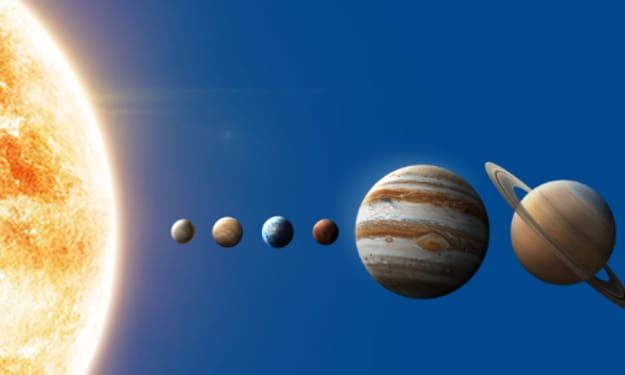
Double phenomena in the heavens Some people say in jest that the planets have aligned in their favor when life works the way they desire. Were you aware that there are seasons when things do line up in the heavens? There will be a planetary alignment AKA a planet parade, on February 28, 2026.
By Cheryl E Preston13 days ago in FYI
KAI KF-21 Boramae South Korea’s Advanced Fighter Jet Revealed
The unveiling of the KAI KF-21 Boramae marks a defining milestone in South Korea’s aerospace and defense evolution. Developed by Korea Aerospace Industries (KAI) the KF-21 represents the nation’s ambitious effort to strengthen its domestic defense capabilities while positioning itself as a competitive force in the global fighter aircraft market. As regional security dynamics continue to evolve the introduction of this advanced multirole fighter jet reflects technological maturity strategic independence, and long-term defense planning.
By Beckett Dowhan7 days ago in FYI
Guard Your Battery
Why are some people so attractive just by standing there? It’s not because they are "likable," but because they don’t need everyone to like them. I realized later that truly charismatic people allow themselves to be criticized, but they never criticize themselves. They never try to please the world; instead, the world stops to watch them.
By Emily Chan - Life and love sharing6 days ago in Poets



Comments
There are no comments for this story
Be the first to respond and start the conversation.