
Uncommon Facts and Come Here To Read Them
Some cool facts to expand your knowledge


Imagine you are sitting on a wooden bench, the green grass tickling beneath your feet and the warm breeze tugging at your hair. Maybe I should tell you this right now: Your hair contains traces of Gold! I know it’s crazy, but along with gold, your hair strand contains traces of 14 different elements.
Sighing that you can’t just run your hand along your locks and extract gold, you look down at the soft grass spreading over the field, but did you know that grass makes up 26% of plant life on earth? There are grasses even found in Antarctica. Antarctic hairgrass is the only type of grass member found in Antarctica.
Your gaze shift from the ground to the sky. Bundle of clouds float by without any final destination. Maybe it’s because 60% of clouds cover earth in any moment of time. The oceans are found to be considerably cloudier than continents. Clouds, clouds everywhere.
Your gaze stays on the sky, slowly darkening as the night time approaches. The moon was already up, waiting to reign over the night sky. Our earth’s rotation is gradually slowing, all because of our moon. The moon adds 1.4 milliseconds to a day every 100 years. Our earth only had 23 hours a day while the dinosaurs were still alive. How is that for a fact?
Along with the moon, tiny, twinkling stars appear, spreading over the warm golden sky. It must be great to be an astronomer, your thoughts wander. To see the stars and to learn so much about them must be so dreamy. But have you ever thought about who the Western history’s first female astronomer was?
Caroline Herschel (1750-1848) was born in Hanover, Germany. Her mother, Anna, forced her to be a maid in her own house. Anna taunted Caroline her for being ugly after surviving smallpox in 1754. She refused her husband to teach Caroline numbers and letters in fear that she might leave the family to be a woman of career. Well look what happened, mom! Caroline was verbally abused by her mother and physically abused by one of her brothers, Jacob. But Caroline’s life turned for the better when her brother William, a musician in Britain, bargained with their mother for the release of Caroline. He freed his sister by giving their mother enough money to find a new maid.
William taught Caroline arithmetic and the means to understand how British currency worked. William was an astronomer, and he discovered a planet in 1781, which he named “The Georgian Studs” and he officially received the title of astronomer in Windsor. Johann Bode later renamed the planet as Uranus.
Caroline and William moved to the scientific facilities at Windsor, leading to Caroline observing the outer space through William’s telescope. She discovered various nebulae, and William noted down her observations. In 1783, Caroline and William embarked on a journey mapping the nebulae of Northern sky. Their work took half a century and they discovered about 2500 phenomenon.
Caroline had the map of the night sky nebulae etched into her brain. So, one night while she was observing, she came across an Interloper. The other astronomers never paid it any mind, waving it off as just another nebula. But her discovery of interloper made her the generation’s most successful comet hunter. She even found the Ball of Ice that won’t be visible to us until 2092. She was suddenly a celebrity in the public’s eyes. People were stunned by her success to find comets. In 1787, she started receiving fifty pounds yearly stipend from King George to continue assisting her brother, William. Thus, Caroline became the history’s first professional female astronomer.

You take off your sunglasses as the sun slowly begins the journey down the horizon. You look at your glasses in your hand, a handy companion that protects your eyes. But sunglasses were not initially made for protection. No. Sunglasses were first made in China during the 12th century. They were made of smoky quartz for the judges to mask their emotions when they were questioning witnesses. The more you know, huh?
As you stand up, you notice a bumble bee landing on the dandelion fluttering in the wind. How adorable! But I bet you didn’t know that Bumblebees can fly higher than the Mount Everest with their little wings. Scientists have recorded bumblebees to fly more than 29,525ft/9000meters, which is higher than Mt. Everest. Who would’ve thought these tiny bumblebees are such high-achievers?
You leave the bumblebee behind and walk over to the magnolia tree in full bloom with their large, pink flowers filling the air with a sweet scent. You watch a tiny spider weaving a gorgeous trap for catching their prey. In ancient times, spider webs were used as bandages in ancient Greece and Rome. The supposed anti-fungal and anti-bacterial properties of the spider silk were used to keep wounds clean and prevent any infections.
Next to the tree, there are a few rocks with greenish Lichen crusts spread all over them. Lichens are complex organisms which are formed by a symbiotic relationship between algae and fungus. They are usually seen as bio-indicators. If the air is clean, the lichens thrive in that area.
Speaking of fungus, I am sure you are not ready to hear about this! There is a fungus that can turn ants into zombies. Yes! You read that right.
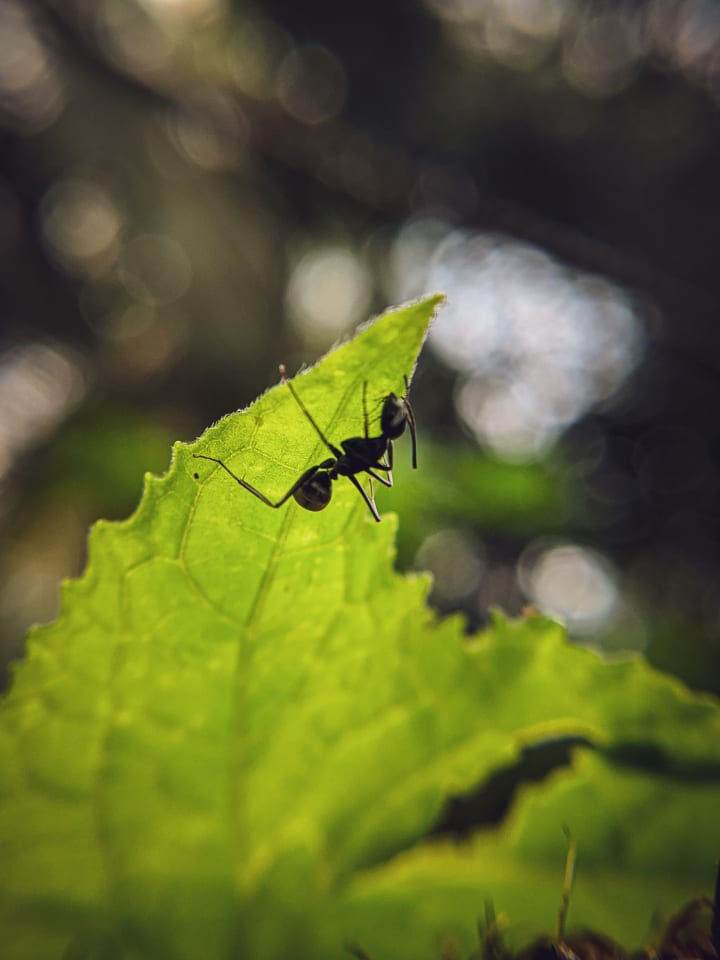
Ophiocordyceps unilateralis, a tropical fungus, is the mastermind behind mind-controlled ants. In tropical countries such as Brazil, it is not hard to find carpenter ants deep in the forest.
The Zombie Fungus, once it infects a carpenter ant, grows inside the ant and sucks the nutrients out of its body, making the ant vulnerable to the fungus’s mind attacks. Within a week’s time, the fungus forces the ant out of its nest and sends a command to climb a plant, overhanging their nest. Once the ant reaches a height of 25 centimeters (or 10 inches), the fungus sends a command to the ant to stop moving. 25 centimeters above ground level is an ideal condition for the fungus to thrive.
The next step in the fungus’s evil plan is to make the ant lock its jaw to the leaf vein while it feeds on the ant’s innards. As the ant slowly dies, the next step in the fungus’s book of evil is ready to be launched.
Once the ant is finally dead, the fungus sends a fruiting body full of spores into the base of the ant’s head, turning the ant’s corpse into a sprinkler for the fungus spores to infect the other ants living in the colony below. The process then continues.
Suppressing a shiver, you think of the Zombie movie you watched a couple of days ago. The main characters all had guns, and they weren’t afraid of using them on those brain-dead zombies. But what if the zombies mutate and their skin becomes as thick as an armadillo’s shell? Armadillo’s shells are bulletproof. A Texas man learned it the hard way when he shot an armadillo lurking at his garden. The bullet hit the animal and ricocheted off the armadillo’s shell and found its way into the man’s jaw. Ouch!
The sun was almost all the way down to the horizon, painting the sky with hues of oranges and reds. You watch the birds flying across the sky, making their way to their home before the darkness swells. There were still a couple of pigeons walking about on the ground, pecking at the dirt and looking for something to eat. Pigeons seem to love walking! Loons, kingfishers, hummingbirds, swifts, and Grebes cannot walk because their legs are positioned towards the rear of their body.
Maybe it’s time you made your way back too. You walk along the sidewalk, your eyes scanning the road. Your ears suddenly catch the sound of a dog barking. That’s because hearing is the fastest human sense. Scientists say that people can recognize sound in less than 0.05 seconds.
A little dog turned the corner with his owner. You smile and stop to let the dog sniff you before you touch him. Dogs usually sniff first with their right nostril to check for any threats. Then they shift to sniff through their left nostril if they smell pleasant things like food or a mate.
You say goodbye to the little dog and his owner and walk through the marketplace and stopped to buy some fruits. The right oranges caught your eyes and you bag them right away. Oranges were not always… well, orange. They were green, and in fact, they were not naturally occurring fruits. Oranges are a hybrid of Tangerines and Pomelos. They only used to grow in sub-tropical climates, but now they can be grown in temperate climates as well. Oranges are now orange because of the loss of the pigment called Chlorophyll that gives them the green color.

The shopkeeper also interests you in a fruit called the Black Sapote. Black Sapote is a native fruit of Central America. Once they are ripe, they are said to taste exactly like Chocolate Pudding. Hence they are also known as the Chocolate Pudding fruit. You absolutely have to taste it now that you know this fact.
In the next shop, you see a glass bottle full of golden honey. You are tempted to buy it, and the shopkeeper is very encouraging. They take a spoonful of honey and offer it to you. It was sweet and perfect, just as you knew it would be. Honey is the only food without an expiration date. So, you buy a bottle, never having to fear about throwing it away.
You quickly pay them and make your way home. You have a dentist’s appointment tomorrow and you were already dreading it. It might not make you feel any better but, the electric chair was invented by a dentist. In 1881, Alfred P. Southwick, a dentist, witnessed a drunken man touch a live electric generator. The man instantly died, and this led to the invention of the electric chair. The electric chair was first used in 1890.
If that didn’t send a shiver down your spine, then you might be interested to learn that dead mice were used in the treatment of toothaches in Ancient Egypt. If that doesn’t make you happy to be born in the modern times, I don’t know what will.
You stop by the windows of the fancy shop that sells expensive shoes and clothes. A black pair of heels was displayed on the front and it looks expensive. High heels were first recorded to be worn by men in Western Asia. The trend migrated to the Europe during the 10th century. The high heels made riding the horses a better experience. Having high heels were also seen as a symbol of wealth and class. Maybe you will buy it some other time.
You cross a narrow bridge and reach the street where the zoo is located. You’ve e wanted to go to the zoo ever since you moved to the city, but you just couldn’t find time to do so. You take the book and flip through the book that shows the details of animals. Dolphins have names for each other, you read. As if you needed another reason to love that mammal. Dolphins have special whistles for members in their pod. They use these unique whistles to distinguish between the members in their pod.

You smile and turn to the next page and looked at the image of a Giant Squid. Giant squids have the largest eyes in the animal kingdom. Their eyes measures 11 inches across. How impressive is that?
The next page was dedicated to turkeys. Turkeys can blush like humans when they are afraid or excited. Their pale skin on their head and neck can turn into hues of bright red, blue, or red when they see a potential threat or a mate. Their snood, the flap of skin over their beaks, also reddens. How cute!
You reach your home and pick up the package delivered to your doorstep. You grimace as you see the Comic sans font used for the label. Vincent Connare designed Comic sans in 1995. He has admitted that he has only used that font only once in his life. Even the creator of Comic sans font wasn’t a fan of that font.
You set the fruits and honey you bought on the table and opened the package. It was a glass covered in bubble wrap. Engineers Alfred W. Fielding and Marc Chavannes invented bubble wrap to be used as wallpapers. Can you imagine trying to resist the urge to pop the bubbles if it was used as wallpaper?!
You took a long shower and settled on your bed with a book. You peeled a couple of oranges and placed it on a plate on your nightstand. The book was about the Eiffel Tower. The Eiffel tower can grow more than 6 inches during summer. The heat during summer expands the iron, causing this phenomenon.
Sleep tugs at your eyelids as you read a couple of pages into the book. You look at the clock; it was barely 10:00 pm. Maybe a lighter read will be better for the night. You take a fiction book from the nightstand and began to read. You idly wonder what the first ever book was like. The Tale of Genji by Murasaki Shikibu in the 11th century is considered the world’s first book. The book stops mid-sentence after 54 intricate chapters. Now, that’s intriguing!
You close your book and cozy into your blankets, waiting for the sleep to consume you. A study done on mice by Dr. Chiara Ciralli and Dr. Guilio Tononi, the scientists in Wisconsin-Madison Centre for Sleep and Consciousness, has found an 18% decrease in the synapses few hours in to the sleep. This is the resting time for the synapses to prepare for the next day.
You adjust the pillows underneath your head and close your eyes. Maybe you will have a pleasant dream tonight. You pull the blanket up to your neck for the rest you desperately need. A person in average dreams about 1-1.5 hours per night.
And just like that your body relaxes. You rest, every worry and thoughts slowly slipping away.
About the Creator
Silpa Sankar
An avid reader. Writer. Animal lover.
Keep reading
More stories from writers in FYI and other communities.
A Failed Artist, A Disillusioned Poet, An Underpaid Game Show Host
I took my son and niece to Gori, a small town in Georgia where Joseph Stalin was born. They talked me into visiting the Stalin's Museum, the largest in the post-Soviet space. I had resisted going there because I just can't stand the monster and know enough about him, or so I thought.
By Lana V Lynx9 days ago in FYI




Comments
There are no comments for this story
Be the first to respond and start the conversation.