
Time Travel: Could We Really Jump Through the Past and Future?
From Ancient Myths to Modern Science, Humanity’s Fascination with Time Knows No Bounds

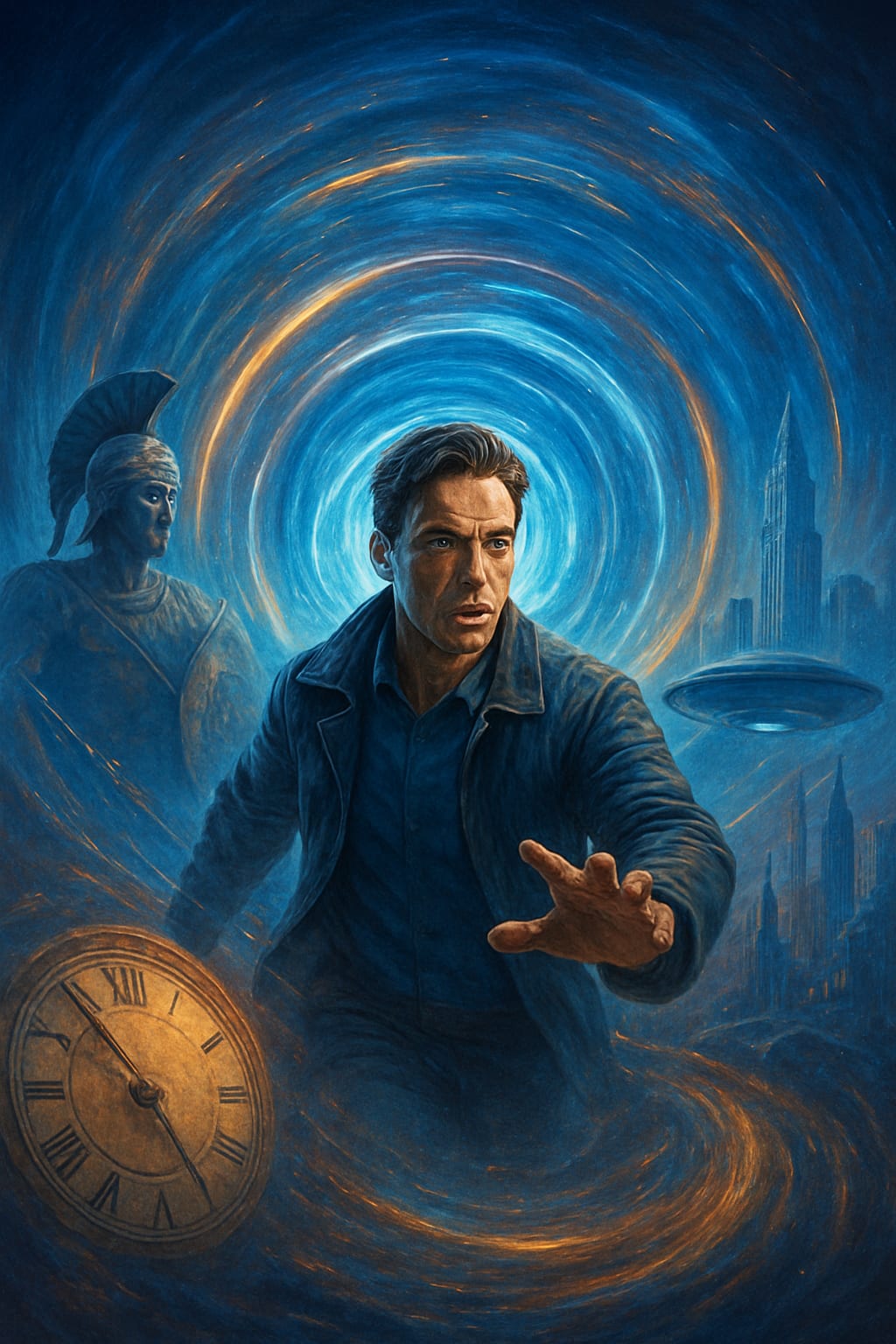
Time travel has captured our imagination for centuries. From sci-fi movies to ancient myths, the idea of moving through time, whether to the past or the future, has always fascinated humanity. While many might dismiss it as pure fantasy, some of the world’s most brilliant minds have seriously explored whether it could ever become reality.
Albert Einstein, for instance, concluded that the past, present, and future all exist simultaneously. His famous theory of relativity showed that time isn’t absolute, as Newton once claimed, but relative. With the right technology, like a super-fast spaceship, one person could experience days while another experiences only hours or minutes. Imagine the implications: if time travel were possible, someone could alter history, but we could never truly know the consequences of changing even a single event.
Interestingly, the idea of time moving differently in various realms isn’t new. Ancient Hindu texts tell the story of a king who visited the creator, Brahma. Although his trip felt brief, 108 yugas had passed on Earth, a period thought to equal millions of years. Similarly, Buddhist texts recount monks who meditated in heavenly realms, only to return to Earth years later, despite feeling they’d spent a single day in paradise. These stories suggest that the concept of “time dilation” fascinated humans long before modern science tried to explain it.
In modern history, some tales of time travel border on the unbelievable. The infamous Philadelphia Experiment of 1943 allegedly attempted to cloak a ship from radar, but the ship reportedly vanished, reappeared in another city, and even traveled ten seconds into the past. Crew members suffered bizarre effects: some fused with bulkheads, others vanished entirely, and a few reportedly glimpsed the future.
Then there’s the mysterious chronovisor, supposedly developed in 1960 by scientist Father Pellegrino Ernetti. This machine allegedly allowed people to “see” past events by detecting energy imprints left behind. While Ernetti’s claims were later denied by an anonymous relative, some insiders maintain the device still exists, hidden in the Vatican.
The fascination with time travel didn’t stop there. In the 1980s, projects like the Monok Experiment allegedly explored similar concepts. Even today, researchers continue to investigate the possibilities. Dr. Marlon Pullman applied for a patent in 2004 for a method of gravity distortion and time displacement. Professor Ronald Lawrence Mallet at the University of Connecticut is confident that human time travel is achievable, and physicist Brian Cox agrees, but only in one direction. More recently, Ali Resei, managing director of the Iranian Center for Strategic Inventions, claimed to have built a device capable of predicting 3, 5 years into the future.
And let’s not forget stories of U.S. military psychic spies trained to see points in history. Whether through technology or the mind, it seems humanity is inching ever closer to the dream of moving through time.
Of course, time travel comes with enormous risks. One small change in the past could have catastrophic effects on the present, or worse, it could fall into the wrong hands. And who’s to say history hasn’t already been altered, leaving us living in an alternate universe with a different future?
Time travel may still be science fiction for now, but as history, myths, and science suggest, it’s a concept that refuses to fade. And honestly, who wouldn’t want to peek into the past, or catch a glimpse of the future?
About the Creator
Areeba Umair
Writing stories that blend fiction and history, exploring the past with a touch of imagination.
Keep reading
More stories from Areeba Umair and writers in FYI and other communities.
5 Underwater Mysteries That Still Have Scientists Scratching Their Heads
If we’re being honest, space gets all the hype. NASA sends a probe past Pluto and the world goes wild, and yeah, that’s seriously cool. But the truth is, Earth still has its own unexplored “final frontier.” More than 95% of our oceans, rivers, and lakes remain untouched, unmapped, and largely misunderstood.
By Areeba Umairabout a month ago in FYI
A Failed Artist, A Disillusioned Poet, An Underpaid Game Show Host
I took my son and niece to Gori, a small town in Georgia where Joseph Stalin was born. They talked me into visiting the Stalin's Museum, the largest in the post-Soviet space. I had resisted going there because I just can't stand the monster and know enough about him, or so I thought.
By Lana V Lynx9 days ago in FYI
I Preached an Entire Sermon Based on Only One Word
As an itinerant preacher, I was invited to preach at a church for its Missionary Sunday. I chose to preach on a practical subject in keeping with the occasion. Even though the sermon was geared toward missionaries, it was appropriate for everyone who heard it.
By Margaret Minnicksabout 3 hours ago in FYI
A Dart at Dusk
Seconds ago, the sullen sun set on the two of us… my exuberant furry companion and me. A fresh breeze embraces us, delivering welcome relief from the day’s oppressive heat. His typical stumbling and staggering along — apace with a sloth — has turned into trip-trapping, high-stepping, almost skipping along.
By Angie the Archivist 📚🪶about 23 hours ago in Petlife


Comments
There are no comments for this story
Be the first to respond and start the conversation.