
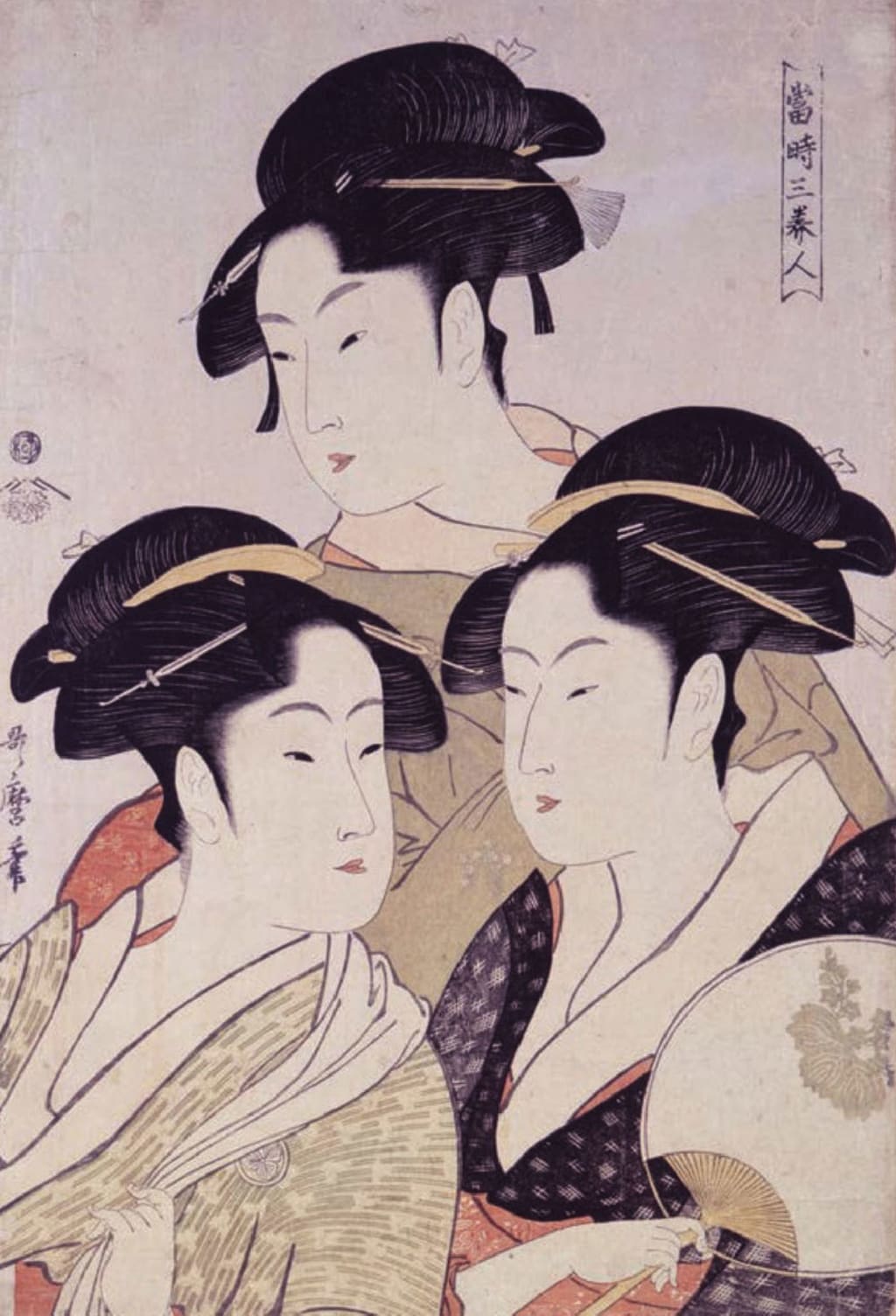
"Bijin-ga" is a major genre of ukiyo-e (Japanese woodblock prints) that depicts beautiful women. However, the women depicted in bijin-ga, like the artists who created them, lived between the world of elegance and the vulgar reality. During the Edo period, the top artists studied under the Kanō and Tosa schools, painting screens for generals and walls for temples. Many of the less successful artists were exiles from these schools, and they turned to ukiyo-e to please the common people. These images of beauties were often modeled by courtesans and kabuki actors. Once the prints were made, they were sold to the general public to hang on walls at home. While the artists used the models for self-promotion, these images were essentially the star posters of the Edo period and were not purchased every day by anyone.
One of the pioneers of bijin-ga, Hishikawa Shun'ei, was known for his elegant, gentle, graceful, and classical style. His famous work, "The Return of the Beautiful Woman," depicted gorgeously dressed women with complex gestures. His characters, whether male or female, were depicted with an understated sensuality that some American critics have described as "healthy sensuality." Although they were embracing and smiling at each other, they did not look like they were engaging in sexual activity at first glance.
In the next generation of artists, Okumura Masanobu used innocent and lively motifs to depict beautiful women. The kimonos and pets of the beauties in his works were always decorated with flowers and intricate embroidery. When he painted erotic prints, he portrayed them in a childish and innocent way. The expressions of his characters looked innocent at first glance, but the lower body would often shock the viewer. His style was all about portraying sex with great attention to clothing.
Suzuki Harunobu, the master of nishiki-e (full-color printing), was good at creating poses for women. His women were elegant and light, with graceful poses. His contemporaries commented that Suzuki's works were full of poetry, and it seemed that one could recite poetry while looking at them. However, his characters were too idealized, and the men and women he depicted in sexual activity had to adopt a very choreographed pose, which looked quite unnatural.
Twenty years later, the style changed again. Torii Kiyonaga created a new image of beautiful women during the Tenmei era. They had a smile at the corner of their mouths, clear eyebrows, and long hands and legs. These women were so tall and slender that they looked exaggerated. Therefore, Kiyonaga's prints were especially large. If the beauty stood up straight, she would be ten times taller than the average person.
In 1791, at the age of 38, Kitagawa Utamaro decided to switch to painting beautiful women with large heads. The figures of the women did not matter, as long as their faces filled the entire painting. In 1792 to 1793, the famous "Three Beauties of the Present Day" was created, which is considered to be the representation of Japanese Edo beauties. The woman in the middle is Tomimoto Toyohina, a geisha from the Yoshiwara district who was known for her dance skills. Although she wore the popular Shimada hairstyle with the other two, she was the only one wearing the attire of a geisha. The girl on the left is Aguu, the eldest daughter of a pancake tea house, who also served as the poster girl, or "kanban musume," which is the equivalent of a modern-day hostess. She was thought to be 16 years old. The girl on the right is the most famous one: Aikawa, the poster girl of a tea room under the Asakusa Kannon temple. It is rumored that the emperor Tenshi came to Asakusa to drink autumn tea and it was Aikawa who served him and received his payment.
Utamaro's style in his erotic paintings remained the same: plump and warm skin, slender eyes, and full lips. It was around this time that beautiful women were no longer portrayed elegantly and beautifully, but rather sexually.
Just three years before the "Three Beauties of the Present Day," the last great master of beautiful women's painting appeared. In 1790, Katsushika Hokusai was born in Edo, which is now in the Chiyoda ward, to a samurai family. His original surname was Matsuo, but he later changed it to Ichida Yoshitoki. When he was 15, he underwent a coming-of-age ceremony and became a government official. Two years later, he had a falling out with his boss. It was said that he had trouble getting along with anyone because his mother died when he was six and his father was very strict. At 17, he went to study kyougen. Kyougen, kabuki, and painter were considered low-class professions at the time, and samurai did not approve of them, but he loved them. While studying kyougen, he made friends with the painters who lived in the chaya. Perhaps after a drunken night, he accidentally revealed that he also studied painting as a child, and then he was encouraged to pursue it. At the age of 20, he began studying ukiyo-e. From then on, he was known as Katsushika Hokusai. He had a neighbor who was 30 years older than him and also a poor painter. They often chatted together, and the neighbor revealed that he occasionally painted erotic paintings using his real name. "Do you use your real name when you paint, Mr. Hokushin?" Hokusai thought for a moment. From then on, two painters appeared in Edo called "Good Woman Studio" and "Lewdness Studio," which were Hokusai's pseudonyms.
We can see that Okumura Toshinobu's women are portrayed as innocent, Suzuki Harunobu's women are portrayed as elegant, Utagawa Kiyonaga's women are portrayed as slim and slender, and Kitagawa Utamaro loves to paint women with large faces, long eyes, plump and fair skin. In general, everyone focused on portraying women and sex in a pure and beautiful way.
About the Creator
A Failed Artist, A Disillusioned Poet, An Underpaid Game Show Host
I took my son and niece to Gori, a small town in Georgia where Joseph Stalin was born. They talked me into visiting the Stalin's Museum, the largest in the post-Soviet space. I had resisted going there because I just can't stand the monster and know enough about him, or so I thought.
By Lana V Lynx25 days ago in FYI
Inside Customer Service
By the end of your shift, you will have smiled through someone’s anger, apologized for things you didn’t do, and wondered why respect has become optional. You will have listened to complaints that aren’t yours, taken responsibility for mistakes you didn’t make, and kept calm when bring treated like you don’t matter. This is the reality of working in customer service.
By Blaire Haven5 days ago in FYI




Comments
There are no comments for this story
Be the first to respond and start the conversation.