
The Hottest Thing Ever Possible: How Hot Can It Get?
Is there an absolute hot?
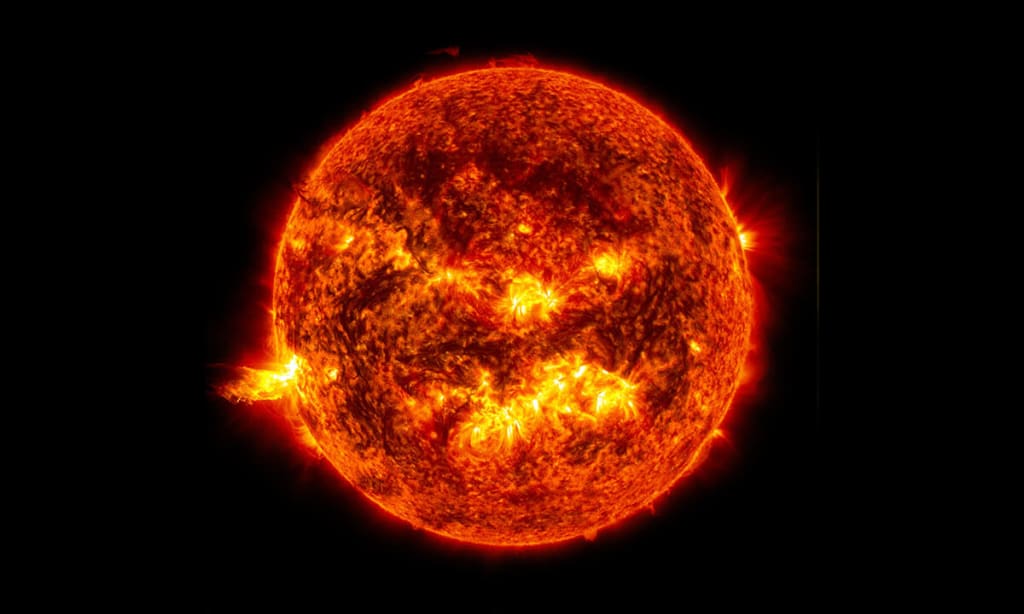
Hello there! My coffe is quite hot, but it's definitely not the hottest thing in the universe. So, what is? We know there's an absolute zero at zero kelvin, or -273.15 degrees Celsius (-460 F), but is there an absolute hot? A point at which something is so hot it can't get any hotter. To find out, let's begin with the human body.
Your internal temperature isn't constant. The average is 98.6 degrees Fahrenheit (37 degrees Celsius), but it fluctuates by about one degree Fahrenheit (half a degree Celsius) throughout the day. Assuming you sleep at night, your body reaches its coolest natural healthy temperature at 4:30 in the morning and its highest at 7 p.m. A dangerous fever is not good, and 108 degrees Fahrenheit is almost always lethal.
The highest recorded air temperature on Earth has occurred four times in Death Valley, reaching 129 degrees Fahrenheit. 180 degrees Fahrenheit is recommended for brewing coffee, and at 210 degrees Fahrenheit, a cake is done baking. Lava fresh out of the ground reaches 2,000 degrees Fahrenheit. You can make your own lava using Fresnel lenses to focus the sun's energy onto obsidian, melting it into actual lava.
The Sun, 93 million miles away, has a surface temperature of 10,000 degrees Fahrenheit. However, at its core, where nuclear fusion occurs, temperatures reach 28 million degrees Fahrenheit (15 million Kelvin). The Kelvin scale has units the same size as Celsius degrees but starts at absolute zero. At the center of the Sun, an enormous amount of energy is radiated. Heating the head of a pin to the Sun's core temperature would be lethal within a 1,000-mile radius.
Any object above absolute zero emits electromagnetic radiation. Humans emit infrared light, invisible to the naked eye but detectable with infrared cameras. To glow visibly, an object must reach the Draper point, about 798 Kelvin, where it begins to glow a dull red. The wavelength of radiation emitted by an object decreases as the temperature increases, from radio waves to gamma-rays, which are created in the Sun's core. At these high temperatures, matter exists as plasma, where electrons are free from nuclei.
But our Sun isn’t the hottest thing in the universe. The peak temperature during a thermonuclear explosion reaches 350 million Kelvin, but only briefly. In the core of a star eight times larger than our Sun, at the end of its life, temperatures reach 3 billion Kelvin (3 GigaKelvin).
At 1 TeraKelvin, the protons and neutrons in the nucleus melt into quarks and gluons, forming a quark-gluon plasma. A star named WR 104, 8,000 light-years away, has a mass equivalent to 25 Suns. When it collapses, the gamma radiation emitted would be devastating, potentially causing mass extinction on Earth from 8,000 light-years away.
Closer to home, scientists in Switzerland have smashed protons into nuclei, reaching temperatures in the 2 to 13 ExaKelvin range. These temperatures last briefly and involve only a small number of particles. The radiation wavelength emitted by an object at 1.41 × 10³² Kelvin, the Planck temperature, would be the Planck distance, the shortest distance possible in the universe.
Adding more energy theoretically leads to a black hole formation, known as a Kugelblitz. So, if you want to tell someone you like that they are incredibly hot, call them a Kugelblitz.
Finally, the Sun, about 4.7 billion years old, has burned the equivalent of 100 Earths' worth of fuel but is the size of 300,000 Earths. Interestingly, one cubic centimeter of human emits more energy than a cubic centimeter of the Sun, which should make you feel quite warm and energized inside.
About the Creator
Keep reading
More stories from writers in FYI and other communities.
A Failed Artist, A Disillusioned Poet, An Underpaid Game Show Host
I took my son and niece to Gori, a small town in Georgia where Joseph Stalin was born. They talked me into visiting the Stalin's Museum, the largest in the post-Soviet space. I had resisted going there because I just can't stand the monster and know enough about him, or so I thought.
By Lana V Lynx29 days ago in FYI
Why Aircraft Components Are Built for Decades, Not Years
Modern aircraft are not designed with short lifespans in mind. Unlike consumer products that are replaced every few years, aircraft components are expected to remain safe, functional, and reliable for decades. This long-term approach is not accidental; it is the result of strict regulations, conservative engineering, and a safety culture that prioritizes endurance over convenience.
By Beckett Dowhan5 days ago in FYI




Comments