
The History of Play-Doh
I once wanted to know where Play-Doh came from

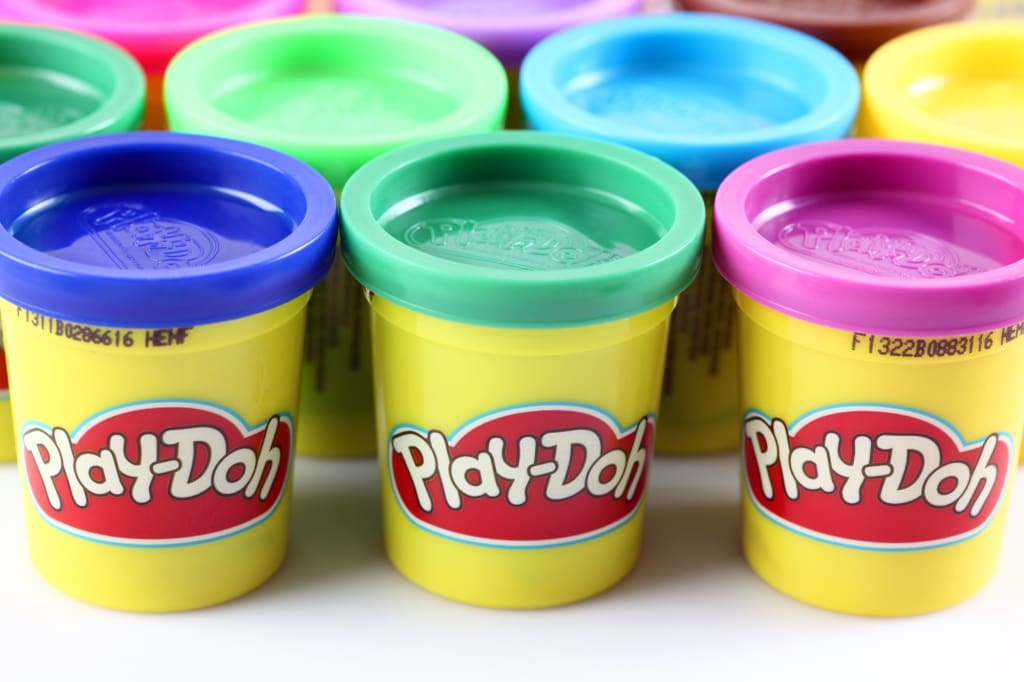
I have always been captivated by the rich history of products and companies, as they offer valuable insights into both American history and the evolution of capitalism. Collecting random facts about enduring products that have thrived for decades allows us to uncover hidden narratives and understand the larger socio-economic context in which they emerged. One such product that has fascinated me is Play-Doh, the colorful clay beloved by children across America. The story of Play-Doh's origins provides a unique window into the annals of American business history.
Interestingly, Play-Doh did not start its journey with that name, nor was it initially intended as a children's plaything. In the mid-1930s, a product that would later become Play-Doh was developed by the Kutol Products Company in Cincinnati, Ohio. Its creation was sparked by a request from the owners of the local Kroger's Grocery Store, who approached Kutol's Noah McVicker for a product that could effectively clean coal dust from wallpaper.
Originally, this malleable substance had no specific name or purpose. However, as homes and businesses gradually shifted away from coal as a primary heating source, the demand for coal dust cleaners diminished. Moreover, the advent of stain-resistant wallpaper further rendered the Kutol product obsolete. In 1955, faced with the prospect of discontinuing the product, Noah McVicker sought a new direction for its usage. This critical juncture led to a fateful conversation between Noah's brother, Joe McVicker, and his sister-in-law, Kay Zufall.
Kay, a teacher in the Cincinnati area, had come across an article in the local newspaper highlighting the use of the non-toxic wallpaper cleaner as modeling clay in schools. Joe shared this idea with Noah, along with Kay's suggestion for a name: Play-Doh. Later that same year, in 1955, the McVicker brothers presented Play-Doh at a national education convention, where they pitched the concept to school administrators across the country.
The response was overwhelmingly positive, leading the McVicker brothers to establish an entirely new company dedicated to producing and marketing Play-Doh. Rainbow Crafts Company emerged as a result, following a successful contract secured with an Ohio department store to sell the product. Play-Doh quickly gained popularity among teachers, who introduced it in classrooms, subsequently prompting parents to purchase it for their children at home.
The McVicker brothers were not only pioneers in the world of Play-Doh but also embraced the burgeoning realm of television. As television programs directly targeting children, such as Captain Kangaroo and Romper Room, gained popularity, Play-Doh garnered significant national attention and witnessed a surge in sales. Within the first year of its official launch, Play-Doh generated over $3 million in revenue, an astonishing figure in 1956, equivalent to nearly $29 million today.
Less than a decade into their business venture, the McVicker brothers sold Rainbow Crafts Company to General Mills. Under General Mills' ownership, the company continued to thrive before eventually being spun off to General Mills' toy subsidiary, Kenner, in 1971. However, as the late 1980s approached, Kenner encountered challenges, leading to its complete acquisition by Hasbro in 1991. Play-Doh has since remained under the Hasbro umbrella, alongside iconic brands such as Transformers, Parker Brothers games, and Milton Bradley games.
As mentioned earlier, the history of products mirrors the history of capitalism in America. A company conceptualizes and invents a product, experiences success, and subsequently sells to a larger entity, creating a ripple effect that propels the product into an industry standard and a renowned intellectual property. This process yields massive profits for years to come, transforming a local innovation into a cornerstone of the capitalist landscape. The story of Play-Doh exemplifies the corporatization of American innovation, tracing the flow of capital from small businesses to massive, multi-faceted corporations.
The essence of innovation lies in identifying a need and filling it, as demonstrated by the McVicker brothers, Noah and Joe. Recognizing the necessity for a coal dust cleaner that would not harm wallpaper, they inadvertently created a billion-dollar product in an entirely different domain. I find this tale fascinating and emblematic of the dynamic history of American business. By choosing any major brand product, one can embark on a captivating journey through the annals of American capitalism, tracing its trajectory from the inception of innovation to the modern-day corporate boardrooms and Wall Street backrooms.
In conclusion, the story of Play-Doh not only unveils the captivating history of a beloved children's toy but also serves as a testament to the power of American innovation and capitalism. Through the lens of products like Play-Doh, we can uncover the remarkable stories that underpin the evolution of businesses, the ingenuity of inventors, and the socioeconomic landscapes in which they thrive. So, let us continue exploring the intricate tapestry of American history, one product at a time, and unravel the fascinating narratives that shape our society.
About the Creator
Billionaire hustler
Embrace the struggle, push yourself to new heights, and never give up. Warriors rise up and fight back. The power to change your life is in your hands. Together, we are unstoppable.
Keep reading
More stories from Billionaire hustler and writers in FYI and other communities.
The Foolish Costermonger and the Miraculous Reunion: A Tale of Love, Deception, and Redemption
Once upon a time, in a distant village, there lived a raggedy and foolish man who sought both companionship and the comforts of married life. As he trundled his cart through the village square one day, his eyes fell upon a plump and simple-minded girl named Myrtle Wormhead, who was carrying a bucket of milk. Filled with a sudden infatuation, the fool approached her, eager to know her name.
By Billionaire hustler3 years ago in Fiction
A Planetary Alignment will coincide with Mercury Retrograde
Double phenomena in the heavens Some people say in jest that the planets have aligned in their favor when life works the way they desire. Were you aware that there are seasons when things do line up in the heavens? There will be a planetary alignment AKA a planet parade, on February 28, 2026.
By Cheryl E Preston16 days ago in FYI
How NSN Systems Improve Interoperability Among Allied Forces
Modern military operations increasingly rely on cooperation between allied nations. Joint missions, multinational exercises, and coalition defense operations require seamless coordination not only at the strategic level but also within logistics and supply chain systems. One of the most important tools that supports this cooperation is the National Stock Number (NSN) system. Developed to standardize the identification and classification of military components, the NSN system enables allied forces to share equipment resources, maintain operational readiness, and streamline procurement processes.
By Beckett Dowhanabout 2 hours ago in FYI
TUS NUA - ch 53
TUS NUA – ch 53 New Beginnings – Mia and Midnight (*)(*)(*) Finola knew Ali’s brother-in-law needed to put his mind at rest. She fed her arm through his and led him outside. “We’ll sit here. If you like, I can put a block around us so our conversation will be private.”
By Margaret Brennan5 days ago in Fiction




Comments
There are no comments for this story
Be the first to respond and start the conversation.