
The Forgotten History of the Alaskan Eskimo Scouts
How the war in the Pacific was changed by the Scouts.
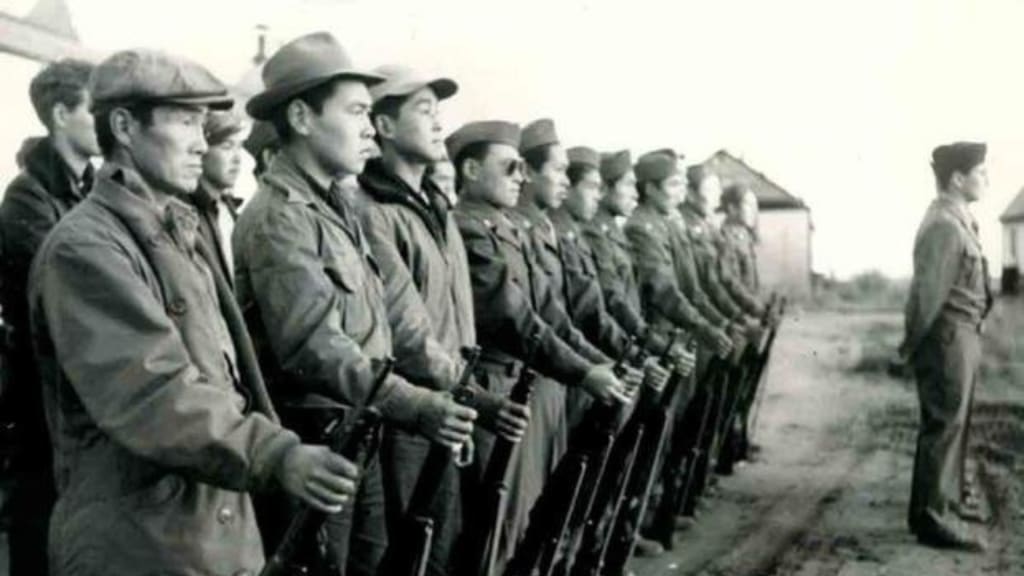
In June 1942, exactly 6 months after Pearl Harbor, the United States was at war with Japan.
The Japanese mounted another surprise bombing attack. They attacked Dutch Harbor on the remote Aleutian Islands of Alaska this time. The Japanese occupied the islands of Attu and Kiska for the first time in history, which were the first occupation by a foreign force in the United States since the War of 1812 by the United Kingdom.
The vast land in northwest Alaska needed to be patrolled for the war after U.S. forces drove out the Japanese.
Alaska's Indigenous communities soon found volunteers from their local villages to join them and formed the new Alaska Territorial Guard. They soon became known as "The Eskimo Scouts.
These recruits came predominantly from the Athabascan, Tlingit, Aleut, Tsimshian, Haida and Yup'ik/Inupiat communities, with some also coming from the Euro-American community. The all-volunteer corps comprised people who lived and worked together in the harsh Alaskan winter weather along the Bering Sea and Arctic coastal regions.
Over 6,300 Native Alaskans became part of the Alaska Territorial Guard. They are men, women and children as young as 12 and as old as 80. They were given a rifle, a uniform, a military training manual, and the proper gear they needed. Some even received snowshoes. They were taught military drills and how to operate military communication systems. In western Alaska, they served as the American military's eyes and ears.
The Alaska Territorial Guard protected areas along the lend-lease transport routes that allowed the United States to get Lend-Lease supplies to the troops in Europe and aircraft to Russia, a wartime ally.
They also protected Platinum, an Alaskan village south of Kwethluk, known to have the only platinum mine in the Western Hemisphere.
They also cached survival supplies along transportation routes critical for allied American forces.
Military officers followed the Alaska Natives' lead as they knew the Alaskan terrain and used dog sleds to get around military bases and remote camps built in the wilderness.
Their responsibilities grew to include transporting materials and equipment, erecting ATG structures and facilities, and creating runways and support infrastructure for other military organizations. Additionally, they constructed and restored dozens of emergency shelter huts, built several hundred miles of wilderness paths, and provided the U.S. Navy with emergency food and ammo containers. Members of the ATG acquired skills in enemy warfare, land and sea rescues, and fighting fires.
While some Alaskans fiercely defended their country, some Alaskans were forced to leave or assigned to work in factories. The Pribilof Islands in Alaska, which are situated in the Bering Sea between the United States and Russia, were evacuated by American forces after the attack on Dutch Harbor. Families of indigenous people were transported to southeast Alaska in cramped cargo ships. Some indigenous families relocated them into abandoned mines, fish canneries, and other dangerous and unhygienic structures. Of the 881 prisoners, almost 100 perished before the war was over.
Members of the Alaska Territorial Guard continued to keep watch when World War II's action shifted to the South Pacific and Europe. However, in the conflict's final months, the Japanese desperately attempted to frighten Americans by dropping 9,000 incendiary balloon bombs onto the mainland. The Alaska Territorial Guard members saw the balloons and assisted in shooting them down and demobilizing them since they were trained to recognize enemy ships and aircraft.
The Alaska Territorial Guard played a significant role during World War II. The Guard was formed in 1940 and tasked with providing security for Dutch Harbor, a key military base in the Aleutian Islands. The Guard also participated in several campaigns, including the Battle of Okinawa. The Guard members served in over 50 campaigns throughout the war. Their bravery and dedication are remembered today through memorials and monuments.
Alaska's first anti-discrimination law, intended to abolish the segregation of its Indigenous people, was passed after the war thanks to a petition from veterans of the Alaska Territorial Guard and their allies to the U.S. government.
The activities of the thousands of volunteers who had defended the country and the territory were later funded by the federal government to ensure they would not be forgotten. A group of American military veterans in Bethel, Alaska, utilized some of the money in 2012 to create a memorial park to honor the members of the Alaskan Territorial Guard.
About the Creator
RonHaddock
Entrepreneur, Military Historian, Traveler
Keep reading
More stories from writers in FYI and other communities.
A Failed Artist, A Disillusioned Poet, An Underpaid Game Show Host
I took my son and niece to Gori, a small town in Georgia where Joseph Stalin was born. They talked me into visiting the Stalin's Museum, the largest in the post-Soviet space. I had resisted going there because I just can't stand the monster and know enough about him, or so I thought.
By Lana V Lynx23 days ago in FYI
Living in a hemp house
Hemp, a multi-purpose crop that delivers fibres, shivs, seeds, and pharmaceuticals is currently used in insulation materials and bio-composites for a more sustainable construction industry. Russ Martin and his wife Karon Korp tell their story as owners of the first hemp house in the U.S.
By Susan Fourtané 2 days ago in Interview
TUS NUA - ch 49
TUS NUA – ch 49 New Beginnings – Mia and Midnight (*)(*)(*) As Mia spoke on the phone to Ali’s sister, Ellen, Finola slipped quietly away and walked to the stream behind Tus Nua. Carefully, she put a block on her family so no one could know what she was about to do.
By Margaret Brennan3 days ago in Fiction



Comments
There are no comments for this story
Be the first to respond and start the conversation.