
The Flower With The Price of A Mansion
The crazy story of how tulips conquered Europe

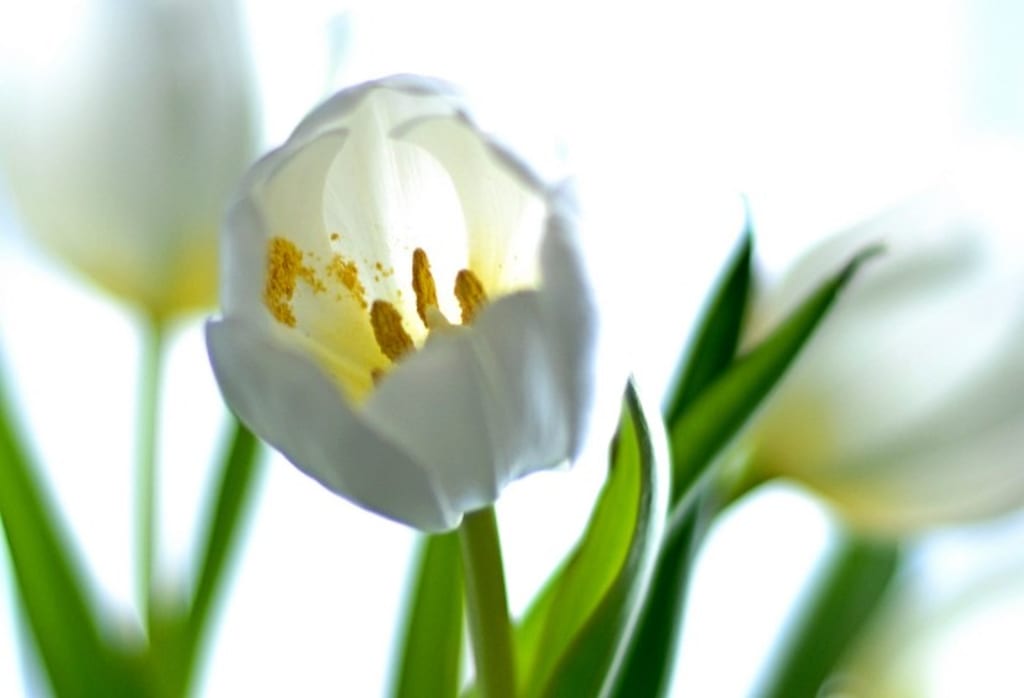
From sailors, jailed for eating bulbs...To mansions, exchanged for a plant... There is probably no other flower in the world with tales and rumors as wild as those of the tulip's journey to fame.
First We Conquer an Empire
Tulips are wildflowers. They grow at the foot of the Himalayas, and they probably would have remained there for much longer were they not discovered by the army of the all-conquering Ottoman Empire.
Soldiers brought flowers and buds back home to Istanbul with them, and it did not take long for this new flower to conquer the very heart of Sultan Suleyman the First.
He ordered tulips to be grown all over his palaces and gardens, and the rest of the country soon followed suit. By the 16th century, the flower was the symbol of wealth and power, as sultans would embellish their turbans with a tulip blossom.
The name itself — tulip or tulipan, came from the old Persian word for the turban (toliban).
Then We Take Europe
Once upon a time, a Dutch merchant found some ugly-looking onion in his clothing. He threw the bulb in the trash, and soon it turned into a beautiful flower, and everybody fell in love with it.
Sounds like a fascinating tale of how the tulip appeared in the Dutch Republic, but it's all it is - a tale.
The true story of the flower's arrival in Europe is much less dramatic but, nonetheless, almost equally accidental.
The story of tulips in the Netherlands began in Istanbul - the city of tulips, as it was called then. The Habsburg dynasty’s ambassador to the Ottoman Empire Ogier Ghiselin de Busbecq was ending his service and received a few bulbs from Sultan Suleiman the Magnificent as a departure gift.
The ambassador took them back home to Vienna, and it so happened that he was friends with a Flemish botanist Charles de l’Ecluse (also known as Carolus Clusius in some sources), who lived and worked in Austria at the time.
The bulbs exchanged hands, and Charles de l’Ecluse became so fascinated with the new specimen that upon returning home to Holland, he brought all the bulbs with him and planted them in the botanical garden of Leiden in 1593.
Even though tulips were already growing in some private gardens, the official date for the first blossoming of the flower in the Dutch Republic is 1594.
Beautiful Disease
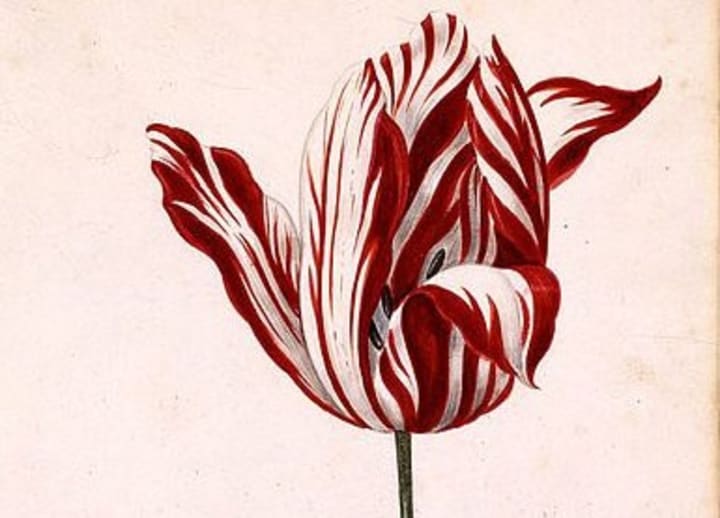
The botanist’s tulips, named Seper Augustus, stood out from the others due to their bright colors and the broken tips of the blossoms. But what nobody knew, not even the professor himself, was the cause of these unique features of his plants.
Only centuries later, it was discovered that cross-breeding weakened the bulbs and their disease resistance, so the unique appearance was no more than the result of a viral infection carried by aphids.
The longer Charles de l’Ecluse experimented with breeding them, the more distinct those features got, and soon everybody wanted what he had.
However, the botanist showed no interest in sharing or selling the bulbs outside his professional circle, which pushed some people to seek less legal ways to get their hands on them.
Mice, Thieves, and Stolen Secrets
Just when Charles thought his greatest enemy was mice and their appetite for the bulbs, he underestimated the lengths his fellow humans would go to get something they really desired.
Botanist's own servants used every opportunity to cash in on the precious bulbs when the professor was gone on trips, so all in all, in two years, thanks to mice and servants' long fingers, Charles lost over a hundred tulip bulbs.
But, as sad as it was for him to lose his flowers, only thanks to the thieves did the tulip trade in the Dutch Republic took off, and soon it turned into a full-blown mania.
Even to this day, money and business gurus use the craze of the tulip trade as an example of market rise and collapse, but was that mania ever real?
The Tales vs the Truth
Much like today, where we want to have the newest smartphones, follow the fashion trends, or own designer pieces that would show off our wealth, in the Dutch Republic of the 17th century, this latest fashion trend was the tulip.
In other words, if your neighbor had them, you also wanted one. Or two. Or more.
As the new and rare flower in the market, it was rather highly priced, so growing them in one’s garden was a statement of wealth and status. In other words, if your neighbor had them, you also wanted one. Or two. Or more. And you wanted them so badly you were willing to pay a ridiculous price.
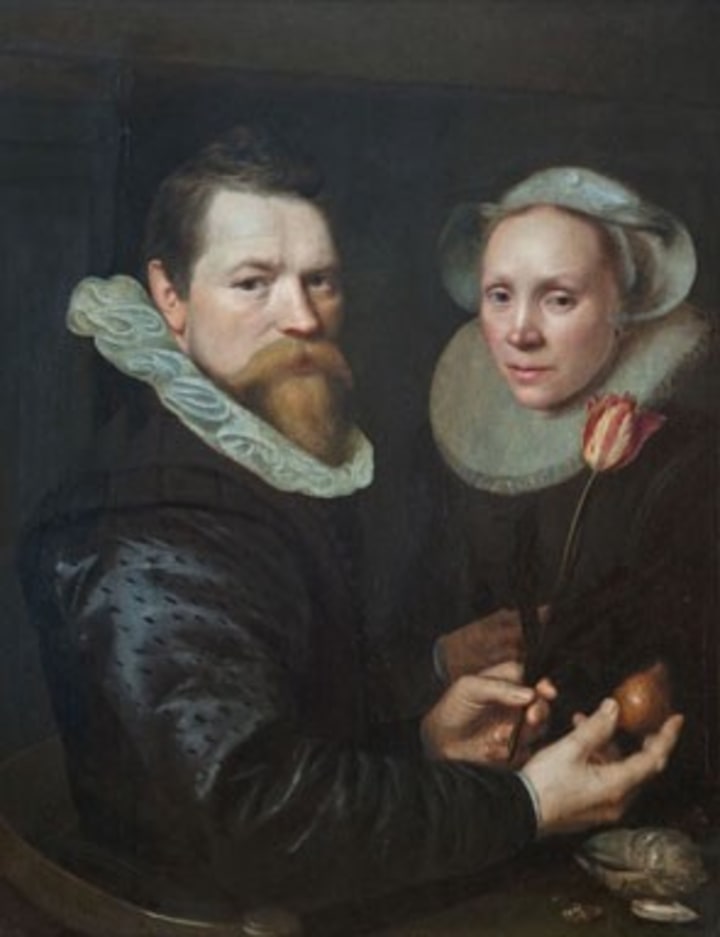
Many popular stories paint a picture of how the tulip trade took over the entire country, turning bulbs into a form of currency. People would sell their properties and waste inheritances just to buy bulbs which they would then sell at a higher price.
Sounds both fascinating and ridiculously crazy, right? That's because those stories are completely bogus. Okay, maybe not completely, but they are certainly over-embellished, and most of them are just that — tales.
The soldier, if there ever was one, probably did not go to jail for eating the bulb he mistook for an onion.
One could not buy an entire canal in Amsterdam for the price of a bulb.
Nobody wasted all their money during the plague on tulips because they thought they'd die anyway and had nothing to lose.
And Dutch economy did not totally collapse once the mania bubble burst.
Why?
First of all, this tulip business happened in the time known as the Golden Age of the Republic. Tulips, no matter how popular, were merely a tiny portion of all the trading goods.
According to the professor of Early Modern History Anne Goldgar, the tulip trade was rather civilized and organized — with companies set up to grow, cultivate, and sell the flowers, and experts to oversee everything.
After studying the archives, she found that the highest price jump happened in 1637 — a year after the plague swept through the country, and she believes it to be the result of the disease.
However, it was not the lost hope, but the simple fact that the plague took numerous lives, thus leaving more money to the living relatives. In return, those families had more to spend, and investing in a blooming (no pun intended) market was one way of doing so.
Fictional Stories That Made History
So how did the extraordinary stories come to be?
We could thank (or not) Scottish author Charles Mackay and his 1841 book called “Memoirs of Extraordinary Popular Delusions and the Madness of Crowds”, where he turned the short period of overpriced tulip trade into what he called a “Tulipomania”.
Here is one quote from the book (which, by the way, can be read for free via the Gutenberg Project, if you are interested):
“Nobles, citizens, farmers, mechanics, sea-men, footmen, maid-servants, even chimney-sweeps and old clothes-women, dabbled in tulips. People of all grades converted their property into cash, and invested it in flowers. Houses and lands were offered for sale at ruinously low prices, or assigned in payment of bargains made at the tulip-mart. Foreigners became smitten with the same frenzy, and money poured into Holland from all directions.”
Of course, the tulip market was on the rise, and with the country experiencing its Golden Age and expanding its international trades, Mackay's recount may have been not far from the truth to some degree.
After all, some rare bulbs went for as high as 5000 guilders, which was enough money to buy a house, and that, let's face it, was ridiculous in itself without additional tales.
However, the above-mentioned price was rare. The majority of bulbs were priced much lower, and the typical highest price, according to Professor Goldar's research, was around 300 guilders per bulb.
To put that into perspective, 300 guilders was the monthly salary of a skilled craftsman. So, again, a fairly shocking amount for something that may or may not even grow in the coming year.
It was only a matter of time until people came to the same conclusion and refused to pay the money. Within days, prices dropped drastically, and the tulip trade sank, but it did not take an entire Dutch economy with it because bulb sales were only a part of it.
So, why did Mackay paint the picture of total madness in his book?
The Church, the Monkeys, and the Shaming
It was the initiative of the Calvinist Church to start producing and publishing booklets and pamphlets with stories of greed and tulip obsession. They were just stories, often exaggerated and always fictional, and their main goal was to mock society's lust for something so unimportant.
Even artists joined the game, painting expressive canvases with tulip trade motives that were equally fictitious.
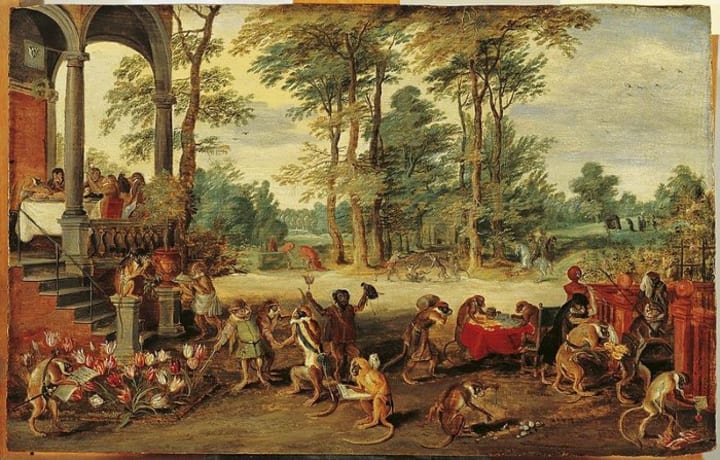
So, it is only logical to assume that Mackey, who was born centuries later, read these stories and saw those paintings, and assumed them to be true, thus creating the continuation of the fiction.
But even though the tulip mania was less of mania and more of a curious historical event, it still perfectly reflects human nature and our love for something new and fashionable.
Not to mention, it is quite the story for one flower to tell of how it conquered Europe.
Side note: This is an updated version of the previously published article on Medium.
About the Creator
GD Madsen
A historian by education, a former journalist by profession, now living in the French countryside writing books and articles.
A Planetary Alignment will coincide with Mercury Retrograde
Double phenomena in the heavens Some people say in jest that the planets have aligned in their favor when life works the way they desire. Were you aware that there are seasons when things do line up in the heavens? There will be a planetary alignment AKA a planet parade, on February 28, 2026.
By Cheryl E Preston19 days ago in FYI
Top tipple tricks
Been thinking a lot about drinking, lately. Not least because of a recent episode of over-indulgence and the inevitable after effects. Some readers may recall the earlier articles I wrote about beating the booze. Here I set out an experiment in techniques for cutting down on my alcohol intake. The experiment was successful, the techniques worked, and I have armed myself with an arsenal of weapons in the war against the demon drink. I have yet to fire the first round however. It's all a question of timing (perhaps procrastination).
By Raymond G. Taylor7 days ago in Psyche




Comments (2)
Thank you for correcting the story that has been spreading! The sequel to Wallstreet also had this Tulipmania as a secondary plot point in it. That's where I first heard about it. Glad to know it was hyperbole and humans weren't really that insane.
Yes!! one flower to tell of how it conquered Europe.... nice dear!!! keep it up!! i supporting you...